
Fungus gnat
Lycoriella ingenua
Description
How to identify
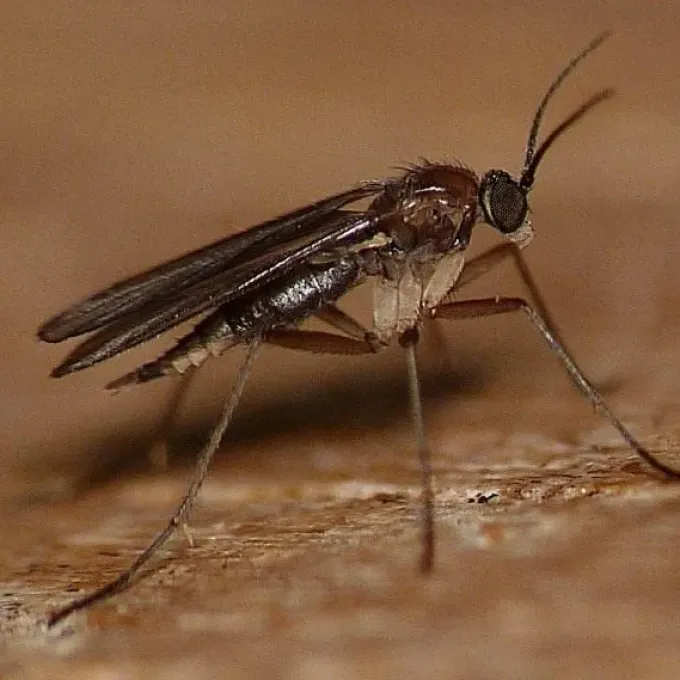
The fungus gnat, scientifically known as Lycoriella ingenua, belongs to the family Sciaridae (order Diptera). These insects are small, typically measuring 3–5 mm in length, with a delicate dark body and long legs, resembling small mosquitoes.
Adult gnats have vestigial mouthparts and do not feed on plants; their primary function is to reproduce. Females lay up to 200 eggs in moist soil or organic-rich substrates where conditions are suitable for larval development.
The larvae are the stage of development that poses a threat to plants. They are translucent, whitish-colored, and grow up to 7 mm long, easily identified by their distinct, shiny black head capsule.
The life cycle from egg to adult is temperature-dependent and takes approximately 3–4 weeks under greenhouse conditions (around 20–25°C). High humidity and saturated soil are the primary drivers of rapid population growth.
Adults are most active in low light and are frequently seen crawling on the surface of the growing medium or flying in short bursts when the plant or pot is disturbed, indicating a potential infestation.
What it damages
This pest affects a wide range of plants, including vegetable seedlings, indoor ornamental plants, and mushroom crops, such as commercial button mushrooms. Young plants with tender root systems are particularly susceptible.
While larvae primarily feed on organic decay, they will consume living plant tissue when organic matter is depleted. They feed on root hairs and fine roots, causing severe nutrient uptake disruption and physiological stress.
Infested plants exhibit wilting, chlorosis, and stunted growth that does not resolve with regular watering. In severe cases, larvae may bore into the crown or stem base, leading to rapid tissue decay and eventual plant death.
Beyond direct feeding damage, fungus gnats act as vectors for various plant pathogens. They can carry spores of Fusarium, Botrytis, and Pythium, facilitating the spread of root and stem rot infections.
In commercial mushroom production, Lycoriella ingenua is a major economic pest. Larvae consume the mycelium and tunnel into the mushroom caps, resulting in significant yield loss and degradation of the harvest quality.
Signs of infestation
The presence of adult gnats flying around plants or congregating on the soil surface is the most immediate indicator of an infestation. Their activity usually increases immediately after watering the plants.
Plant health deterioration, such as sudden wilting despite moist soil, is a strong symptom. If a plant is carefully removed from its pot, larvae may be seen moving through the upper layers of the potting mix.
Yellow sticky cards are a highly effective tool for early detection. Monitoring these traps regularly allows growers to gauge the level of infestation and take action before the larval population causes significant root damage.
The appearance of algae or mold growth on the soil surface often coincides with high fungus gnat activity, as both thrive in consistently wet conditions. These factors combined create an ideal habitat for the larvae.
For greenhouse growers, patchy growth or thinning mycelium in mushroom beds serves as a classic sign of infestation. Close inspection of the compost often reveals the presence of larvae or the damage they have inflicted.
Control measures
Cultural control is the most important step in managing fungus gnats. Growers should adjust irrigation practices to allow the top layer of the substrate to dry out between waterings, effectively killing larvae and eggs.
Using sterilized growing media and ensuring strict sanitation practices in greenhouses, such as removing debris and disinfecting equipment, significantly reduces the risk of infestation and prevents the establishment of new colonies.
- Deploy yellow sticky traps to capture and monitor adult populations.
- Apply biological insecticides based on Bacillus thuringiensis israelensis.
- Use biological control agents, such as the entomopathogenic nematode Steinernema feltiae.
- Apply targeted chemical insecticides when infestation levels exceed the economic threshold.
Biological control using entomopathogenic nematodes is highly effective, especially in greenhouse environments. These microscopic worms seek out and infect larvae in the soil while remaining safe for plants, people, and beneficial insects.
If chemical intervention is necessary, systemic insecticides should be applied to the soil. Two or more applications at 7–10 day intervals are recommended to break the life cycle and ensure that new gnats emerging from eggs are also controlled.
Taxonomy
- Latin name
- Lycoriella ingenua
- Order
- Diptera (flies)
- Family
- Sciaridae
- EPPO code
- LYCLIN
Discussion
No discussions yet — be the first.