
Pale Pinion
Lithophane socia
Description
How to identify
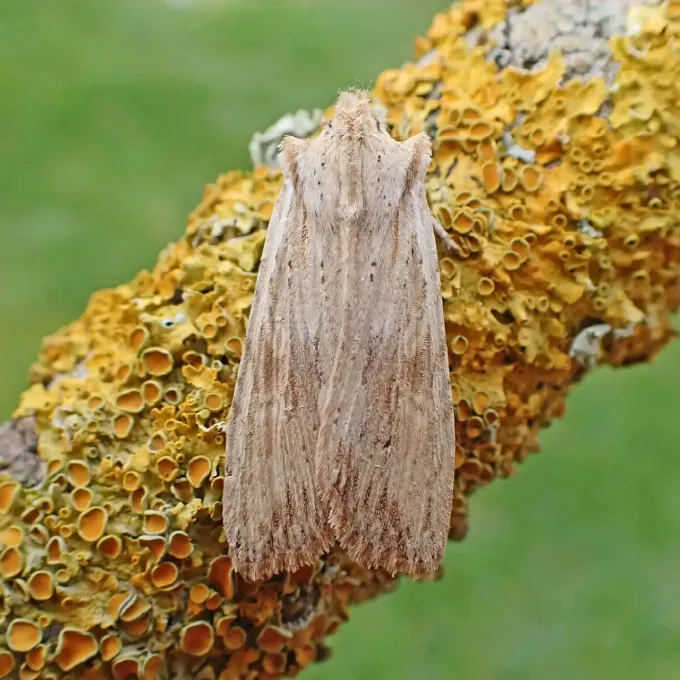
The Pale Pinion (Lithophane socia) is a moth belonging to the family Noctuidae. The adult moth features mottled greyish-brown forewings that mimic the appearance of tree bark, serving as effective camouflage against predators.
The larvae are typical noctuid caterpillars, growing up to 50 mm long. They are generally greenish-brown with lighter longitudinal lines, blending into the foliage and stems of host plants.
The species has one generation per year. Adults emerge in early spring, often hibernating through the winter months and becoming active on the first warm nights of the season.
The eggs are typically laid singly or in small clusters on the twigs and bark of host trees, ensuring that the hatching larvae are immediately near the budding food source.
In terms of taxonomy, this species is a member of the diverse Noctuidae family, which includes many significant agricultural pests that pose risks to both orchards and forest ecosystems.
What it damages
The Pale Pinion is known primarily as a fruit tree pest. It targets pome fruits such as apples and pears, as well as various stone fruits including plums and cherries.
The larvae are highly destructive in the early spring, as they feed on developing buds. By consuming the terminal and floral buds, they directly reduce the potential yield for the current season.
Beyond buds, the caterpillars will feed on young leaves and developing fruitlets. Extensive feeding causes stunted growth and loss of photosynthetic surface area, weakening the tree's health.
In cases of severe infestation, young saplings may suffer significant deformation due to the loss of leading buds, which can impact the structural development of the tree for several years.
The combination of early emergence and intensive feeding habits makes Lithophane socia a pest that requires early season monitoring in commercial and private orchards.
Signs of infestation
Visual evidence of infestation includes hollowed-out buds that appear empty or partially eaten. These injuries are often clustered on specific branches where eggs were laid.
Frass (larval excrement) found on leaves or at the base of the tree is a strong indicator of caterpillar presence. Small amounts of webbing may also be present as the larvae grow.
Larval activity can be confirmed by nocturnal inspection. Using a torch to inspect buds and foliage at night reveals the caterpillars, which remain hidden in crevices during the day.
Mid-season signs include ragged or skeletonized leaves, showing irregular feeding patterns characteristic of noctuid caterpillars feeding on foliage.
If pupae are found in the soil beneath the canopy during orchard maintenance, it confirms that the population has completed its larval development and is preparing for overwintering.
Control measures
Effective management of the Pale Pinion involves an integrated pest management (IPM) strategy focused on early detection and preventative maintenance.
- Scraping off loose tree bark to remove overwintering pupae and potential hiding spots.
- Monitoring adult flight activity using light traps or pheromone-based lures to time insecticide applications.
- Applying systemic insecticides at the bud-burst stage if infestation levels exceed economic thresholds.
- Promoting biological diversity in the orchard to encourage natural predators like birds and parasitic wasps.
- Keeping the orchard clean of debris and controlling weeds that may provide alternative food sources for the larvae.
Taxonomy
- Latin name
- Lithophane socia
- Order
- Lepidoptera (butterflies)
- Family
- Noctuidae
- EPPO code
- LITPSO
Discussion
No discussions yet — be the first.