
Ring-tailed lemur
Lemur catta
Description
How to identify
The ring-tailed lemur (Lemur catta) is a primate belonging to the Lemuridae family. It is easily identified by its long, iconic tail adorned with alternating black and white rings.
Native to Madagascar, these animals are diurnal, which is a notable trait compared to other lemur species. They possess strong limbs that allow them to navigate efficiently through both arboreal and terrestrial environments.
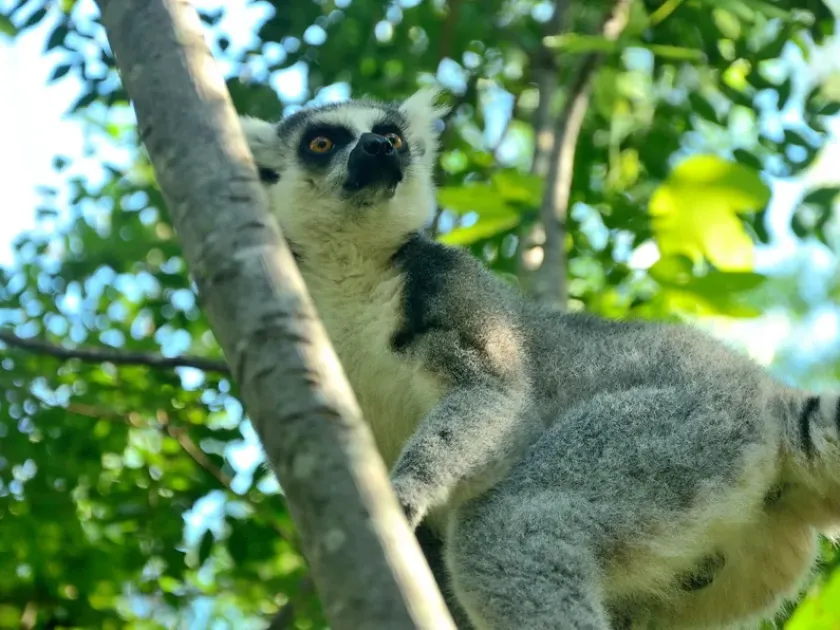
Their physical appearance includes dense gray-brown fur, a white face with distinctive dark patches around the eyes, and sharp, alert ears.
The species lives in social groups, which increases the intensity of their foraging impact on specific vegetation areas when they invade agricultural lands.
While often viewed as exotic, in rural areas near their habitat, the ring-tailed lemur can act as an agricultural pest due to its opportunistic feeding habits and high mobility.
What it damages
Ring-tailed lemurs are opportunistic omnivores, but a significant portion of their diet consists of plant materials such as fruits, flowers, tree bark, and young shoots.
When entering agricultural fields, they can cause substantial damage to fruit orchards by consuming ripening crops, leading to significant commercial losses.
In addition to eating fruits, lemurs damage the bark of young saplings and sugarcane crops, which weakens the plants and makes them susceptible to various secondary infections.
The intense foraging of a lemur troop can result in the destruction of fruit buds or the complete defoliation of vulnerable plants in a single visit.
They pose the greatest threat to smallholder farms located near forest edges, where natural food resources may become scarce during certain parts of the year.
When it appears
Lemur activity near cultivated areas increases significantly during fruit ripening seasons when the animals seek high-energy food sources.
In drier seasons, when wild fruit availability is limited, ring-tailed lemurs are more likely to raid irrigated agricultural lands in search of moisture-rich vegetation.
The breeding season, which occurs in spring, encourages groups to forage more aggressively to meet the increased metabolic needs of nursing females and growing offspring.
Seasonal migrations of lemur troops can intersect with farming areas, resulting in short-lived but highly destructive bursts of feeding activity.
Consequently, the peak period of nuisance behavior corresponds with the flowering and fruiting phases of most tropical agricultural crops.
Signs of infestation
The primary sign of lemur presence is damage to fruit on trees, characterized by bite marks typical of primates, which are distinct from the peck marks of birds or chewing of insects.
Beneath the trees, one can often find a large amount of discarded fruit fragments, shredded leaves, and broken twigs left over after their foraging sessions.
Specific droppings and footprints on soft soil near field borders serve as clear evidence of a group's presence in the sector.
Frequent damage to the bark of young trees, where the animals strip the outer layer to reach the cambium or tree sap, is another common indicator.
Acoustic monitoring is also effective; lemurs are quite vocal, and their distinct calls during movement through the canopy allow for rapid identification.
Control measures
The most effective method for prevention is the installation of physical barriers, such as robust mesh fencing, to deny the animals access to high-value plantings.
The use of visual and acoustic deterrents that simulate predator presence or produce unpleasant noises can provide short-term protection.
Agrotechnical strategies include clearing the perimeter of the farm from wild fruit trees that attract lemurs from nearby forests.
Application of repellents with scents that are offensive to primates can be used to protect individual trees during critical ripening stages.
- Installation of low-voltage electric fencing.
- Consistent monitoring and timely harvesting to minimize access time.
- Establishing buffer zones with plants that are unpalatable to lemurs.
- Deploying motion-sensor-activated sound systems.
Taxonomy
- Latin name
- Lemur catta
- Family
- Lemuridae
- EPPO code
- LEMUCA
Discussion
No discussions yet — be the first.