
New York weevil
Ithycerus noveboracensis
Description
How to identify
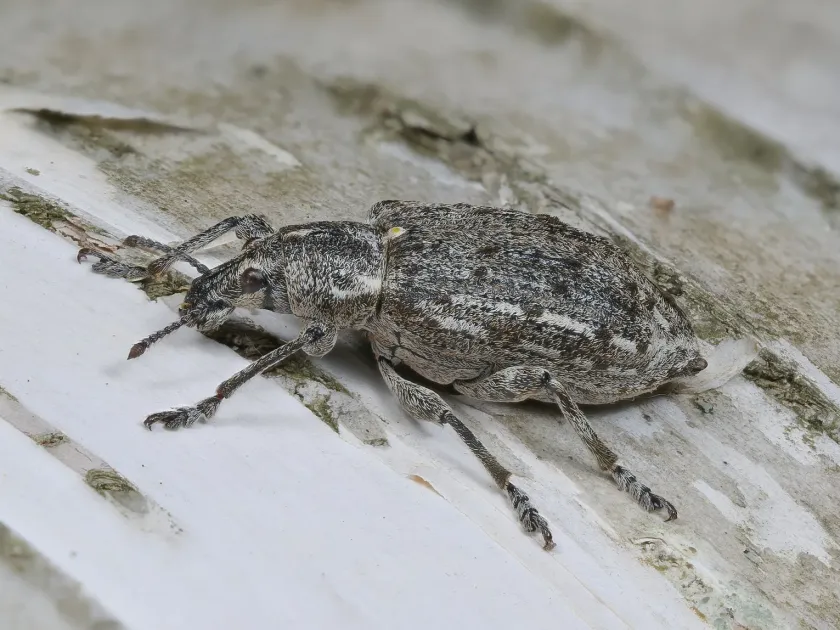
The New York weevil (Ithycerus noveboracensis) is a unique beetle belonging to the Ithyceridae family, representing one of the most primitive species of weevils in North America.
Adults reach 12–18 mm in length and are distinguished by their greyish-brown marbled bodies covered with dense scales, which provide excellent camouflage on tree bark.
They possess a prominent rostrum, characteristic of weevils, which they use to feed on the tender tissues of young shoots, buds, and twigs.
The larvae, which live underground, have a typical white, C-shaped body with a hardened dark head capsule, growing significantly during their development.
As a relict species, it holds scientific importance and exhibits distinct morphological traits that differ from more evolved members of the Curculionoidea superfamily.
What it damages
This pest primary affects various hardwood tree species, with a strong preference for members of the Fagaceae family, such as oaks, beeches, and hickories.
Adult beetles inflict damage by stripping bark from young twigs and eating buds, which leads to stunted growth and structural deformity in young trees.
The larvae feed on the roots of host trees within the soil, causing significant stress to the root system and reducing the overall vigor of the plant.
Heavy infestations in tree nurseries can be devastating, as the destruction of terminal buds permanently alters the tree's growth form.
While hardwoods are the main hosts, the weevil may occasionally feed on other deciduous species, including basswood, elm, and fruit trees, when located near infested forests.
When it appears
Adults emerge from the soil in late spring, typically during May, to begin their feeding and mating cycle in the tree canopy.
They remain active throughout the early summer months, causing peak damage when trees are actively growing and producing new, tender shoots.
The egg-laying process occurs in the soil near the base of the tree, where the larvae begin their long development period.
The larval stage is known to be quite extended, often spanning one or two years depending on environmental conditions and food availability.
Pupation occurs in a small earthen cell constructed by the larva within the soil, where the beetle remains until the following spring for emergence.
Signs of infestation
The most visible sign of infestation is the presence of deep, longitudinal grooves or notches on young, current-year twigs caused by adult feeding.
Significant bud loss is frequently observed, as the weevils often sever the buds or petioles, causing them to fall to the ground prematurely.
Young trees often show signs of crooked stems or multi-leader formations resulting from past injuries to the terminal buds.
In nursery settings, systemic root damage can cause unexplained wilting, yellowing of leaves, and poor development of saplings during hot and dry spells.
- Notched or girdled tender twigs.
- Premature leaf and bud drop under the tree canopy.
- Deformed or stunted terminal shoots.
- Presence of adults on trunks during early morning hours.
Control measures
Managing the New York weevil requires an integrated approach focusing on both cultural practices and chemical interventions when necessary.
In nurseries, maintaining vigorous tree growth and removing heavily infested or damaged twigs helps reduce the overall local population of the pest.
If adult feeding pressure is high, the application of registered insecticides during the emergence period in late spring can prevent significant damage.
Regular soil monitoring and cultivation in nursery beds can disturb larval development and help prevent large-scale soil-based infestations.
Protecting young saplings with physical barriers or insecticidal sprays on the main stem can be effective in preventing the initial damage to the bark.
Taxonomy
- Latin name
- Ithycerus noveboracensis
- Order
- Coleoptera (beetles)
- Family
- Ithyceridae
- EPPO code
- ITHYNO
Discussion
No discussions yet — be the first.