
Poplar grey moth
Ipimorpha subtusa
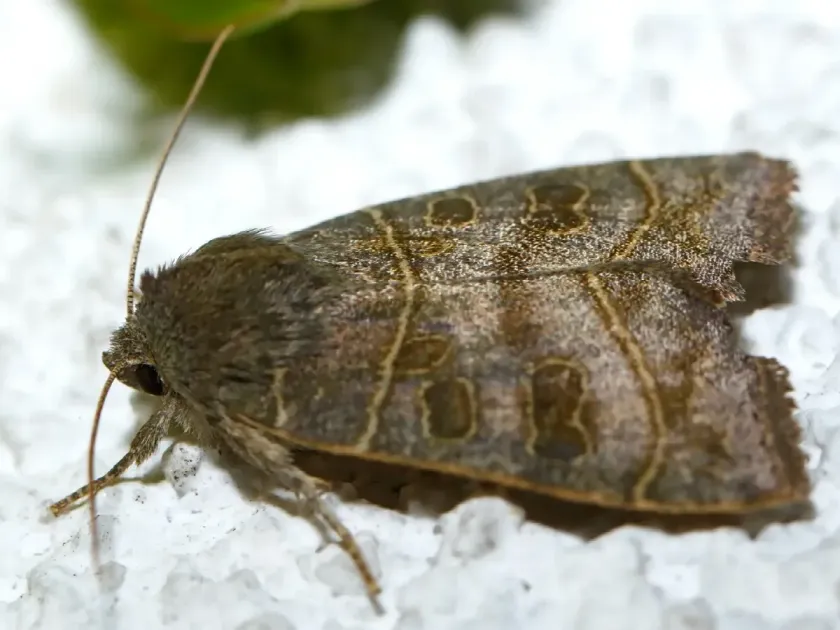
Description
How to identify
The Poplar grey moth (Ipimorpha subtusa) is a member of the Noctuidae family. The adult moth has a wingspan of approximately 30–35 mm.
The forewings are typically a greyish-brown or ochre-brown color, marked with darker cross-lines that provide excellent camouflage against tree bark.
The larvae are cylindrical and green with pale longitudinal stripes, allowing them to blend in perfectly with the underside of poplar leaves.
Like other Noctuids, the adult moth is nocturnal, which makes observing them during daylight hours difficult for foresters and researchers.
The species is univoltine, meaning it completes only one generation per year, making the timing of monitoring crucial for effective management.
What it damages
The primary hosts for Ipimorpha subtusa are various species of the Populus genus, including black poplar and aspen.
The larvae are leaf-rollers that feed on the foliage. They cause significant damage by consuming leaf tissue, which can lead to reduced growth rates in young trees.
In forest nurseries and plantations, severe infestations can lead to substantial defoliation, weakening the health of the entire stand.
Repeated defoliation over several seasons can lead to secondary infections and increased susceptibility to other biotic and abiotic stressors.
While mature trees can usually withstand moderate feeding, saplings are at high risk of stunted growth and developmental deformities due to larval activity.
When it appears
Adult moths are typically active during the mid-summer months, usually between June and August, when mating and egg-laying occur.
The species overwinters in the egg stage. Eggs are laid on the bark of young twigs of the host tree, where they remain dormant until the following spring.
Larval emergence coincides with the budding and leaf expansion of poplar trees, usually occurring in late April or May.
The feeding phase lasts until the end of June. During this time, the larvae grow rapidly and construct their characteristic leaf-rolling shelters.
Pupation takes place inside these rolled leaves or within leaf litter on the ground, where they remain until the next summer's adult emergence.
Signs of infestation
The most obvious sign of infestation is the presence of rolled or curled leaves held together by silk webbing produced by the larvae.
These rolled leaves serve as protective retreats for the larvae. Inspecting these structures often reveals the larvae inside or their frass.
Feeding damage manifests as irregular holes or skeletonized areas on the leaves, where only the veins are left behind by the developing larvae.
An increased presence of insectivorous birds and predatory insects in the canopy may indicate a high density of larvae in the area.
Early leaf drop in early summer, particularly if the leaves are curled, is a strong indicator of an Ipimorpha subtusa outbreak.
Control measures
Cultural control practices, such as removing and destroying infested leaf litter, can help reduce the population density for the following season.
Biological control using microbial insecticides based on Bacillus thuringiensis is highly effective against young larvae during the spring feeding period.
In industrial forestry and nurseries, systemic or contact insecticides may be applied if the economic threshold is exceeded.
Promoting a healthy ecosystem by protecting natural predators, such as parasitoid wasps and birds, is essential for long-term population suppression.
- Regular monitoring of poplar stands during the spring months.
- Pruning infested branches in nurseries to curb localized outbreaks.
- Using pheromone-based monitoring to track the seasonal activity of adults.
Taxonomy
- Latin name
- Ipimorpha subtusa
- Order
- Lepidoptera (butterflies)
- Family
- Noctuidae
- EPPO code
- IPIMSU
Discussion
No discussions yet — be the first.