
Crested porcupine
Hystrix cristata
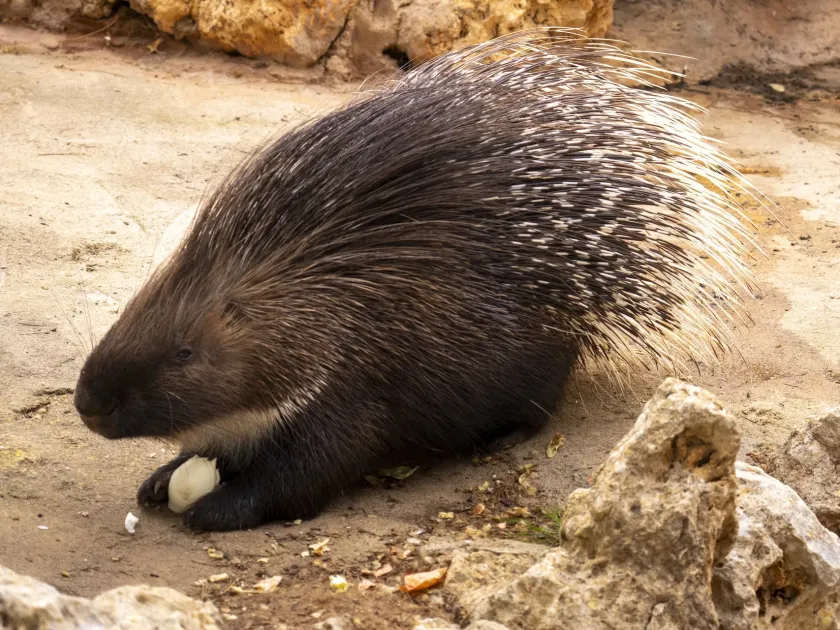
Description
How to identify
The crested porcupine (Hystrix cristata) is a member of the rodent order and the Hystricidae family. It is a large rodent characterized by long, sharp, erectile quills that serve as a primary defense mechanism against predators.
These animals are nocturnal and possess powerful teeth designed for gnawing through tough plant material, bark, and roots. An adult can weigh up to 15 kilograms, making them formidable foragers in agricultural environments.
Biologically, they are adapted to burrowing, creating complex den systems where they spend daylight hours. Reproduction is seasonal, allowing populations to expand rapidly when food sources are abundant near their habitats.
They prefer diverse landscapes, including hillsides, ravines, and areas adjacent to forest edges. These locations provide both shelter for their burrows and easy access to high-energy food sources on nearby farms.
Their acute sense of smell allows them to locate tubers and buried plant materials with high precision. This biological efficiency makes them a significant challenge for farmers in affected regions.
What it damages
The crested porcupine causes extensive damage to vegetable crops, particularly melons, watermelons, and pumpkins, by consuming the internal pulp. They often leave the outer rind intact after hollowing out the fruit.
Root crops like potatoes and beets are frequently targeted. The rodents dig up the ground to access these energy-rich roots, leading to significant yield losses across entire field sections.
Young orchards face a severe threat from porcupine activity. They gnaw the bark of trees near the base, which can girdle the trunk, causing the death of saplings due to the disruption of nutrient transport.
Cereal crops, especially corn during the milk stage, are also vulnerable. Porcupines not only consume the cobs but also flatten stems and leaves, making mechanical harvesting difficult and reducing total yield.
In vineyards, porcupines can damage both the ripening fruit and the young vine shoots. This impacts not only the current season's production but also the long-term vigor and health of the vines.
Signs of infestation
The primary sign of porcupine presence is the appearance of hollowed-out melons or pumpkins. You may also observe tooth marks on the edges of the fruit rind, which are distinctively large and deep.
Tracks and well-defined paths leading from dens toward cultivated fields are common indicators. One might also find shed quills in the soil, which are easily identifiable and confirm the animal's path.
Bark gnawing at the base of trees is another major sign. These wounds are typically rough and jagged, often located within a few inches of the ground, consistent with the feeding height of the rodent.
Disturbed soil around root crop patches suggests burrowing and digging behavior. After a nightly visit, a patch may appear heavily disturbed with discarded fragments of roots left on the surface.
Auditory cues, such as the clattering of quills or heavy breathing during the night, can help detect their presence. They are relatively vocal animals that make various grunting and whining sounds while foraging.
Control measures
Physical barriers are the most effective control method. Installing woven-wire fencing buried at least 30 centimeters underground is essential to prevent these rodents from digging under the perimeter.
Repellents that utilize strong odors or taste-based deterrents can be applied to crops, though they must be reapplied frequently, especially after rainfall, to remain effective in deterring the animals.
Ultrasonic and light-based deterrents can create a hostile environment for nocturnal foragers. These devices are most effective when used in combination with regular site monitoring and habitat modification.
Cultural practices, such as maintaining clear boundaries around fields and removing debris or thick brush, reduce the number of suitable denning sites near agricultural production areas.
- Use of live-traps for humane relocation.
- Wrapping tree trunks with hardware cloth or metal mesh.
- Frequent site inspections during the ripening season.
- Collaborating with local wildlife management agencies for large-scale issues.
Taxonomy
- Latin name
- Hystrix cristata
- Order
- Rodents
- Family
- Hystricidae
- EPPO code
- HYSXCR
Discussion
No discussions yet — be the first.