
Mole flea
Hystrichopsylla talpae
Description
How to identify
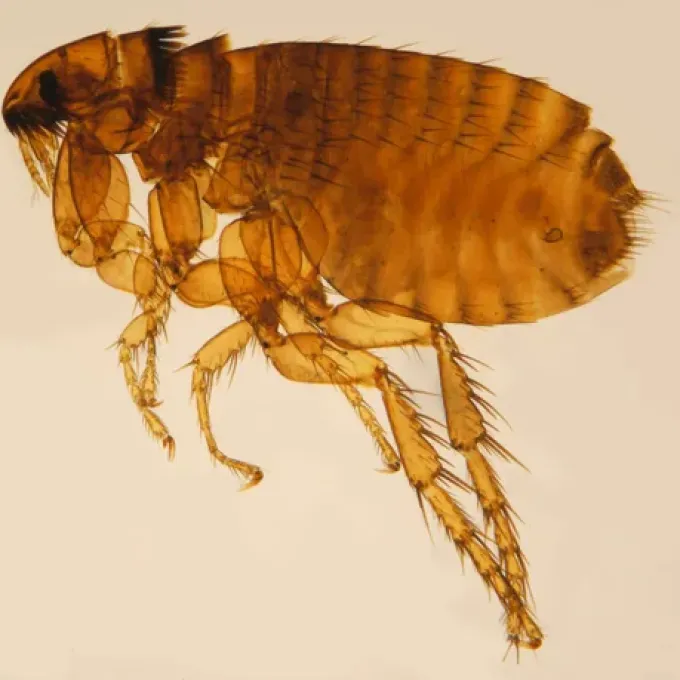
The mole flea (Hystrichopsylla talpae) is a prominent member of the order Siphonaptera and the family Hystrichopsyllidae, known as one of the largest flea species.
Adult insects have a laterally compressed body, which allows them to move efficiently through the dense fur of small burrowing mammals, mainly moles.
A distinctive feature of this species is the presence of heavy, coarse combs (ctenidia) on the pronotum, which serve as anchoring mechanisms.
The biological development follows a complete metamorphosis: eggs are laid in the mole's nest, followed by larval stages, pupation, and the adult phase.
Larvae are detritivores, thriving in the organic debris and dried blood within the nest material, showing a preference for stable microclimates.
What it damages
It is crucial to clarify that the mole flea does not damage agricultural crops, as it does not consume any plant parts or vegetable tissues.
Its status as a pest is limited to being an ectoparasite of vertebrates, and it carries no direct economic impact on crop yields or farming operations.
Any perceived damage in an agricultural context is strictly linked to the activities of its host, such as the disruption of soil structure by moles.
The flea plays a role in the natural transmission of pathogens among wild mammal populations, which is of interest to veterinary entomologists.
Therefore, farmers do not need to implement protection measures specifically against this flea species regarding crop health.
When it appears
Mole fleas remain active throughout the entire year, as they are protected from seasonal weather changes inside the deep tunnels of their hosts.
Reproduction cycles are tightly correlated with the activity patterns of the mole, peaking during the spring breeding season of the mammal.
Soil temperature serves as the primary environmental regulator for the speed of the larval development and the duration of the pupal stage.
During colder months, the population density remains stable within the warm, insulated environment of the underground nesting chambers.
Dispersal to new hosts occurs mainly through the intersection of burrows, allowing the flea to colonize new territories within a field or garden.
Control measures
Specific chemical control for the mole flea in agricultural fields is neither required nor recommended by professional agronomic standards.
Integrated pest management strategies focused on the host animals, such as soil cultivation, indirectly affect flea populations by destroying habitats.
Sanitation of storage facilities and perimeter maintenance helps keep the rodent population under control, reducing the presence of flea vectors.
Applying insecticides in open fields to combat fleas is environmentally irresponsible and ineffective due to the subterranean nature of the pest.
In cases where parasite load is a concern near structures, standard rodent control and area cleaning are the most effective management practices.
Taxonomy
- Latin name
- Hystrichopsylla talpae
- Family
- Hystrichopsyllidae
- EPPO code
- HYSRTA
Discussion
No discussions yet — be the first.