
Hutchinsoniella macracantha
Hutchinsoniella macracantha
Description
How to identify
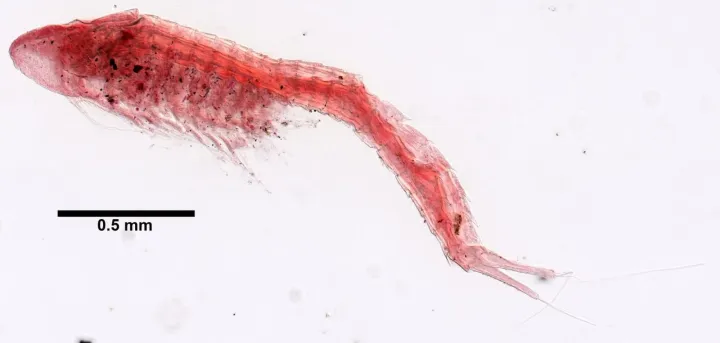
Hutchinsoniella macracantha is a member of the class Cephalocarida, belonging to the family Hutchinsoniellidae. These are tiny marine crustaceans, typically measuring less than 3 millimeters in length.
The organism possesses a primitive body plan, which makes it a key subject for evolutionary research regarding crustacean development. It features a broad head shield that covers the first thoracic segment.
Its body is elongated and segmented, with thoracic limbs that show a relatively uniform structure. These limbs are adapted for movement within fine-grained marine sediments.
The species is entirely blind, an adaptation suited to life in the dark, buried layers of the sea floor. Despite their small size, they represent a significant lineage of ancient crustacean evolution.
Scientists rely on detailed morphological studies to distinguish this species from other benthic invertebrates. They play a vital role in marine sediment ecology.
What it damages
Hutchinsoniella macracantha is not an agricultural pest and does not affect terrestrial crops. It is exclusively an aquatic organism that occupies specific niches on the seafloor.
In the context of aquaculture or marine research, they are generally considered beneficial or neutral. As detritivores, they process organic matter and contribute to nutrient cycling in the benthos.
There is no economic damage associated with this species in commercial farming. Their presence is often considered an indicator of a healthy, organic-rich marine environment.
Concerns about this species as a "pest" are nonexistent in any documented agronomic or commercial marine practice. They are part of the natural balance of coastal ecosystems.
Their impact on the environment is primarily focused on bioturbation, which facilitates oxygen exchange in the top layers of marine muds.
When it appears
The activity levels of Hutchinsoniella macracantha are closely linked to water temperature and the availability of organic food particles on the sea floor.
Reproductive cycles are usually synchronized with seasonal changes in water temperature and currents. This ensures that larvae find adequate resources for growth.
During winter months, metabolic activity slows significantly, and the individuals move deeper into the sediment layers to survive colder temperatures.
The developmental process involves several naupliar stages, all occurring within the benthic substrate. Stability in salinity and temperature is crucial for their survival.
Population density often peaks when currents deliver high levels of organic detritus to the near-shore environment.
Signs of infestation
Detection of this species requires specialized sampling techniques, such as using box corers or benthic grabs followed by fine-mesh sieving.
Visual identification is impossible without the use of a microscope due to their minute size. Once samples are collected, they are preserved for laboratory analysis.
Micro-structural disturbances in the top layer of sediment may indicate the presence of high-density populations, though this is rarely visible without specific equipment.
Researchers use staining and specific fixation methods to highlight the anatomical details necessary for taxonomy. This allows for accurate counting and species verification.
Their presence is confirmed through biological monitoring rather than visual signs of crop or material damage.
Control measures
There are no control measures required for Hutchinsoniella macracantha as it is not a pest. In natural habitats, populations are self-regulating based on food availability.
In aquaculture environments, management focuses on maintaining high water quality and preventing excessive organic sludge build-up.
Preventative measures are limited to general ecosystem stewardship. Excessive waste management is the most effective way to maintain ecological balance.
Chemical intervention is strictly prohibited as it would cause irreversible damage to the marine community. Monitoring is the only recommended action for conservation purposes.
The recommended management approach consists of:
- regular environmental monitoring;
- maintaining sediment health;
- controlling organic loading;
- protecting the benthic substrate integrity.
Taxonomy
- Latin name
- Hutchinsoniella macracantha
- Family
- Hutchinsoniellidae
- EPPO code
- HUTCMA
Discussion
No discussions yet — be the first.