
Fungus beetle
Holoparamecus signatus
Description
How to identify
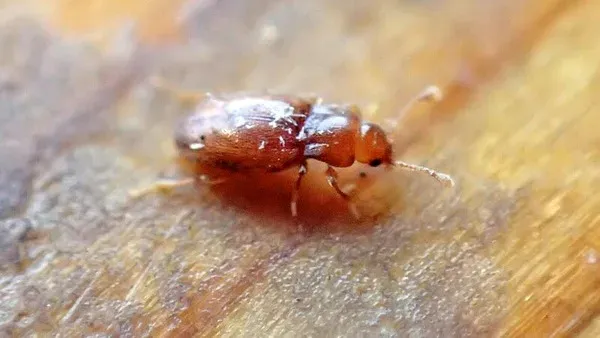
The fungus beetle, scientifically known as Holoparamecus signatus, belongs to the family Endomychidae. It is a very small insect, typically measuring between 1 and 1.5 mm in body length.
These beetles exhibit an elongated, oval-shaped body with a coloration ranging from light brown to deep reddish-brown. The surface of the body is characterized by tiny punctures, which are difficult to see without strong magnification.
The antennae are 11-segmented and terminate in a distinct two-segmented club. This morphological feature is crucial for distinguishing H. signatus from other similar species found in stored commodities.
Larvae are cream-colored, mobile, and live primarily within the moist, moldy substrates they consume. They thrive in environments where fungi and molds are present due to high humidity levels.
As a cosmopolitan species, it has a high capacity for dispersal, often invading mills, granaries, and warehouses where poor storage conditions allow for the growth of mold.
What it damages
The fungus beetle Holoparamecus signatus is primarily considered a pest of stored grain, animal feed, and processed vegetable products that have become damp and moldy.
While the beetle itself is a mycophage, feeding on the mycelia and spores of various mold fungi, its presence significantly contaminates the stored product with frass and cast skins.
High infestation levels are associated with "hot spots" in grain silos, where the heat generated by the metabolism of both the beetles and the fungi accelerates the degradation of the product.
Infested goods develop a musty, moldy odor and show signs of physical decay. This degradation makes the grain or feed unsuitable for commercial use or animal consumption.
The presence of this beetle serves as a biological indicator that the storage environment is poorly controlled and that grain moisture content has reached dangerous levels.
When it appears
In temperature-controlled storage facilities, the beetle can complete its life cycle throughout the year, provided there is enough moisture to support fungal growth.
The optimal development conditions for the species are temperatures between 22°C and 28°C combined with relative humidity levels in the grain exceeding 15%.
During the warmer summer months, the metabolic rate increases, leading to a rapid generation turnover and potential population explosions within the warehouse.
Winter conditions in unheated storage areas tend to slow down development, but the beetles remain active in small, protected cracks, seams, and structural crevices of the building.
Monitoring is most critical during periods of high ambient humidity or following seasonal temperature changes that may induce condensation inside grain bulk containers.
Control measures
The most effective management strategy is to maintain storage conditions that prevent mold growth, such as keeping grain moisture levels below the critical threshold of 14%.
Strict sanitation protocols must be enforced, including the removal of dust, spilled grain, and debris from warehouse corners, as these act as breeding grounds for the pest.
The use of aeration systems is essential to regulate the temperature and humidity within the grain mass, thereby creating an environment unsuitable for fungus beetles.
When infestations are identified, appropriate insecticides or fumigants approved for use in grain storage facilities must be applied to eliminate the pest population.
Preventive measures, such as deep cleaning and disinfection of empty warehouses prior to loading new grain, are mandatory to ensure long-term protection against cross-contamination.
Taxonomy
- Latin name
- Holoparamecus signatus
- Order
- Coleoptera (beetles)
- Family
- Endomychidae
- EPPO code
- HOLASI
Discussion
No discussions yet — be the first.