
Hesperophanes forficulatus
Hesperophanes forficulatus
Description
How to identify
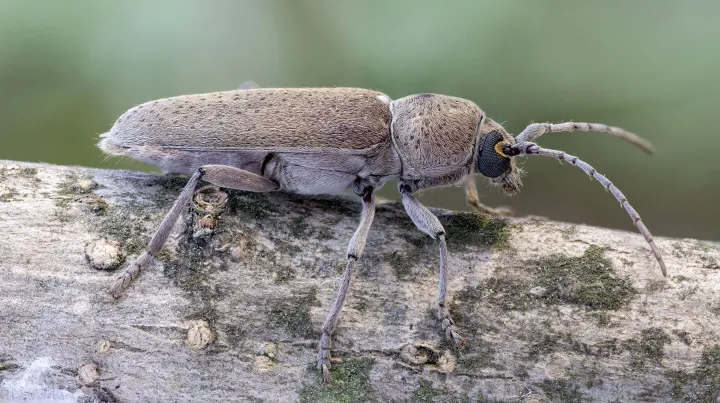
Hesperophanes forficulatus is a species of beetle belonging to the family Cerambycidae, commonly known as longhorn beetles. Adults are characterized by their elongated bodies and long antennae, which are typical for this diverse family of insects.
The beetle typically exhibits a reddish-brown to dark brown coloration, providing effective camouflage against tree bark. Its body length generally ranges from 15 to 25 millimeters, and the surface is often covered with sparse, fine hairs.
The larvae, which are the primary destructive stage, have a creamy-white, fleshy body with a well-developed head and powerful mandibles designed for boring through wood. They lack functional legs, relying on body contractions to move through tunnels.
The life cycle of this beetle is complex and spans several years, involving several larval instars. The emergence of adults usually occurs during warm summer months, coinciding with their reproductive period.
As a xylophagous insect, its development is strictly tied to the availability of suitable woody substrates, primarily focusing on stressed or declining deciduous trees.
What it damages
The larvae are specialized wood-borers that create intricate galleries within the xylem and cambium layers of trees. This activity severely disrupts the transport of water and nutrients throughout the plant.
Initial feeding occurs under the bark, but as larvae mature, they penetrate deeper into the sapwood and heartwood, significantly compromising the structural integrity of the tree trunk and major branches.
In cases of high infestation levels, trees exhibit progressive decline, including branch dieback, sparse canopy growth, and reduced fruit production, eventually leading to mortality.
The tunnels created by larvae often serve as entry points for various secondary fungal pathogens and moisture-seeking pests, which further accelerate the decay of the infested woody tissue.
Orchards and urban tree stands are particularly vulnerable when maintenance is neglected, as weakened or dead wood provides an ideal breeding ground for successive generations of this beetle.
Signs of infestation
The most visible sign of infestation is the presence of oval-shaped exit holes on the tree surface, marking the point where adults emerged after pupation.
Presence of frass, a mixture of fine sawdust and excrement produced by larvae, is often found in crevices of the bark or at the base of the trunk, signaling active feeding within the tree.
Canopy thinning, yellowing leaves, and premature leaf drop are common systemic responses to the vascular damage caused by larval tunneling, indicating that the tree is under severe stress.
Physical inspection of the bark may reveal longitudinal cracks or sunken areas, which are indicators of larval activity occurring directly beneath the protective outer layer.
Hollow sounds when tapping the bark can also indicate significant internal damage caused by extensive gallery systems deep within the tree structure.
Control measures
The primary control measure is rigorous sanitary maintenance. Removing and destroying infested or dead wood immediately helps in reducing the local population of the pest.
Improving general tree vigor through proper irrigation, fertilization, and site management can increase the tree's natural resistance to initial larval colonization.
Direct application of systemic insecticides via trunk injection into detected larval galleries can be an effective intervention to eliminate existing populations within the wood.
Light traps are useful during the peak flight season of adults to monitor and decrease their numbers, thereby reducing the probability of new eggs being deposited on trees.
Protective bark treatments applied during the flight period can act as a deterrent to females seeking suitable sites for oviposition, helping to safeguard high-value trees.
Discussion
No discussions yet — be the first.