
Lucerne moth
Heliothis viriplaca
Description
How to identify
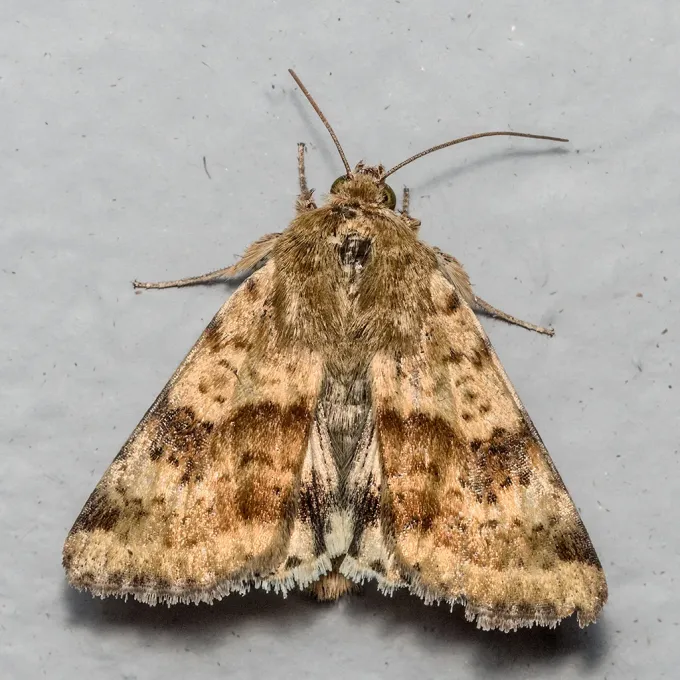
The lucerne moth (Heliothis viriplaca) is a member of the Noctuidae family. The adult moth has a wingspan ranging from 25 to 35 mm, with forewings that vary in color from greenish to yellowish-gray.
A distinctive dark spot in the center of the forewings and a dark band along the outer edge are primary identification features. The hindwings are paler with a broad dark margin, which is typical for this species.
The body is covered in dense scales and hairs, giving the moth a robust appearance. These insects are nocturnal and often remain hidden during the daylight hours among plant foliage.
The larvae, or caterpillars, can grow up to 40 mm in length. Their color is highly variable, ranging from light green to brownish or even black, which helps them blend into their surroundings.
Pupae are approximately 15–20 mm long and dark brown. They typically overwinter in the soil at a depth of 3 to 10 cm, providing protection against winter frosts.
What it damages
This pest is a polyphage, capable of feeding on a wide range of agricultural crops. Legumes, particularly alfalfa (lucerne), are among the most frequently attacked plants.
The caterpillars primarily consume the generative organs of plants, such as buds, flowers, and ovaries. This behavior leads to significant yield losses in seed production areas.
When flowers are unavailable, larvae feed on vegetative parts, including leaves and terminal shoots. This stunt growth and reduces the overall vigor of the crop, making it more susceptible to environmental stress.
Other crops affected include soybeans, peas, flax, and sunflowers. In years of high population density, the lucerne moth can cause severe economic damage to field-scale agricultural operations.
Feeding damage also introduces pathways for secondary infections, such as bacterial or fungal diseases, which can further degrade the plant tissues and quality of the yield.
When it appears
The first generation of moths typically emerges in late spring or early summer, depending on regional temperature patterns. Adult activity is closely aligned with the flowering period of host plants.
Females deposit eggs individually on flowers, buds, or the undersides of leaves. A single female is capable of producing up to 1,000 eggs during her lifecycle.
The embryonic stage lasts from three to eight days, influenced by ambient temperature and humidity levels. Once hatched, larvae begin feeding immediately to sustain their rapid growth.
The larval stage lasts approximately one month. After reaching maturity, the caterpillars descend into the soil to pupate, marking the end of the feeding cycle.
Depending on the latitude, the insect completes one to two generations per year. The second generation is often larger and can pose a greater threat to late-season crops.
Signs of infestation
The most visible sign of infestation is damaged or missing flower buds. Flowers may drop prematurely, resulting in poor pod or seed set in legumes.
Caterpillar droppings (frass) on the leaves below the feeding site are a clear indication of a larval presence. This is particularly noticeable in dense crop canopies.
Rolled or tied leaves, held together by silk threads, serve as daytime shelters for larvae and are easy to spot during field inspections.
Reduced flower count in alfalfa racemes, combined with healthy-looking stems, is a hallmark sign that the lucerne moth is targeting the generative organs.
The sight of adult moths during dusk or dawn indicates active egg-laying and signals the need for immediate field monitoring to prevent future larval outbreaks.
Control measures
Integrated pest management involves cultural practices such as deep fall tillage, which destroys overwintering pupae and reduces the next year's population density.
Managing weeds around field margins is essential, as these areas provide supplemental food and shelter for adult moths, facilitating their survival and reproduction.
Biological control methods, such as the strategic release of Trichogramma wasps, can effectively parasitize the moth's eggs and reduce the infestation level without chemical intervention.
If economic thresholds are exceeded, targeted insecticide applications should be timed to target younger larval stages, which are significantly more susceptible to control measures.
- Monitor populations using pheromone traps.
- Practice crop rotation to disrupt the life cycle.
- Use selective insecticides while minimizing impact on pollinators.
Taxonomy
- Latin name
- Heliothis viriplaca
- Order
- Lepidoptera (butterflies)
- Family
- Noctuidae
- EPPO code
- HELIDI
Discussion
No discussions yet — be the first.