
Spotted clover moth
Heliothis scutosa
Description
How to identify
The spotted clover moth (Heliothis scutosa) is a significant agricultural pest belonging to the Noctuidae family within the order Lepidoptera.
The adult moth has a wingspan of approximately 35–40 mm, with forewings varying from yellowish-grey to olive-brown in color.
A distinctive feature of this moth is the prominent dark spot located in the center of the forewing, accompanied by transversal bands.
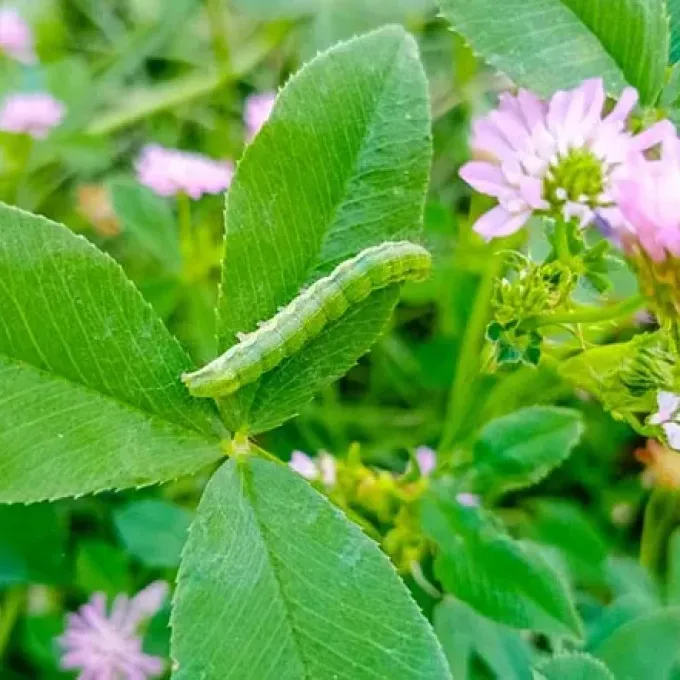
The larvae, or caterpillars, exhibit a varied coloration ranging from green to brown, often featuring longitudinal stripes along the body.
As mature larvae, they can reach a length of 40 mm and are covered with small, fine hairs, making them easily identifiable in the field.
What it damages
The primary host for this pest is alfalfa, although it is known to cause damage to various other legumes such as clover, soybean, and sainfoin.
Caterpillars feed aggressively on leaves, often stripping plants down to the main veins, which significantly impacts the photosynthetic capacity.
Beyond foliage, the larvae target reproductive structures, causing flower and bud destruction, which leads to substantial yield losses in seed crops.
In outbreaks, the pest can migrate to secondary crops like sunflower or flax, broadening its negative economic impact on agriculture.
The destruction of generative organs results in poor seed set, reducing the quality and quantity of the harvest for farmers.
When it appears
The spotted clover moth overwinters in the pupal stage, buried in the soil at depths of up to 10 cm to escape frost.
Adult emergence typically begins in late spring, with the timing closely linked to rising soil temperatures and the onset of plant growth.
The insect completes two to three generations per year, with activity levels peaking during warm and dry summer months.
Mass emergence of the second generation usually occurs in mid-summer, which often coincides with the most vulnerable stage of alfalfa growth.
Environmental factors, specifically temperature and humidity, play a critical role in determining the speed of the pest's lifecycle development.
Signs of infestation
Initial signs of infestation include small, irregular holes on the leaves that progress to complete defoliation of the leaflets.
Plants infested by larvae show stunted growth and a shredded appearance due to intense feeding activity on the foliage.
Floral abortion and the absence of healthy seed pods are classic indicators that larvae are feeding within the reproductive clusters.
Presence of frass (caterpillar droppings) on leaves and at the base of the plant confirms active feeding by the spotted clover moth.
Larvae can be observed during dusk or nighttime using a flashlight, as they tend to feed and move across plants during these cooler hours.
Control measures
Deep autumn plowing of fields is a primary cultural control method, effectively burying and destroying the pupae residing in the soil.
Regular maintenance of field margins to remove weeds prevents the buildup of larval populations that might later invade the main crop.
Chemical control is required when population density exceeds economic injury levels, usually involving targeted insecticide applications.
Biological control, including the use of entomopathogenic fungi or bacterial strains, offers a sustainable method to manage pest numbers.
Timing of interventions should be based on systematic monitoring of moth flight using pheromone or light traps to predict egg-laying cycles.
Taxonomy
- Latin name
- Heliothis scutosa
- Order
- Lepidoptera (butterflies)
- Family
- Noctuidae
- EPPO code
- HELISC
Discussion
No discussions yet — be the first.