
Heliothis rama
Heliothis rama
Description
How to identify
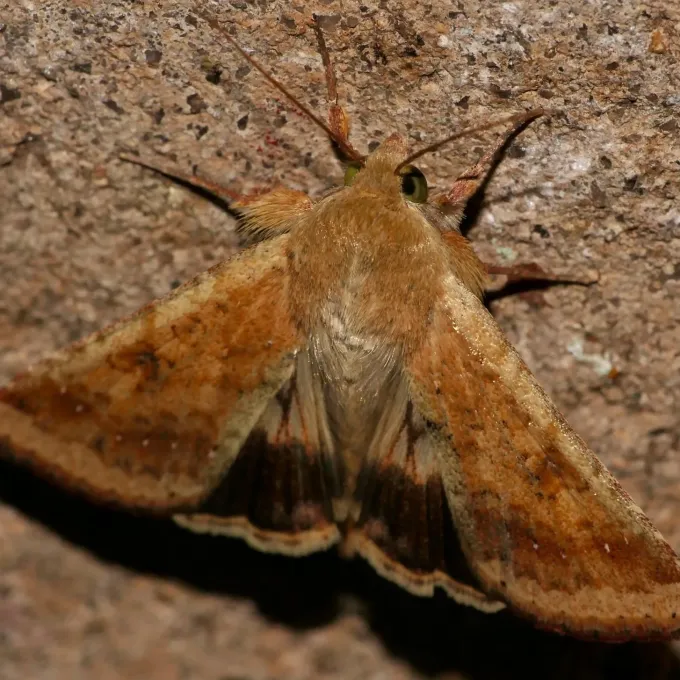
Heliothis rama belongs to the family Noctuidae (Owlet moths) within the order Lepidoptera. The adult insect is a nocturnal moth characterized by specific morphological features common to its genus.
The forewings of the moth usually display a protective coloration ranging from ochre-yellow to brownish tones, providing effective camouflage against vegetation during the daytime.
The larvae, or caterpillars, undergo several developmental stages, often varying in color from greenish to dark brownish or nearly black, depending on their diet and environmental factors.
A distinctive feature of the larvae is the presence of well-defined longitudinal stripes on their body and a powerful chewing mouthpart adapted for feeding on plant tissues.
Pupae are typically reddish-brown in color, featuring smooth surfaces, and are usually located within the soil substrate where they overwinter to survive harsh conditions.
What it damages
This pest is a highly polyphagous insect, capable of causing significant damage to a wide range of agricultural crops, including vegetables, legumes, and industrial plants.
The most severe damage is caused by mature larvae, which actively consume leaves, buds, flowers, and reproductive organs, leading to a substantial decrease in yield.
In crops like tomatoes or cotton, larvae can bore into the fruit, consuming the internal tissues and rendering the produce completely unmarketable or prone to rotting.
Beyond direct mechanical damage to plant tissues, the feeding sites often become entry points for secondary infections, including various fungal and bacterial pathogens.
During outbreak years, the infestation levels can cause catastrophic losses, necessitating immediate and effective intervention by agronomic management teams.
When it appears
The life cycle of the pest is closely linked to temperature patterns and the accumulation of active temperatures throughout the growing season.
The first flight of adults usually occurs in spring, triggered by the warming of the soil, which allows moths to emerge from their overwintering pupal stage.
Depending on the climatic zone, the insect may complete multiple generations within a single growing season, significantly complicating population management.
Larval activity typically peaks during the flowering and fruit-setting stages of the host crops, as these periods provide the most nutritious food sources for development.
As temperatures drop and day length decreases in the autumn, the pest enters diapause, burrowing into the soil to a depth of 10-15 centimeters to survive the winter.
Signs of infestation
The primary visual sign of infestation is the presence of holes with irregular shapes on leaves, as well as gnawed edges on buds and young foliage.
The accumulation of larval frass (excrement) on the leaf surfaces or in the plant axils is a strong diagnostic indicator of active larval feeding in the vicinity.
Damaged fruit often exhibits characteristic hollows or entry holes, where larvae or signs of their feeding activity can be detected upon closer inspection.
Wilting or yellowing of stems due to the destruction of vascular tissues by feeding larvae can also be observed in cases of severe infestation.
Adult moth presence can be monitored and confirmed using light traps or pheromone monitoring systems deployed across the field perimeter.
Control measures
An integrated pest management (IPM) approach is essential, combining agronomic practices with biological and chemical control methods to minimize crop losses.
Deep autumn plowing is a critical practice, as it disrupts the soil, exposing overwintering pupae to predators and adverse environmental conditions.
Maintaining proper crop rotation and the systematic removal of weeds surrounding the fields helps reduce alternative food sources for the early larval stages.
When the economic injury level is exceeded, application of appropriate insecticides, such as pyrethroids or insect growth regulators, is recommended.
- Utilizing pheromone traps for population monitoring.
- Releasing entomophages, such as Trichogramma species.
- Timely spraying during the early stages of larval hatching.
Taxonomy
- Latin name
- Heliothis rama
- Order
- Lepidoptera (butterflies)
- Family
- Noctuidae
- EPPO code
- HELIRA
Discussion
No discussions yet — be the first.