
Bordered straw
Heliothis peltigera
Description
How to identify
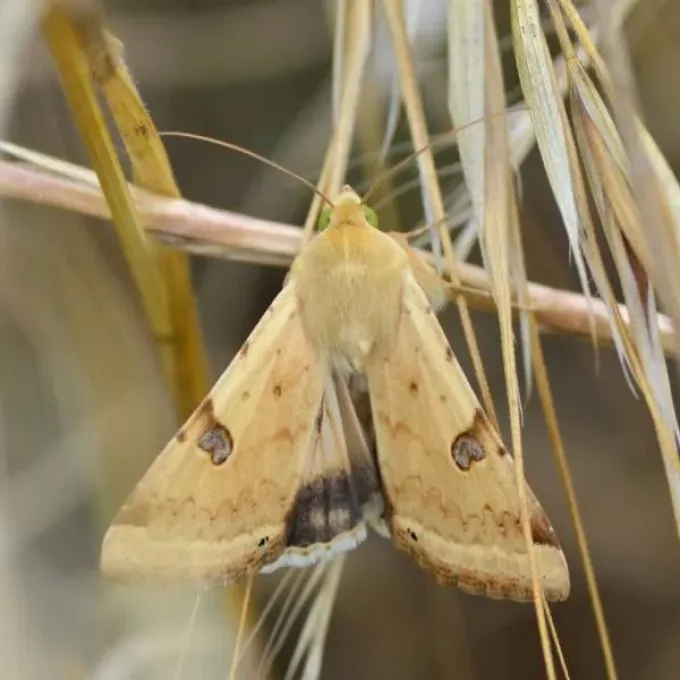
The bordered straw (Heliothis peltigera) belongs to the Noctuidae family of the order Lepidoptera. It is a moth with a wingspan of up to 40 mm, exhibiting a coloration ranging from yellowish-grey to ocher-brown, with characteristic dark spots on the forewings.
The larvae, or caterpillars, can reach a length of 35–40 mm. Their bodies are covered with fine bristles, from which their name is derived. The coloration of the larvae varies from light green to reddish-brown, with dark dorsal stripes and lighter lateral lines.
The pupa is brown, measuring approximately 15–20 mm in length, and possesses a pointed cremaster with two spines at the tip, which serves as a crucial taxonomic feature for species identification.
This species is migratory and commonly found in warm climate regions. In temperate latitudes, populations are often supplemented by migrating individuals arriving from warmer southern regions during the spring and summer months.
The life cycle includes the egg, five larval instars, pupa, and adult stages. Depending on temperature conditions, two to three generations can occur within a single growing season.
What it damages
The bordered straw is a polyphagous pest, meaning it attacks a wide variety of plants. It causes significant damage to members of the Lamiaceae (mint family), Fabaceae (legumes), and Solanaceae families.
Affected crops include sage, flax, soybeans, chickpeas, alfalfa, clover, and various vegetable crops such as tomatoes and peppers grown in open fields.
Young larvae feed primarily on buds and leaves, chewing holes or skeletonizing the leaf blade, leaving only the major veins intact.
As the larvae reach older stages, they shift their focus to the generative organs of the plants. They aggressively damage buds, flowers, and ovaries, often leading to total crop failure or a significant reduction in quality and marketability.
During outbreaks, this pest is capable of destroying a large portion of a field's yield, particularly during the critical flowering and fruit-setting stages of the crops.
When it appears
The flight of the overwintering generation of moths typically begins in April and May, as soon as average daily temperatures reach 15–18 degrees Celsius.
Egg-laying is a prolonged process. Females deposit eggs individually or in small clusters on the undersides of leaves, bracts, or the sepals of host plant buds.
Embryonic development lasts 3 to 7 days, depending on environmental humidity and temperature. The first caterpillars emerge in late May or early June, initiating intense feeding.
The most active period of crop damage occurs from June to August, when larval populations reach their peak. During this time, regular field monitoring is essential for effective management.
Pupation occurs in the soil at a depth of 3–5 cm. The species typically overwinters in the pupal stage within the topsoil layer or under plant debris.
Signs of infestation
The first sign of infestation is the presence of adult moths in the evening; they are attracted to light sources and are seen flying actively over fields while seeking suitable host plants for oviposition.
Leaves often exhibit characteristic damage, such as irregularly shaped holes or ragged margins, which can eventually cause premature wilting and defoliation of the plants.
The detection of larval frass (droppings) on the leaves or on the soil surface beneath the plants is an indirect but reliable indicator of the pest's presence in the field.
Damage to buds and flowers is manifested by premature drying and dropping, which is easily observed when inspecting the generative organs of the crop under field conditions.
In areas where larvae congregate, one may observe partial or total defoliation of stems, leading to stunted plant growth and a dramatic decrease in photosynthetic efficiency.
Control measures
The most important agrotechnical control measure is high-quality deep autumn plowing, which helps eliminate pupae in the soil through mechanical destruction or by exposing them to the surface.
Regular weed control, particularly targeting weeds within the Lamiaceae family, on fields and surrounding areas significantly reduces the pest's available food sources.
The use of biological control agents, such as products containing Bacillus thuringiensis, is effective against young larvae while ensuring environmental safety for the harvested produce.
During population spikes exceeding economic thresholds, the use of approved systemic or contact insecticides is recommended, provided that pre-harvest interval guidelines are strictly followed.
The use of pheromone traps for adult monitoring allows for the precise timing of control measures, thereby avoiding unnecessary chemical applications and reducing overall costs.
Taxonomy
- Latin name
- Heliothis peltigera
- Order
- Lepidoptera (butterflies)
- Family
- Noctuidae
- EPPO code
- HELIPE
Discussion
No discussions yet — be the first.