
Flax bollworm
Heliothis ononis
Description
How to identify
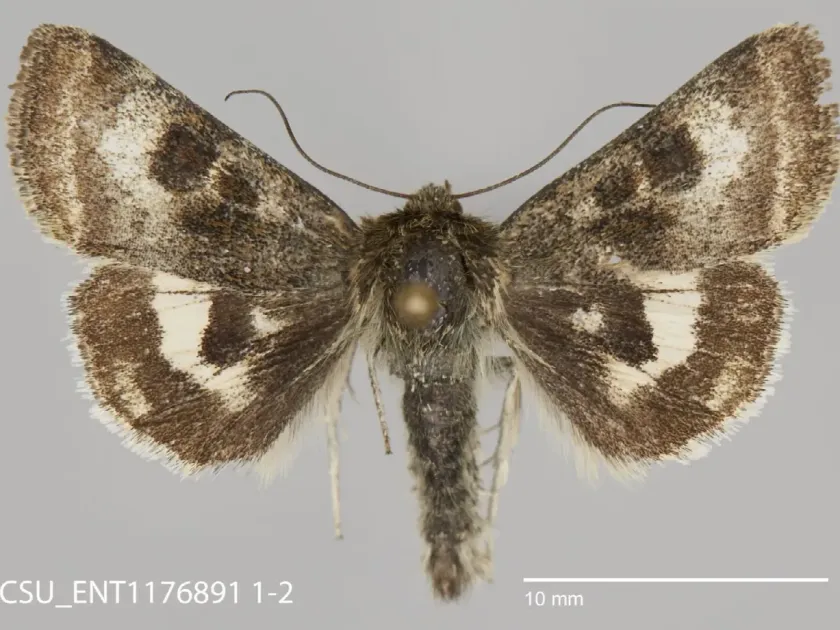
The flax bollworm (Heliothis ononis) belongs to the Noctuidae family within the Lepidoptera order. The adult moth has a wingspan of 28–32 mm, featuring yellowish-grey or brown forewings with a distinct dark spot in the middle.
The larvae, or caterpillars, pass through five instars, growing up to 35 mm in length. Their coloration ranges from pale green to brownish, providing excellent camouflage against the stems and buds of the flax plant.
The pupae hibernate in the soil at depths of 10–15 cm. This dormant stage allows the insect to survive winter conditions and emerge as adults during the warm summer months to begin the annual cycle.
The lifecycle typically consists of one generation per year. Moth emergence is highly synchronized with the budding and flowering phases of the flax crop, which is essential for the survival of the offspring.
Entomological monitoring using pheromone traps is the standard approach for identifying the presence of this pest, allowing growers to track moth activity and plan necessary intervention measures.
What it damages
The flax bollworm is a specialized pest primarily targeting flax crops (both fiber and linseed). Its larvae exhibit high feeding activity, focusing on the reproductive structures of the plant.
Young larvae feed on leaf epidermis and young buds, while older caterpillars are capable of consuming entire flower buds and developing seed capsules, which significantly impacts seed yield.
Beyond direct loss of seeds, the damage inflicted by the bollworm provides entry points for secondary pathogens and fungal infections, further compromising the quality of the flax fibers.
Severe infestations can lead to a drastic reduction in crop productivity, forcing farmers to take urgent control measures to prevent economic losses in seed and fiber quality.
- Consumption of reproductive organs (buds and flowers).
- Destruction of developing seeds inside the capsules.
- Reduced plant growth and overall vitality due to larval feeding.
When it appears
Adult moths generally emerge in June, corresponding with the rise in temperatures. Mating and egg-laying occur shortly after emergence, typically on the upper leaves and flower buds.
Incubation of eggs takes about a week, depending on weather conditions. Warm and dry weather during this period can accelerate the development of the larvae, leading to faster infestation rates.
The larval stage is the most destructive period, lasting for approximately 3–4 weeks. During this time, they feed aggressively to accumulate the energy required for pupation.
By late summer, the caterpillars burrow into the soil to form pupae. They remain in the soil in a state of diapause until the following summer, completing the annual cycle.
Monitoring weather patterns is crucial for flax farmers, as shifts in temperature and humidity can lead to variation in the timing and intensity of the bollworm emergence each year.
Signs of infestation
Early symptoms include small, irregular holes on the leaves caused by young larvae. These signs are easily overlooked if the fields are not inspected thoroughly during the early growth stages.
The presence of frass (larval droppings) on leaves or on the ground is a key indicator of infestation, especially when the larvae are hidden inside the developing capsules.
Deformed or dried flower buds and hollowed-out seed capsules are definitive signs of bollworm damage, as the larvae consume the interior tissue of these parts.
Seeing adult moths flying in the twilight hours suggests that egg-laying is occurring, signaling the need for immediate field assessment to detect early larval activity.
In high-density infestations, flax fields may show patches of stunted or wilting plants, which often points to localized feeding pressure by the larval population.
Control measures
Management of the flax bollworm relies on an integrated approach. Deep autumn plowing is a highly effective cultural practice that exposes hibernating pupae to predators and cold temperatures.
Crop rotation is essential for breaking the pest cycle. Avoiding consecutive years of flax in the same field helps to minimize the buildup of local bollworm populations.
Chemical control should be implemented based on economic thresholds. Applications must be timed precisely to target young larvae before they bore into the seed capsules where they are protected.
Biological control, including the use of Trichogramma wasps, can be highly effective in reducing egg populations, providing an environmentally friendly alternative to traditional pesticides.
Regular field scouting and the use of pheromone traps allow growers to make informed decisions about when to apply treatments, ensuring efficacy while minimizing unnecessary chemical use.
Taxonomy
- Latin name
- Heliothis ononis
- Order
- Lepidoptera (butterflies)
- Family
- Noctuidae
- EPPO code
- HELION
Discussion
No discussions yet — be the first.