
Heliothis maritima
Heliothis maritima
Description
How to identify
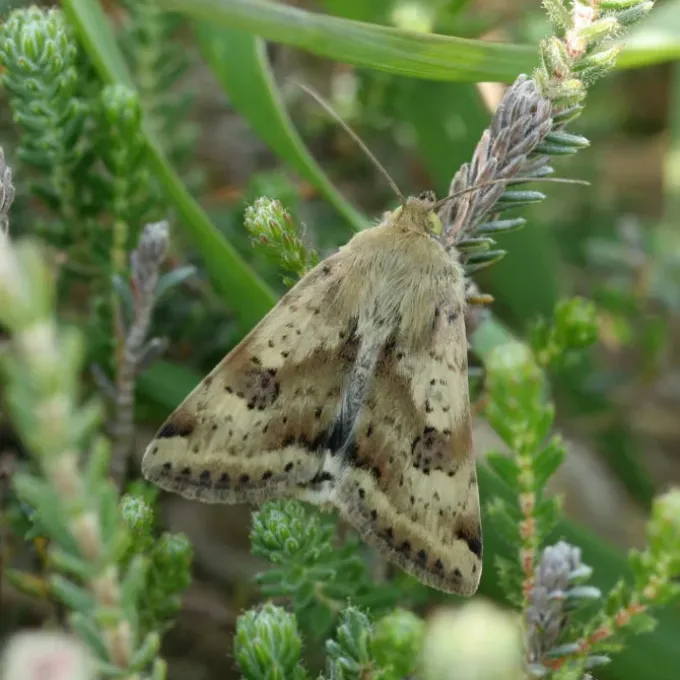
Heliothis maritima is a small nocturnal moth belonging to the Noctuidae family, order Lepidoptera. The adult moth has a wingspan of approximately 25–30 mm, with forewings typically marked in grayish-brown or ochre tones, featuring distinct dark bands and characteristic spots.
The larvae of this species exhibit variable coloration, ranging from light green to brownish, which allows them to effectively camouflage themselves on host plants. The body of the caterpillar is covered with fine spines and sparse hairs, usually showing longitudinal light stripes along the dorsal side.
The pupa of the pest is reddish-brown with a smooth surface and typically overwinters in the soil at a depth of 10–15 cm. Pupation occurs within a dense cocoon, which protects the insect from harsh environmental conditions during the winter months.
The life cycle of Heliothis maritima depends directly on regional climatic conditions. Usually, there are one or two generations per year, depending on the temperature regime and precipitation levels during the spring-summer period.
For accurate identification of adults, specialists utilize light traps, as the moths are primarily nocturnal and are actively attracted to light sources during dusk and nighttime hours.
What it damages
The primary damage is caused by young and intermediate-instar larvae that actively feed on the vegetative parts of plants. Unlike some related species, Heliothis maritima prefers specific host plants, including species from the Gentianaceae and Ericaceae families.
In an agricultural context, this pest can infest wild-growing species related to crops, creating reservoirs for population spread. Larval feeding leads to skeletonization of leaves, as well as significant damage to buds and developing ovaries.
Damaged plant tissues serve as entry points for secondary fungal and bacterial infections. This significantly reduces the overall resilience of the crop and can lead to premature leaf drop or stunted growth.
Intensive damage to reproductive organs leads to substantial yield losses. During mass outbreaks, the destruction of marketable crop parts can reach critical levels that require immediate intervention.
The economic injury level depends on the crop development stage. The most dangerous period is during active flowering and fruit set, where even moderate damage can reduce overall yields by 15–20%.
When it appears
The emergence of the first generation of moths typically begins in late spring, usually May or June, when soil temperatures reach optimal levels. The flight period is staggered and can last until the end of July.
Oviposition is carried out by females, predominantly on the underside of leaves or directly onto the buds of host plants. Embryonic development under favorable temperatures takes between 5 to 10 days.
Larvae appear in early summer and feed for 3–4 weeks, passing through several molting stages. The peak of larval activity occurs in mid-summer, coinciding with the most intense biomass accumulation phase.
The second generation, if climate conditions allow, pupates by late August or early September. Following this, the pest enters diapause and settles into the soil for overwintering.
Weather conditions, such as air humidity and rainfall frequency in June, heavily influence the survival rate of early-instar larvae, thereby determining the total population density for the current season.
Signs of infestation
The first noticeable sign of infestation is the appearance of small "windows" or holes in the leaves. The foliage may appear eaten, which is often misidentified as damage caused by other leaf-chewing insects.
The presence of larval frass, appearing as small dark pellets on the leaf surface or in the plant's axils, is a clear indicator of the pest's presence. This allows for early detection of hidden larval activity.
Deformation or drying of buds also serves as an alarming symptom. If a plant stops developing or sheds flowers without a clear cause, inspection for larvae during evening or early morning hours is necessary.
During field inspections, one can often find silk threads spun by the larvae to reinforce damaged areas or for protection during pupation. Additionally, damaged plant tissues may change color, turning yellowish or brown.
- Detection of adults via light traps.
- Presence of irregularly shaped holes in leaves.
- Trace evidence in the form of dark pellets (frass).
- Damaged buds and blossoms.
- Color change of affected plant tissues.
Control measures
Agrotechnical methods include deep autumn plowing or tilling of soil between rows. This helps to destroy overwintering pupae by exposing them to the surface, where they become vulnerable to frost and natural predators.
Biological control methods involve the application of products based on Bacillus thuringiensis, which are effective against early-instar larvae. Encouraging natural predators, such as Trichogramma wasps, is also beneficial.
Chemical control is implemented using contact-intestinal insecticides during the periods of mass larval emergence. It is crucial to rotate products from different chemical groups to prevent the development of resistance in the pest population.
Regular monitoring of crop status using pheromone traps allows for precise scheduling of treatments. Optimal timing is usually in the evening hours when the pest is most active and emerges to feed.
Practicing crop rotation and the timely removal of weeds in surrounding areas significantly reduces the risk of field colonization by Heliothis maritima, thereby depriving it of secondary food resources.
Taxonomy
- Latin name
- Heliothis maritima
- Order
- Lepidoptera (butterflies)
- Family
- Noctuidae
- EPPO code
- HELIMA
Discussion
No discussions yet — be the first.