
Cotton bollworm
Heliothis
Description
How to identify
The cotton bollworm (Helicoverpa armigera) is a devastating polyphagous pest belonging to the Noctuidae family. It is one of the most significant agricultural pests globally due to its wide host range, high reproductive capacity, and ability to develop resistance to insecticides.
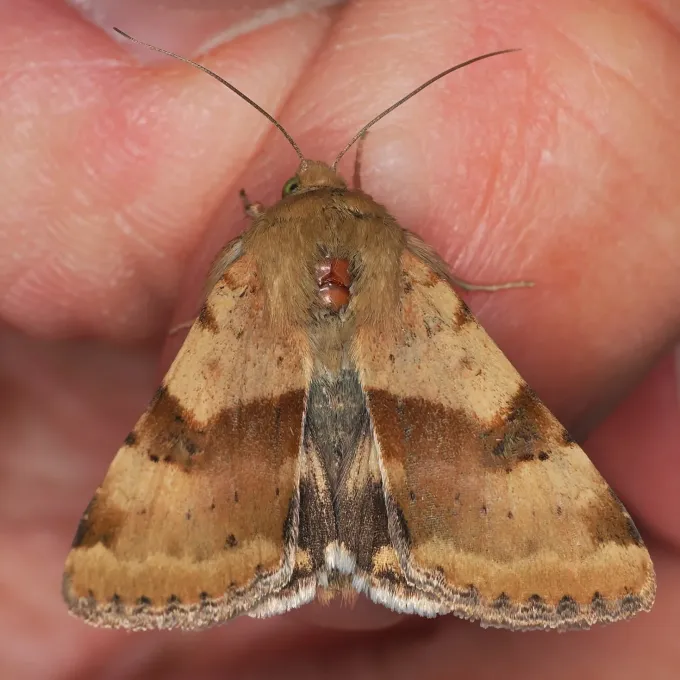
The adult moth has a wingspan of 30–40 mm. Its forewings vary in color from light yellowish-grey to reddish-brown, often featuring a distinct dark kidney-shaped spot. Adults are nocturnal, which makes them difficult to observe during the day without specific monitoring tools.
Larvae (caterpillars) go through five to six growth stages (instars). They are highly variable in color, ranging from pale green to yellow, brown, or even black. A key identification feature is the presence of three dark longitudinal stripes along the back and a body covered with fine hairs.
The pupal stage occurs in the soil at a depth of 3 to 10 cm. The pupa is brown, smooth, and measures about 20 mm in length. This is the stage in which the insect enters diapause to survive unfavorable cold weather conditions during winter.
The life cycle duration is highly dependent on temperature. In warm climates, the entire cycle from egg to adult can take as little as 30 days. This allows for several overlapping generations throughout the growing season, leading to persistent pest pressure.
What it damages
The cotton bollworm infests over 100 plant species, causing massive damage to economically vital crops such as cotton, tomatoes, maize, sunflowers, legumes, and various tobacco varieties. The primary damage is caused by the larvae feeding on reproductive organs.
Young larvae initially feed on leaves and terminals, but as they grow, they move to flower buds, flowers, and fruit. By boring into these organs, they destroy the plant's yield potential directly. A single larva can damage numerous buds or bolls during its development.
In maize, larvae tunnel into the ears, consuming grains. This physical damage is exacerbated by the introduction of fungal pathogens and mold, which significantly degrade the quality of the harvested produce and may produce harmful mycotoxins.
On tomato plants, larvae penetrate the fruit, creating deep exit holes. This not only makes the fruit unmarketable but also exposes the inner pulp to secondary bacterial and fungal infections, leading to rapid rotting of the fruit on the vine.
The economic impact is often severe because the larvae are hidden inside the fruit or buds, making them difficult to target with insecticides once they have bored into the plant tissue. This necessitates precise timing of control measures.
When it appears
Adult moths of the first generation emerge in the spring when temperatures consistently reach 18–20 degrees Celsius. They are highly migratory and can be carried by wind over long distances to infest new fields.
Peak infestation usually coincides with the flowering and fruiting stages of the host plants. Because generations often overlap, it is common to find eggs, various larval instars, and pupae simultaneously in the same field during the summer months.
The intensity of the pest population typically increases during the mid-to-late summer period. High temperatures accelerate the development rate, leading to explosive increases in caterpillar density if not managed during the initial egg-laying phase.
As autumn approaches and temperatures drop, the larvae prepare for pupation in the soil. They enter a state of diapause, which allows them to withstand winter conditions until the following spring, when the cycle starts anew.
Regular field scouting and monitoring are essential to identify the start of the moth flight. Since migration is a key factor in their survival, monitoring should be coordinated at a regional level to warn producers of incoming moth waves.
Signs of infestation
Early signs of infestation include small, ragged holes in the leaves and the presence of frass (larval excrement) near the entry points of flower buds or fruit. These are often the first visible indicators of larval activity.
Flower buds that yellow and drop prematurely are a strong indicator of bollworm activity. When such buds are opened, a small larva can often be found inside, having already damaged the internal tissues of the bloom.
The use of pheromone traps is the standard practice for identifying the arrival of moths. A spike in trap counts serves as a critical warning to begin field inspections for eggs, which are usually deposited singly on terminal leaves or flower parts.
On maize, the appearance of damaged silks and chewed kernels at the ear tips is a clear symptom. On sunflower heads, dark, decaying areas indicate that larvae have successfully penetrated the bracts to reach the seeds.
Plants may show stunted growth or localized wilting if the larvae have damaged the main stem or terminal bud. Checking for the presence of larvae at the base of the plant or in the soil around the stem can also yield results during heavy infestations.
Control measures
Effective management relies on an Integrated Pest Management (IPM) approach. Cultural practices like deep plowing after harvest expose pupae to predators and environmental stress, significantly reducing the overwintering population.
Weed control is essential, as many common weeds serve as early-season hosts for the first generation of moths. Eliminating these reservoirs helps limit the initial population density before they migrate to primary crops.
Biological control, such as the release of *Trichogramma* wasps, can be highly effective when applied during the egg-laying stage. These parasitoids destroy the eggs, preventing the larvae from ever causing damage to the plants.
Chemical control must be applied at the right time—specifically when young larvae are active on the surface and before they penetrate the fruit. Rotating insecticide classes is vital to manage the development of resistance within the population.
- Deep autumn plowing to eliminate overwintering pupae.
- Strict control of weeds within and around field borders.
- Use of pheromone traps for early population detection.
- Biological control through parasitoid wasp release.
- Targeted insecticide applications timed with egg-hatch.
Taxonomy
- Latin name
- Heliothis
- Order
- Lepidoptera (butterflies)
- Family
- Noctuidae
- EPPO code
- HELISP
Discussion
No discussions yet — be the first.