
Native budworm
Helicoverpa punctigera
Description
How to identify
The native budworm (Helicoverpa punctigera) belongs to the order Lepidoptera, family Noctuidae. It is a highly significant endemic pest in Australia, known for its impact on broadacre crops.
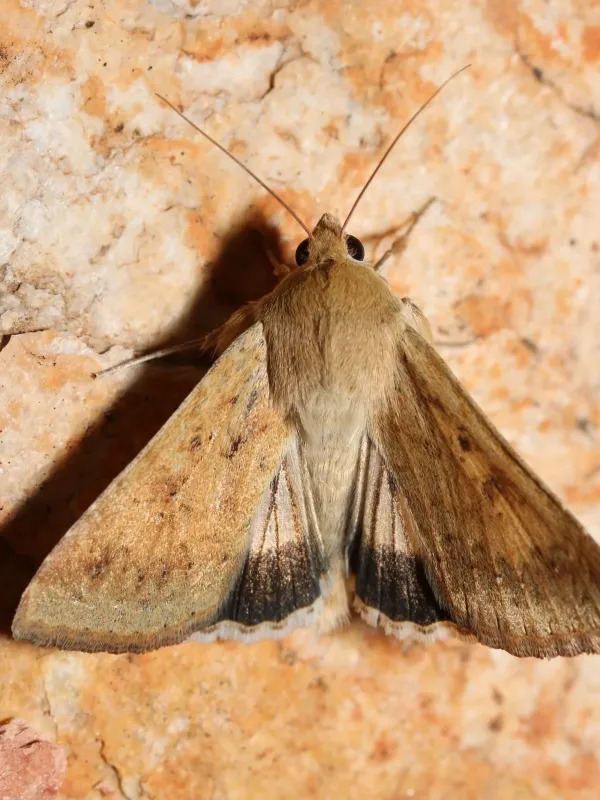
Adults are nocturnal moths with a wingspan of approximately 40 mm. Forewings vary in color from light brown to olive, featuring a characteristic dark spot near the center.
Larvae undergo five to six instars, exhibiting significant color variations from green to brown or black, usually marked with longitudinal stripes and fine bristles.
Identifying this species in the field is difficult as it closely resembles the common bollworm (Helicoverpa armigera), often requiring specialized diagnostic tools for confirmation.
Eggs are dome-shaped with distinct ridges and are laid singly on the surfaces of young leaves or reproductive structures of host plants.
What it damages
The native budworm is highly polyphagous, attacking over 100 plant species, including cotton, grain legumes, tomatoes, sunflowers, and various pulse crops.
Larvae primarily feed on reproductive plant parts, such as flower buds, blooms, and fruit, leading to direct yield loss and reduced market quality of the harvest.
Early in the season, populations thrive on various weeds, which act as primary reservoirs before the larvae migrate to emerging commercial crops.
In cotton, feeding damage to fruiting bodies increases susceptibility to secondary infections, such as boll rot, further aggravating total crop yield reduction.
Feeding on grain crops involves consuming seeds within heads or cobs, which significantly decreases crop weight and destroys the economic value of the produce.
When it appears
Development of Helicoverpa punctigera is highly temperature-dependent, with optimal growth occurring at temperatures between 25 and 28 degrees Celsius.
These moths are known for their ability to migrate long distances on prevailing wind currents, often resulting in sudden, unpredictable outbreaks across agricultural regions.
Pupation occurs in the soil, and unlike some other species, they do not undergo deep diapause, allowing them to remain active if climatic conditions permit.
The life cycle from egg to adult takes approximately 3 to 5 weeks in favorable conditions, facilitating multiple overlapping generations during the growing season.
Active flight periods typically align with spring and summer, when host plants are in their most vulnerable reproductive stages.
Signs of infestation
The presence of larval frass (excrement) on leaves beneath feeding sites is one of the earliest indicators of an active infestation.
Visual evidence of entry holes in flower buds, pods, or fruits confirms that larvae are actively feeding inside the protective plant tissue.
Massive shedding of buds and blossoms, in the absence of obvious disease symptoms, is a classic sign of hidden damage by larval activity.
Careful inspection of the undersides of leaves can reveal individual eggs, which are small, pale, and exhibit a distinct ribbed texture.
- Holes or "shothole" damage on young leaves.
- Hollowed-out buds or damaged flower petals.
- Visible entry holes in developing seed pods.
Control measures
Effective management relies on intensive monitoring using pheromone traps to detect moth arrival and determine the timing of necessary interventions.
Insecticide applications are most effective against early-instar larvae, as they are easier to target before they bore into the fruit or buds.
Biological control strategies include the use of Bacillus thuringiensis sprays and the preservation of natural parasitoids that regulate larval numbers.
Cultural practices, such as weed management in surrounding areas, are essential to remove alternative food sources that support initial population build-up.
Strategic planting dates and crop rotation can help avoid peak migration periods, effectively minimizing the window of vulnerability for high-value crops.
Taxonomy
- Latin name
- Helicoverpa punctigera
- Order
- Lepidoptera (butterflies)
- Family
- Noctuidae
- EPPO code
- HELIPU
Discussion
No discussions yet — be the first.