
Spiral nematode
Helicotylenchus dihystera
Description
How to identify
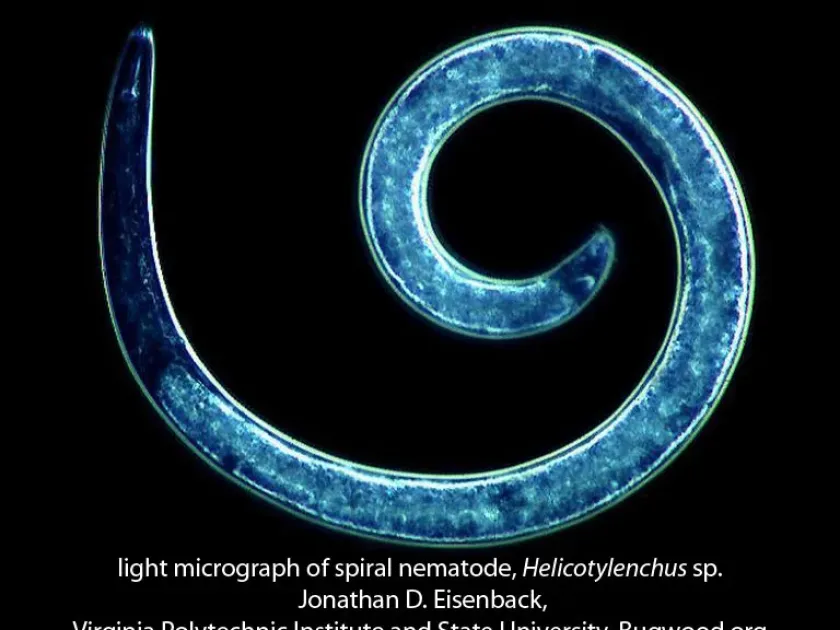
The spiral nematode (Helicotylenchus dihystera) belongs to the order Tylenchida, family Hoplolaimidae. It is named for its distinctive habit of coiling into a spiral shape when inactive or dead.
This microscopic worm typically measures between 0.5 and 0.8 mm in length. It possesses a well-developed stylet, which is a needle-like structure used to puncture root cells for feeding on plant cytoplasm.
Populations consist primarily of females, as the species reproduces mainly through parthenogenesis, allowing for rapid population growth under favorable environmental conditions.
These nematodes thrive in well-aerated, moist soils, with an optimal temperature range for development between +20°C and +30°C.
The life cycle consists of several larval stages that molt within the soil environment, with a generation time typically ranging from three to four weeks depending on soil temperature.
What it damages
The spiral nematode is a polyphagous ectoparasite, meaning it attacks a wide variety of plants including cereals, vegetables, legumes, and ornamental crops.
Common hosts include corn, soybeans, potatoes, tomatoes, and various fruit trees. These nematodes can also inhabit the roots of turfgrass and nursery stock.
By feeding on the outer layers of the root system, the nematode disrupts the plant's ability to absorb essential water and nutrients effectively.
Mechanical injuries caused by the stylet serve as entry points for secondary pathogens, such as fungi and bacteria, which can cause root rot and systemic illness.
High population densities can lead to significant yield reductions, stunted plant growth, and lower quality of agricultural produce in affected fields.
Signs of infestation
Symptoms of infestation are often non-specific, frequently appearing as general stunted growth, leaf chlorosis, and reduced vigor in affected plants.
Root systems may appear sparse and underdeveloped, with visible browning and necrotic lesions at the root tips where the nematodes have been feeding.
Plants often exhibit symptoms similar to drought stress or nutrient deficiencies, as the damaged root system struggles to support the nutritional needs of the plant.
In large-scale farming, infestation often manifests in patches, where groups of plants show significantly lower growth performance than the surrounding crop.
Accurate identification requires professional laboratory analysis, as visual signs can be confused with other soil-borne diseases or poor environmental conditions.
Control measures
Managing the spiral nematode requires an integrated pest management (IPM) approach to maintain population levels below the economic threshold of damage.
Crop rotation is one of the most effective cultural practices, as alternating with non-host crops helps to starve the nematode population in the field.
Maintaining soil health through organic amendments and effective weed control reduces alternative food sources and helps suppress nematode numbers.
Chemical control involving the application of nematicides is possible but should be used selectively due to potential environmental impacts and strict regulatory requirements.
- Prioritize the use of clean, pathogen-free planting material to prevent initial introduction.
- Implement cover crops with suppressive properties to reduce soil nematode density naturally.
- Conduct periodic soil sampling and analysis to determine the necessity of intervention.
Taxonomy
- Latin name
- Helicotylenchus dihystera
- Order
- Nematodes
- Family
- Hoplolaimidae
- EPPO code
- HELYDH
Discussion
No discussions yet — be the first.