
Silver Y moth
Hadena
Description
How to identify
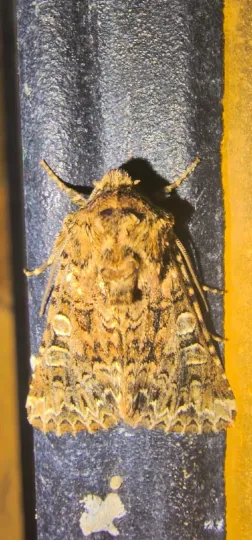
The Silver Y moth (Autographa gamma) is a member of the Noctuidae family. It is a migratory insect with a wingspan of up to 48 mm. The forewings display various shades of grey and brown, featuring a distinct metallic, silvery-white spot in the center that resembles the Greek letter 'gamma' (γ).
The larvae, or caterpillars, are smooth and primarily green, adorned with longitudinal light-colored stripes along the body. A key diagnostic feature is the presence of only three pairs of prolegs, causing them to move in a distinctive looping gait similar to inchworms.
Pupation occurs within a fragile white silken cocoon, typically spun on the underside of leaves or hidden among plant debris. The color of the pupa darkens from green to dark brown or black as the adult moth prepares to emerge.
Known for its migratory nature, the Silver Y moth travels vast distances across continents. This mobility makes it a sporadic but significant pest, as large numbers can suddenly arrive in agricultural fields from distant breeding grounds.
The life cycle consists of four distinct stages: egg, larva, pupa, and adult. Depending on the geographical region and climate, the moth can complete multiple generations per season, leading to overlapping life stages throughout the growing period.
What it damages
The Silver Y moth is a polyphagous pest, meaning it attacks a wide range of host plants, exceeding 300 species. Its primary targets include legumes, sugar beets, potatoes, sunflowers, and various leafy vegetables grown in open fields.
Early-instar larvae feed predominantly on the undersides of leaves, creating small, circular 'windows' by consuming the parenchyma while leaving the upper cuticle intact. At this stage, the damage is often subtle and easily overlooked.
Later-instar larvae consume entire leaf segments, skeletonizing the foliage until only the major veins remain. In high-density populations, this massive defoliation drastically reduces the plant's photosynthetic capacity, stunting development.
Besides foliage, these caterpillars may feed on reproductive organs, including buds, flowers, and young fruits. This feeding habit is particularly destructive for pulse and vegetable crops, as it can lead to complete yield loss through the destruction of fruit sets.
Furthermore, larval feeding creates wounds that serve as entry points for secondary pathogens, including various bacteria and fungi, which can cause soft rot in root crops like sugar beets or further weaken the host plant.
When it appears
Adult migration usually begins in late spring when temperatures consistently remain above 10-12 degrees Celsius. The moths are active during both day and night, frequently seen feeding on nectar from flowering plants.
The period of most intense larval activity occurs from June through August. Because generations overlap significantly, it is common to find larvae of various developmental stages present on the same crop simultaneously.
The most critical time for crop protection coincides with the flowering and fruit-setting stages. During these physiological phases, any significant loss of photosynthetic leaf area directly translates into reduced seed filling and lower overall productivity.
By autumn, moths of the final generation typically migrate to warmer latitudes, although some pupae may remain in the soil in temperate zones. Their ability to overwinter as pupae or late-stage larvae adds to the complexity of managing their population.
Field monitoring using pheromone traps is standard practice for agricultural professionals. These traps help detect the initial influx of migrating moths and provide data to forecast potential pressure, allowing for proactive intervention.
Signs of infestation
The first indicator of a Silver Y infestation is the observation of adult moths flitting around the field. A thorough inspection of the crop, especially the lower foliage, should be initiated immediately upon sighting adults.
- Presence of 'window-like' feeding marks on leaves where the tissue has been removed.
- Small dark pellets of frass (excrement) scattered on leaves or at the base of the plant.
- Skeletonized leaf surfaces showing a net-like appearance of veins.
- Leaves tied together with silk, concealing caterpillars within the folded tissue.
- Reduced plant vigor and visible yellowing of damaged leaves during peak growth.
Scouting should ideally take place in the early morning or late evening when the caterpillars are most actively feeding. During the heat of the day, larvae are often elusive, resting near the soil or in the dense canopy.
Prompt identification is essential, as the growth and appetite of the caterpillars increase exponentially with each instar. Identifying and treating the infestation while the larvae are young is key to minimizing crop injury.
Control measures
Effective agrotechnical control includes deep autumn plowing to bury pupae and crop residues, which disrupts the life cycle and prevents the successful emergence of moths in the following spring.
Rigorous weed control is a cornerstone of management, as weeds often serve as essential hosts for the early generations of the moth. Maintaining clean fields minimizes the attractiveness of the area to egg-laying females.
Chemical control involves the application of authorized insecticides. To be effective, spraying should target young larvae and must be timed correctly. Rotating between different chemical classes is vital to prevent the development of insecticide resistance.
Biological control methods, such as the release of *Trichogramma* parasitic wasps, are highly effective during the egg-laying stage. This practice helps suppress population numbers naturally without relying heavily on broad-spectrum chemicals.
Integrated Pest Management (IPM) strategies emphasize constant monitoring. By applying thresholds based on actual scouting data rather than calendar-based spraying, farmers can protect their crops while preserving beneficial insects and the environment.
Taxonomy
- Latin name
- Hadena
- Order
- Lepidoptera (butterflies)
- Family
- Noctuidae
- EPPO code
- HADNSP
Discussion
No discussions yet — be the first.