
Gyropsylla spegazziniana
Gyropsylla spegazziniana
Description
How to identify
Gyropsylla spegazziniana is a species of insect belonging to the family Psyllidae, order Hemiptera. These small jumping insects are known for their high degree of host specificity, primarily targeting specific trees within their native range.
Adult specimens are characterized by their specialized morphology, allowing them to remain hidden among the leaves of their host plants. Their life cycle involves several nymphal stages that exhibit distinct physiological traits.
The insects possess a piercing-sucking mouthpart, which is essential for extracting nutrients from the vascular system of the host plants. This feeding mechanism is central to their biological survival strategy.
Psyllids in this genus are highly sensitive to environmental fluctuations, which directly influences their population dynamics and annual distribution patterns across agricultural zones.
Identifying this species requires microscopic examination of the morphological structures, as they can often be confused with other related psyllid species present in the same geographical area.
What it damages
The primary economic impact of G. spegazziniana is its infestation of Ilex paraguariensis, the plant used to produce the popular beverage known as Yerba Mate. The feeding activity causes significant physiological stress to the crop.
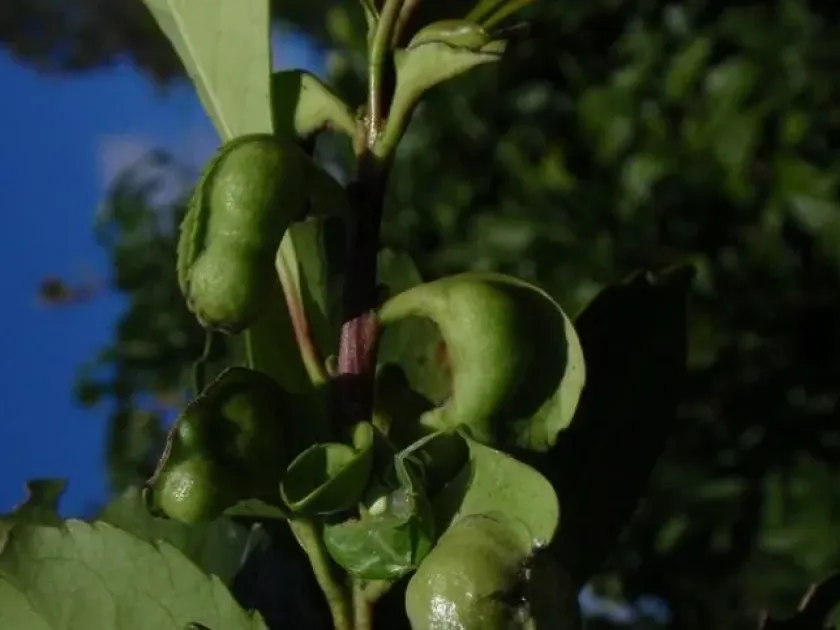
Both nymphs and adults cause damage by extracting plant fluids. This process leads to the formation of galls, which are abnormal growths on the leaf surface that divert energy away from vegetative growth.
The economic consequence for producers is a reduction in leaf yield and quality, as the infested foliage becomes unsuitable for processing. This directly affects the profitability of mate plantations.
Severe infestations can lead to leaf curling, premature senescence, and overall weakening of the trees, making them susceptible to secondary pathogenic infections.
Continuous damage over multiple growing seasons can result in the thinning of the canopy and long-term decline in the productivity of the entire plantation.
When it appears
The seasonal activity of this pest is closely correlated with the flushing periods of the host plant. Peak infestation usually occurs during the spring and early summer when new growth is most abundant.
Temperature and humidity levels play a critical role in determining the speed of development of each generation. Warmer climates may support more frequent reproductive cycles throughout the year.
During the dormant winter season, the population numbers typically decline, with the insect surviving in protected areas of the tree or in leaf litter near the host plant.
Monitoring efforts should be intensified during the transition periods between seasons, as this is when the overwintering population initiates new colonization.
Understanding the synchronization between the host plant’s growth cycle and the pest’s life cycle is essential for predictive modeling in pest management.
Signs of infestation
The most diagnostic sign of an infestation is the presence of characteristic galls on the leaves. These structures vary in size and color, often appearing as localized swelling or deformation of the leaf tissue.
Visible curling and chlorosis of the young leaves are indicators of the physiological strain caused by the insects. As the infestation progresses, these leaves may eventually turn brown and fall off.
Nymphal stages can often be found protected inside these gall formations, which provide a microenvironment safe from many external natural enemies and contact insecticides.
Sooty mold may develop on the leaf surface as a secondary consequence, growing on the honeydew-like substances excreted by the nymphs during their feeding process.
Regular inspection of the apical buds and new leaf flushes is the most effective way to detect the early stages of a developing pest problem.
Control measures
Integrated Pest Management (IPM) is the recommended approach for managing G. spegazziniana, incorporating both cultural and chemical control strategies.
Cultural practices such as sanitation pruning, which involves the removal and destruction of heavily infested leaves and shoots, can significantly reduce the pest population density.
Chemical control should rely on the application of systemic insecticides that are capable of reaching the nymphs protected inside the gall structures.
Biological control, using natural parasitoids or predatory insects, should be encouraged by maintaining high biodiversity within and around the Yerba Mate plantations.
Strategic timing of interventions, based on population monitoring with pheromone or sticky traps, is crucial for maximizing the effectiveness of any pest management program.
Discussion
No discussions yet — be the first.