
Gyrodactylus salaris
Gyrodactylus salaris
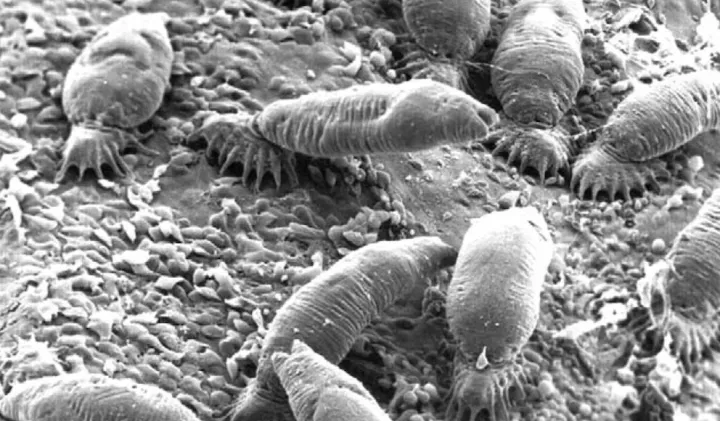
Description
How to identify
Gyrodactylus salaris is a microscopic monogenean ectoparasite that primarily infects the skin and fins of salmonid fish species.
The parasite is equipped with a sophisticated attachment organ known as an opisthaptor, featuring large median hooks and smaller marginal hooks, allowing it to grip the host firmly.
It is characterized by a high reproductive rate due to viviparity (giving birth to live young). A unique feature is the presence of several developing embryos within the parent, allowing rapid population expansion.
The parasite does not require an intermediate host; it completes its entire life cycle on the fish host, which allows for very rapid transmission within crowded populations.
Under favorable water temperatures between 10 and 15 degrees Celsius, the parasite population can multiply exponentially in a matter of days.
What it damages
The primary host for this parasite is the Atlantic salmon, but it also affects rainbow trout, Arctic char, and other salmonid species.
The damage is caused by the parasite feeding on the fish's mucus and epithelial cells. This results in significant erosion and lesions on the skin and fins.
These lesions compromise the fish's osmotic regulation, making them highly susceptible to secondary bacterial and fungal infections, particularly Saprolegnia.
In wild populations, high levels of infestation often result in significant mortality among juvenile salmon, leading to the collapse of local wild stocks.
For fish farms, an outbreak of Gyrodactylus salaris can cause catastrophic economic losses, potentially leading to the total loss of fish stocks if not managed immediately.
Signs of infestation
Clinical signs of infection include a greyish-white coating on the skin and fins, which is caused by the excessive mucus secretion in response to the parasite.
Fin degradation is a common diagnostic indicator, where the fins appear frayed or ragged due to the mechanical feeding activity of the parasite.
Infected fish often display lethargy and abnormal swimming behavior, such as rubbing against substrates in an attempt to dislodge the parasites.
Microscopic examination of skin scrapings reveals high densities of moving parasites that exhibit characteristic wavy, muscular contractions.
As the infection progresses, severe inflammation of the skin is often observed, which may be complicated by secondary fungal growths forming cotton-like patches.
Control measures
The most effective strategy for managing Gyrodactylus salaris is strict biosecurity and prohibiting the movement of live fish from infected to uninfected water systems.
In aquaculture environments, therapeutic treatments using saltwater baths are highly effective in killing the parasite while the fish are kept under controlled conditions.
Chemical treatments, including specific formulations of formalin or organic acids, are employed in hatchery and farm settings to eradicate the parasite from systems.
In extreme cases involving natural river systems, chemical treatment of the entire river may be necessary to eliminate the parasite, followed by restocking with disease-free fish.
Routine health monitoring and mandatory quarantine periods for all new arrivals are essential protocols for preventing the introduction of this pest into salmonid facilities.
Taxonomy
- Latin name
- Gyrodactylus salaris
- Family
- Gyrodactylidae
- EPPO code
- GYRCSA
Discussion
No discussions yet — be the first.