
New Zealand grass moth
Graphania mutans
Description
How to identify
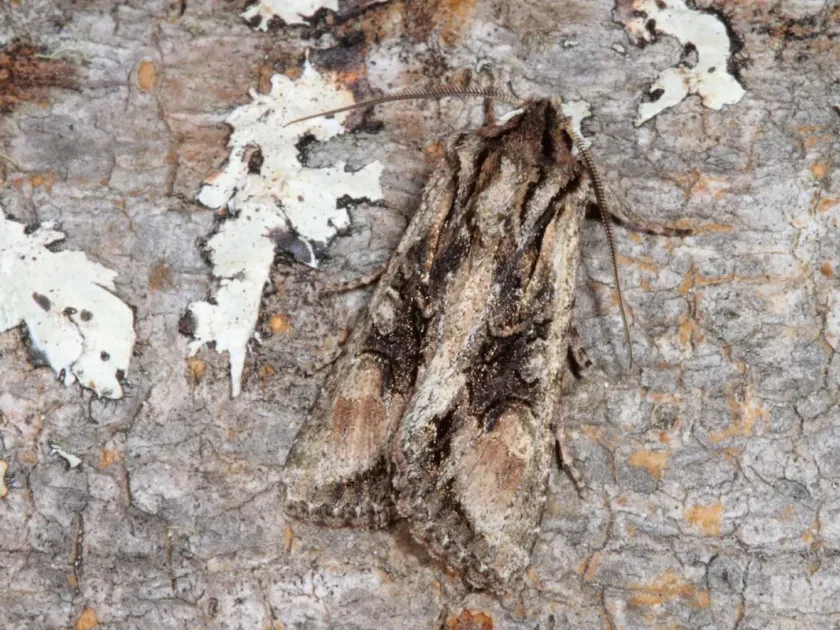
The New Zealand grass moth (Graphania mutans) belongs to the Noctuidae family within the order Lepidoptera. It is a nocturnal insect with a wingspan ranging from 35 to 40 mm, featuring cryptic greyish-brown patterns that help it blend into vegetation.
The adult moth possesses a robust, hairy body typical of many owlet moths. The forewings display intricate markings consisting of various lines and spots, providing effective camouflage against bark and plant stems.
Larvae undergo several developmental stages (instars), transitioning through color variations from light green to brown or grey. Their longitudinal stripes are a key identification feature that aids in hiding on host plants.
Eggs are typically laid in groups on the undersides of leaves or within plant axils, which enhances the survival rate of the emerging larvae. Pupation usually occurs in the soil or within dense leaf litter for protection.
As an endemic species of New Zealand, this moth has evolved to be highly adaptable, successfully colonizing agricultural fields, pastures, and home gardens alike.
What it damages
This pest is a polyphagous insect, meaning it can feed on a wide variety of agricultural and decorative plants, making it a significant concern for growers.
Cereal crops, including wheat, barley, and oats, are frequently attacked by the larvae, which consume both the leaf tissues and the developing grain heads.
In vegetable gardens, the moth poses a threat to solanaceous and brassica crops, where larvae graze on leaf surfaces, sometimes skeletonizing the foliage entirely.
In addition to cultivated crops, Graphania mutans feeds on various wild grasses and weeds, allowing the population to persist throughout the entire growing season.
During outbreaks, these larvae can cause extensive damage to green cover, potentially destroying significant portions of a crop in a matter of nights due to their voracious appetite.
When it appears
The life cycle of the New Zealand grass moth is closely linked to the local climate. Adult flight activity generally begins in late spring as temperatures rise steadily.
Peak activity occurs during the warmer summer months, facilitating the development of several successive generations within a single season.
Larvae are primarily nocturnal feeders, emerging from their hiding spots in the soil or at the base of plants during the night to feed on aerial parts of the host.
During winter, the insect typically enters diapause as a pupa or a late-stage larva, sheltering deep within the soil or under debris to survive colder temperatures.
Agro-consultants monitor adult populations using light traps to predict potential infestation spikes and schedule necessary intervention measures.
Signs of infestation
The first signs of infestation include small "windows" or holes in the leaves caused by the early-instar larvae grazing on the upper layer of the foliage.
As the larvae mature, feeding damage becomes more severe, characterized by irregular edges on leaves and complete consumption of leaf tissue, often leaving only the midribs.
The presence of larval excrement (frass) on leaves or on the soil surface below the host plant is a reliable indicator of active larval feeding nearby.
Wilting of individual stems or branches may indicate that larvae are feeding on the plant's crown or near the soil line, causing structural damage.
Nighttime observation with a flashlight often reveals the larvae actively feeding on the top portions of the plants, confirming their current activity levels.
Control measures
Managing the New Zealand grass moth requires an integrated pest management (IPM) approach that combines cultural, biological, and chemical strategies.
Cultural control is centered on deep soil cultivation, which disrupts the pupation site and exposes the pupae to natural predators and environmental stressors.
Biological control involves the use of entomopathogenic fungi or bacterial agents that target the larvae, providing a sustainable option for organic or low-input farming.
Chemical control is applied when the pest population exceeds the economic threshold, using registered insecticides effective against lepidopteran larvae.
- Regular mowing of field margins to reduce weed host reservoirs.
- Deployment of light traps to reduce adult moth populations.
- Use of pheromone lures to monitor and potentially disrupt mating.
- Application of biological insecticides upon detecting early larval stages.
- Implementing crop rotation to break the moth's reproductive cycle.
Taxonomy
- Latin name
- Graphania mutans
- Order
- Lepidoptera (butterflies)
- Family
- Noctuidae
- EPPO code
- GRAFMU
Discussion
No discussions yet — be the first.