
Frosted Orange moth
Gortyna flavago
Description
How to identify
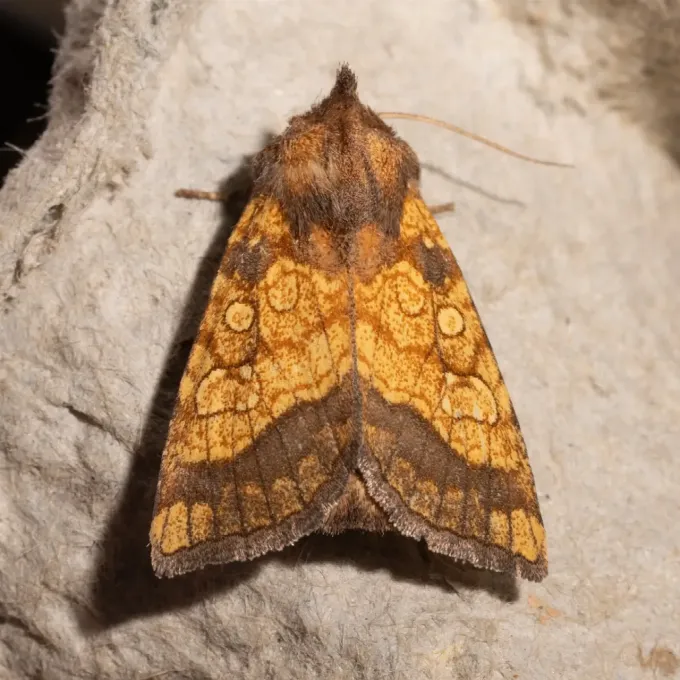
The Frosted Orange moth (Gortyna flavago) is a species of moth in the family Noctuidae. The adult moth is characterized by its vibrant orange-yellow forewings with distinctive dark markings and lines.
The larvae are stem borers that reach a length of up to 50 mm. They have a yellowish-grey body, a brown head, and dark dorsal plates on each segment, which are typical features for this species.
This species is univoltine, meaning it produces only one generation per year. The eggs are the overwintering stage, usually laid on the stems of host plants, remaining dormant throughout the winter season.
Larval development typically occurs during the spring and summer months. Upon hatching, the larvae quickly bore into the stems of host plants to feed, staying protected from predators and environmental factors.
Pupation takes place inside the larval tunnels or within the soil, depending on the host plant species. The adult moths emerge in late summer to early autumn to complete the lifecycle.
What it damages
The Frosted Orange moth is a polyphagous pest that targets a wide variety of plants. Common hosts include potato, tomato, artichoke, and various ornamental plants such as dahlias and irises.
Weed species like thistle, burdock, and couch grass act as natural reservoirs for the pest. When crops are planted near these weeds, the larvae often migrate to the cultivated plants.
The primary damage is caused by the larvae feeding inside the stems, where they consume the pith. This boring activity destroys the plant's vascular tissue, preventing nutrient and water uptake.
The stems of infested plants often wither, become deformed, and eventually snap under their own weight or wind pressure, leading to a complete loss of the affected stem and its produce.
In addition to direct damage, the entrance and exit holes created by the larvae serve as entry points for bacterial and fungal pathogens, often leading to secondary rot and plant death.
Signs of infestation
A classic sign of infestation is sudden wilting of the top shoots or leaves, which does not recover after irrigation. This indicates that the stem's vascular system has been compromised.
Growers should look for small entry holes on the stems, often surrounded by "frass" (larval excrement), which appears as a pile of brown, granular debris near the hole or on the ground.
Stem distortion is another key indicator. Infested stems may show localized swelling or thinning, and they often become brittle at the point where the larva has been feeding.
If the stem is opened, an internal tunnel will be visible, filled with frass and decaying plant matter. The larva itself can often be found inside the lower part of the tunnel.
Discoloration of the foliage, ranging from chlorosis to premature yellowing, is a common reaction of the plant to the systemic stress caused by the internal boring activity of the moth larvae.
Control measures
Effective management begins with strict weed control. Removing host weeds like thistle and burdock from the perimeter of crop fields significantly reduces the pest population.
Deep autumn ploughing is a recommended cultural practice to destroy pupae overwintering in the soil and to expose them to natural predators and freezing temperatures.
Early detection and immediate destruction of infested plants are crucial. Removing and burning the plants containing larvae prevents them from maturing and starting the next cycle.
Chemical control must be timed precisely. Systemic insecticides are most effective when applied just as the larvae hatch, before they penetrate deep into the host plant stems.
Integrated Pest Management (IPM) should prioritize preventive measures and monitoring rather than relying solely on chemical sprays, which have limited effectiveness once the larva is inside the stem.
Taxonomy
- Latin name
- Gortyna flavago
- Order
- Lepidoptera (butterflies)
- Family
- Noctuidae
- EPPO code
- GORTFL
Discussion
No discussions yet — be the first.