
Fennel Moth
Gortyna borelii
Description
How to identify
The Fennel Moth (Gortyna borelii) is a moth of the Noctuidae family. It is a specialized pest that is of significant concern to producers of bulbous crops in its distribution range across Europe.
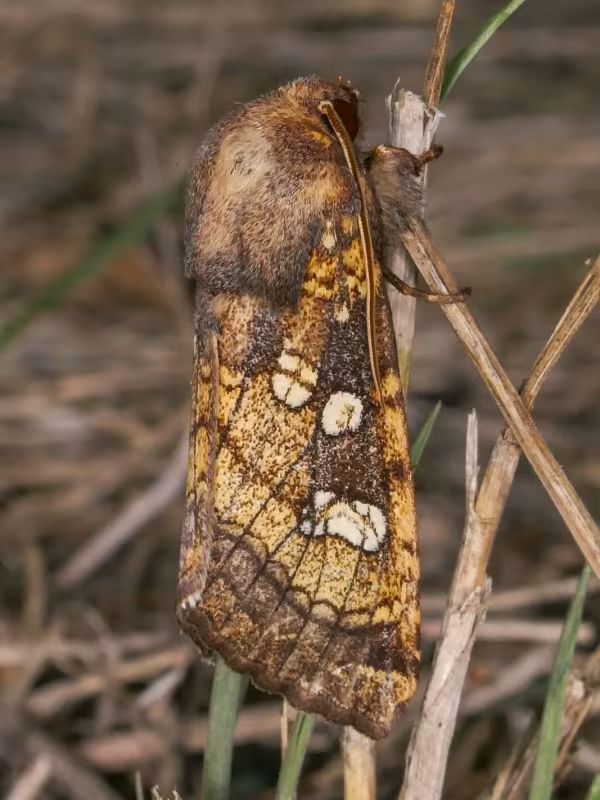
Adult moths have a wingspan of approximately 40–50 mm. Their forewings are typically ochre-yellow to light brown, featuring subtle cross-lines and markings that provide excellent camouflage against dried vegetation.
The larvae are stout caterpillars, often reaching lengths of up to 50 mm. They exhibit a pale, greyish-white, or pinkish coloration, sometimes with darker spots and small bristles across their segments.
This species is univoltine, meaning it completes only one generation per year. The eggs serve as the overwintering stage, protected by the foliage or plant debris left in the field.
As a nocturnal insect, the moth spends its days resting in dense vegetation. Its flight activity is restricted to late summer and early autumn evenings, making direct observation challenging.
What it damages
The primary host plants for Gortyna borelii are various species of the Allium genus, including onions and related bulbous crops. The larvae act as borers, feeding hidden within the host tissues.
Upon hatching, the young larvae tunnel into the leaves or stems. This boring action initially causes the foliage to wither and lose its structural integrity, significantly slowing plant development.
As the larvae mature, they move downwards into the bulb. Feeding inside the bulb destroys the storage tissue, leading to structural collapse and the death of the plant during the growing season.
Secondary infections are a common consequence of this damage. Fungi and bacteria enter the feeding tunnels, causing the bulbs to rot, which results in catastrophic losses during harvest and storage.
The economic threshold is quite low due to the potential for total crop destruction in specific patches, requiring aggressive management strategies if the pest is identified.
When it appears
Adult moth emergence typically occurs between August and September. This is the period when mating occurs and females begin selecting sites for oviposition.
Eggs are deposited near the base of the host plants, where they remain throughout the winter. Larval development begins in the following spring as temperatures rise.
The active feeding phase of the larvae occurs during the late spring and early summer months, which coincides with the rapid growth and bulb initiation stages of onions.
Pupation takes place within the soil, usually near the base of the host plant. The pupal stage lasts several weeks before the emergence of the next generation of adults.
Agricultural monitoring should be intensive during the spring hatch period, as early intervention is essential to prevent the larvae from entering the bulb tissues.
Signs of infestation
The most early-stage sign of infestation is the yellowing and drooping of the central leaves, which may appear drought-stressed despite adequate soil moisture levels.
Closer examination of the plant base often reveals entry holes created by the larvae. The presence of larval frass (excrement) around the base of the plant is a definitive diagnostic feature.
- Stunted or deformed foliage growth.
- Small boreholes at the neck or base of the plant.
- Soft, rotting tissues inside the bulb.
- An unpleasant odor caused by internal bulb decay.
- Plants that detach easily when pulled due to destroyed roots or base.
Infested patches often show clear symptoms of localized decline, where multiple plants in the same area exhibit identical wilting patterns due to the larval feeding habits.
Control measures
A rigorous crop rotation schedule is the most effective cultural control method. Avoiding the cultivation of bulb crops in the same field for at least 3-4 years breaks the pest's life cycle.
Deep autumn plowing is a critical agricultural practice that exposes pupae and eggs to environmental stressors, effectively reducing the overwintering population density.
Chemical control focuses on the use of systemic insecticides during the early larval stage. Timing is critical, as once the larvae bore into the bulb, chemical control becomes much less effective.
Sanitation practices, including the removal of volunteer plants and host weeds in the surrounding area, are necessary to prevent the buildup of the moth population.
Integrated Pest Management (IPM) programs should incorporate pheromone traps to monitor adult flight patterns, ensuring that protective measures are applied only when necessary.
Taxonomy
- Latin name
- Gortyna borelii
- Order
- Lepidoptera (butterflies)
- Family
- Noctuidae
- EPPO code
- GORTBL
Discussion
No discussions yet — be the first.