
Senegal bushbaby
Galago senegalensis
Description
How to identify
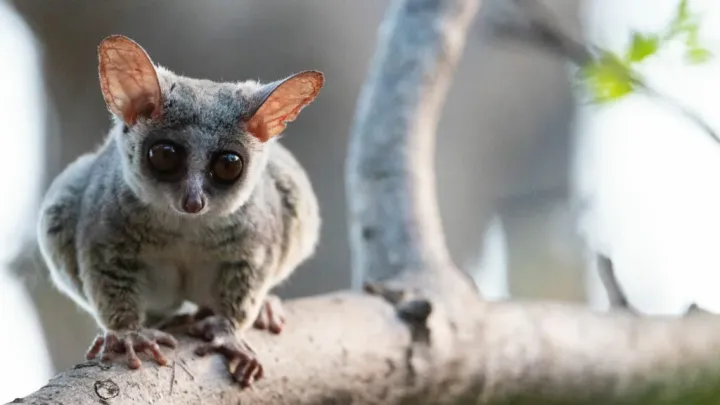
The Senegal bushbaby (Galago senegalensis) is a small nocturnal primate belonging to the Galagidae family. It is characterized by large eyes adapted for night vision and strong hind limbs for jumping.
These animals have dense, grayish-brown fur, a long bushy tail, and highly mobile ears. An adult rarely exceeds 300 grams, allowing them to navigate easily through thin tree branches.
In agricultural settings, they prefer to nest near orchards, using trees as both cover and a primary food source. Their nocturnal habits make them difficult to spot during daylight hours.
Their biology is closely tied to arboreal habitats where they build nests in tree hollows or dense foliage. Their ability to leap distances of up to 2-3 meters makes them elusive targets for most terrestrial predators.
With a reproduction cycle occurring twice a year, populations can grow rapidly under favorable conditions, increasing their impact on nearby agricultural lands.
What it damages
The primary damage occurs during the ripening period of fruits. While bushbabies are omnivorous, they are known to favor sweet fruits, berries, and tender shoots, causing significant economic loss.
They pose a particular threat to tropical and subtropical plantations, including mango, papaya, and guava trees, where they consume or spoil substantial portions of the harvest.
Beyond direct consumption, they frequently bite into fruits, leaving them vulnerable to fungal infections and rot while still on the tree, which ruins the fruit's marketability.
They also damage tree bark to stimulate the flow of sap, which they feed upon. This activity creates open wounds on the tree, weakening its defense system and inviting secondary infections.
In many regions, they are classified as serious pests because their agile movement and nocturnal activity render conventional pest control measures ineffective.
Signs of infestation
The primary sign of infestation is the presence of characteristic bite marks on fruits situated in the upper canopy. These tooth marks are distinctively small but deep.
Traces of claw marks and fresh sap leaks on tree trunks indicate intentional damage aimed at harvesting tree sap. Premature fruit drop is also commonly observed around the tree base.
At night, their presence is often signaled by specific vocalizations, ranging from sharp chirps to sounds resembling a crying baby, as they move between branches.
Droppings found in the vicinity of the orchard often contain seeds or fibers from the fruits they have consumed, serving as a reliable indicator of their activity.
A decline in harvest quantity without signs of insect activity often suggests the presence of nocturnal mammals feeding in the canopy.
Control measures
The most effective strategy involves the use of mechanical barriers, such as installing metal baffles or collars on tree trunks to prevent the primates from climbing into the canopy.
Deterrent technology, including ultrasonic repellers and motion-activated lights, can disrupt their nocturnal activity and encourage them to move away from protected areas.
Using protective netting over individual trees or rows is a highly effective way to exclude bushbabies from crops, especially during the peak ripening season.
Cultural practices are essential: regular pruning of overhanging branches that allow the animals to leap from nearby trees or structures onto the crop is a critical preventive step.
In certain scenarios, reducing nesting opportunities by removing old, hollow trees and restricting access to artificial water sources at night can decrease the local population pressure.
Taxonomy
- Latin name
- Galago senegalensis
- Family
- Galagidae
- EPPO code
- GALGSE
Discussion
No discussions yet — be the first.