
Cutworm (Euxoa subalba)
Euxoa subalba
Description
How to identify
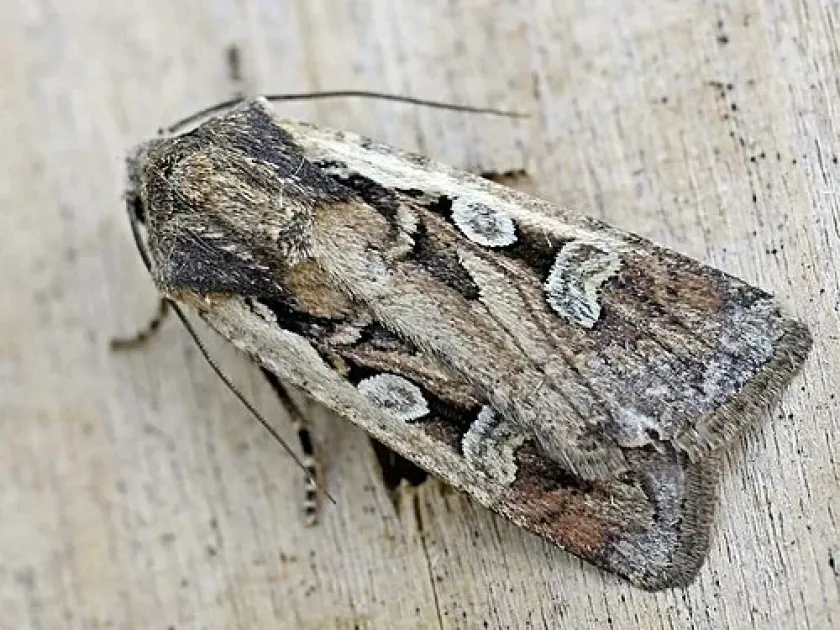
The cutworm (Euxoa subalba) belongs to the Noctuidae family, within the order Lepidoptera. Adults are moths with a wingspan of approximately 40 mm, exhibiting a grey to brownish pattern that provides camouflage in the natural environment.
The larvae, known as cutworms, have a thick, fleshy body that is usually earth-grey or brownish in color. They are characterized by a well-developed head capsule, which allows them to cut through firm plant tissues effectively.
These pests are primarily nocturnal, hiding in the topsoil or under plant debris during the day. This behavioral trait makes early detection difficult without targeted field scouting.
The pupal stage occurs within the soil, typically inside an earthen cell constructed by the larva. They pupate at a depth of 3 to 10 cm, which protects them from predators and environmental fluctuations.
The species is commonly found in steppe and forest-steppe zones, where population density can surge during favorable climatic conditions, posing a significant risk to young crops.
What it damages
As a polyphagous insect, Euxoa subalba attacks a wide range of agricultural crops. Cereal crops, including winter wheat, rye, and barley, are particularly vulnerable during their seedling phase.
Row crops such as maize, sunflowers, and sugar beets also suffer significant losses. The larvae feed by severing the stems of young plants at or just below the soil surface, leading to rapid plant death.
Vegetable crops, including cabbage, carrots, and tomatoes, are frequently damaged. High soil moisture levels can stimulate the larvae to feed more aggressively, leading to widespread destruction in vegetable fields.
The damage often appears as patches of wilted plants throughout the field. Because the larvae consume the base of the stem, the transport of nutrients to the upper parts of the plant is completely disrupted.
Economic damage is most severe when early-stage larvae infest crops shortly after germination, as the small plants are unable to recover from the physical damage to their stems.
When it appears
Adult moths typically emerge in early summer, spanning from June to August. Females lay eggs on weeds or in moist soil rich in organic matter, which serves as an initial food source for the hatching larvae.
Larvae development occurs in two main phases: one in the autumn for winter crops, and one in the spring. The species typically overwinters as late-instar larvae buried deep within the soil profile.
In the spring, as soil temperatures reach 10-12 degrees Celsius, the overwintered larvae migrate to the surface to resume feeding. This timing coincides with the germination of major agricultural crops.
Peak activity is usually observed in late spring and early summer. Monitoring adult moth flight using pheromone traps is essential for predicting subsequent larval infestation levels.
The lifecycle completes as larvae descend into the soil to pupate after an intense feeding period, remaining in the soil until the next generation of moths emerges in the following year.
Signs of infestation
The most prominent sign of an infestation is the sudden wilting and lodging of young plants. Inspection reveals that the stem has been neatly severed at the ground level.
Frass (larval excrement) in the form of small, dark pellets found near the base of the damaged plants is a clear indicator of cutworm presence. Digging around the base of the stem usually uncovers the curled-up larvae.
The presence of adult moths flying in the evening hours, particularly those attracted to light sources, signifies the beginning of the oviposition period and the potential for upcoming larval damage.
Damage patterns typically manifest as expanding gaps or patches in crop rows. As the larvae mature, they move from one plant to the next, increasing the size of the damaged area over several days.
Unlike other soil pests that feed on roots, Euxoa subalba leaves clear, ragged bite marks at the base of the stalk, which is a definitive diagnostic feature of cutworm activity.
Control measures
Cultural control practices are the first line of defense. Deep autumn plowing is highly effective, as it exposes the overwintering larvae and pupae to birds and harsh weather conditions.
Weed management is critical. Removing weeds from fallow lands and field borders eliminates the primary habitat and food sources used by the moths for egg-laying and early larval feeding.
Chemical control should be applied during the evening when larvae emerge from the soil to feed. Contact insecticides are most effective when applied to the base of the plants and the surrounding soil.
Biological control, such as the use of entomopathogenic fungi or Bacillus thuringiensis, can be applied, provided that environmental conditions are optimal for the efficacy of these agents.
- Frequent field scouting to identify early signs of wilting in seedlings.
- Use of systemic seed treatments to provide early-season protection.
- Implementation of crop rotation to break the pest's lifecycle and reduce populations.
Taxonomy
- Latin name
- Euxoa subalba
- Order
- Lepidoptera (butterflies)
- Family
- Noctuidae
- EPPO code
- EUXOSU
Discussion
No discussions yet — be the first.