
Red-backed cutworm Euxoa ochrogaster
Euxoa ochrogaster
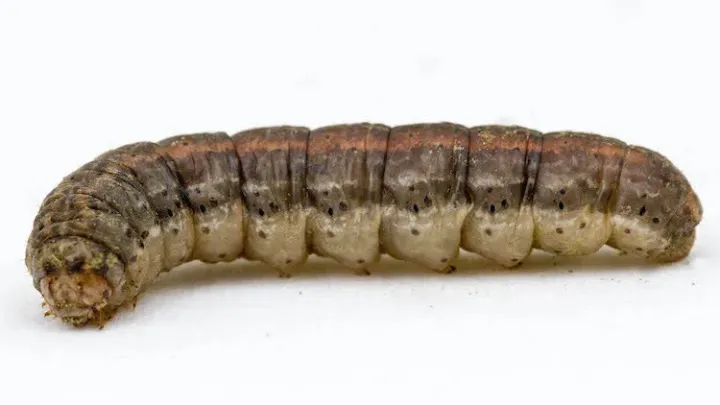
Description
How to identify
The red-backed cutworm Euxoa ochrogaster is a member of the Noctuidae family, widely recognized in North American agriculture as a destructive subterranean pest.
The adult moth has a wingspan of 30-40 mm, with forewings varying in color from reddish-brown to greyish-ochre, which provides camouflage against soil and stubble.
Larvae are the damaging life stage; they possess a distinct dull, greyish-brown body with two prominent reddish or orange stripes running along the dorsal side.
The head capsule of the larva is dark brown and robust, facilitating the cutting of plant tissues just below or at the soil line.
Pupation occurs within an earthen cell in the soil, where the insect remains protected until the adult moth emerges to begin the reproductive cycle.
What it damages
This species is highly polyphagous, attacking a wide variety of field crops, vegetables, and ornamentals during the early vegetative stages.
Commonly damaged crops include wheat, barley, corn, canola, and various garden vegetables that have tender stems easily severed by the larvae.
The larvae feed primarily at night, cutting through the stems of seedlings, which results in the plant wilting and eventually dying within a very short timeframe.
In addition to cutting stems, larvae may also feed on the foliage or roots of the plants, further weakening the crop and reducing the potential for recovery.
Heavy infestations can lead to substantial stand reduction in fields, often creating visible bare spots that significantly lower total yield potential.
When it appears
The red-backed cutworm typically completes one generation per year, with the insect overwintering primarily as eggs buried in the soil or as young larvae.
Larval activity begins in the spring as temperatures rise, with the most destructive feeding occurring during late May and throughout June when crops are small.
Adult moths are generally active during the mid-summer months, from July through August, seeking out host plants and loose soil to deposit their eggs.
The eggs remain dormant in the soil during the summer and autumn until conditions are right for the embryo to develop, often hatching the following spring.
Environmental conditions, particularly moisture levels in the soil, significantly influence the survival rate of the eggs and the subsequent intensity of larval activity.
Signs of infestation
Early identification is crucial; the first sign of Euxoa ochrogaster is the sudden appearance of wilted, fallen plants within otherwise healthy crop rows.
Close inspection of the base of the damaged plant reveals a clean, sharp cut, often accompanied by the absence of the plant's top portion, which may be dragged into the soil.
Searching the soil around the base of a freshly damaged plant, especially at dawn or dusk, usually reveals a curled-up larva hiding just below the surface.
Large, irregular gaps in rows or patchy crop stands are common signs that the larvae have migrated through the field, leaving a trail of destruction behind.
Plants affected by the larvae typically do not recover, as the primary vascular connection has been severed, leading to irreversible wilting and death.
Control measures
Effective management requires scouting fields for larval populations before they reach economic threshold levels, followed by timely interventions.
Tillage practices, such as fall cultivation, can help disrupt the life cycle by destroying eggs and exposing larvae to natural predators like birds and ground beetles.
Weed management is vital, as dense weed cover during the egg-laying period attracts adult moths and provides shelter for developing larvae.
When monitoring confirms high numbers, chemical control using labeled insecticides is necessary, ideally applied during late evening when larvae are actively feeding.
- Utilize pheromone traps to monitor adult moth flight activity and population spikes.
- Apply systemic insecticide seed treatments to provide early-season protection.
- Maintain clean field borders to reduce alternative host plants for the larvae.
Taxonomy
- Latin name
- Euxoa ochrogaster
- Order
- Lepidoptera (butterflies)
- Family
- Noctuidae
- EPPO code
- EUXOOC
Discussion
No discussions yet — be the first.