
Obelisca moth
Euxoa obelisca
Description
How to identify
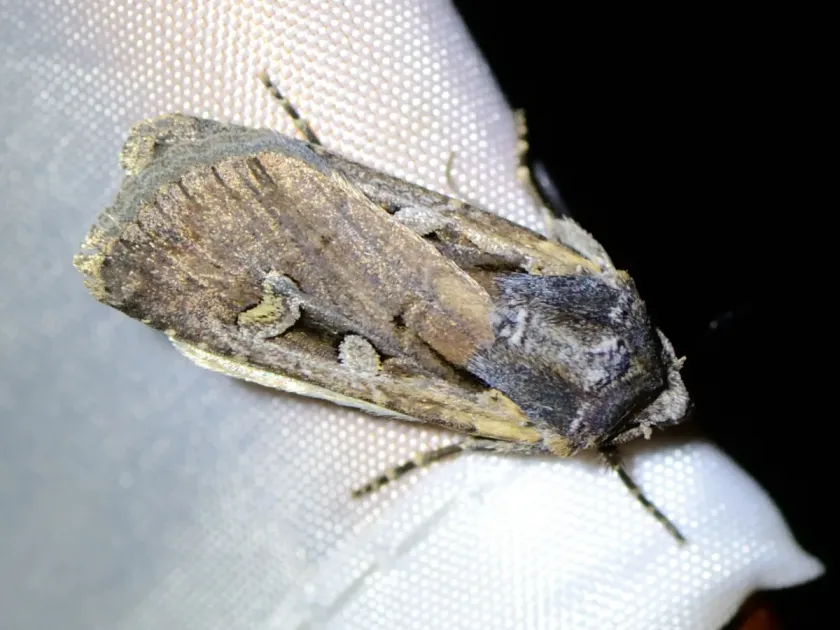
Euxoa obelisca, known as the Obelisca moth, belongs to the Noctuidae family. The adult moth has a wingspan of 35–40 mm and features grey-brown forewings with distinctive dark markings shaped like obelisks.
The larvae, commonly known as cutworms, are earthy-colored with a dark dorsal line. They reach a length of up to 40 mm and possess a hard, dark head capsule that distinguishes them from similar species.
The life cycle consists of four stages: egg, larva, pupa, and adult. In most regions, this species completes one generation per year, spending the winter in the larval stage.
As nocturnal insects, adults spend their daylight hours hidden in the soil or under organic debris, making them difficult to detect without specialized equipment.
Effective monitoring involves the use of pheromone traps placed at crop height, which help identify the start of the flight period and determine the density of the local population.
What it damages
Euxoa obelisca is a polyphagous pest, meaning it feeds on a wide range of agricultural crops, including winter cereals, corn, sugar beets, and various vegetable species.
Young larvae feed on the foliage of seedlings, while older larvae exhibit the typical "cutworm" behavior of severing stems at or just below the soil surface.
This damage causes rapid wilting and plant death, often resulting in patchy crop stands and significant reductions in overall field yield potential.
Fields with high larvae populations may experience complete loss of seedlings in localized areas, especially during the early spring when larvae resume feeding.
Even non-lethal feeding damage can weaken the plants, making them more susceptible to subsequent secondary infections by soil-borne pathogens and fungi.
When it appears
The flight of adult moths typically occurs between late summer and early autumn, which coincides with the timing of winter crop sowing in many regions.
Females lay eggs in the soil or on low-lying vegetation. Larvae emerge shortly after and begin feeding before entering a state of dormancy to survive the winter months.
During the winter, larvae retreat deeper into the soil profile to avoid freezing temperatures, remaining inactive until the soil warms up in the spring.
As spring temperatures rise, the larvae become active again, feeding on emerging shoots and roots until they reach their final instar stage and prepare for pupation.
Pupation takes place within an underground earthen cell, and the adult moth emerges several weeks later to start the next annual generation.
Signs of infestation
The first indicator of an Obelisca moth infestation is the appearance of wilted or dead seedlings scattered throughout the field in otherwise healthy stands.
By digging around the base of damaged plants, farmers can usually find the larvae curled in a C-shape, typically located just beneath the soil surface.
Other signs include irregular holes in the leaves of younger plants and severed stems that appear as if they have been neatly cut with a sharp instrument.
During nighttime inspections, particularly in humid conditions, the larvae may be observed feeding on the stems or leaves of the target crops.
A high density of weeds in the field often acts as a precursor to infestations, as the larvae initially rely on these plants for food before the main crop emerges.
Control measures
Integrated pest management (IPM) for Euxoa obelisca focuses on combining cultural practices with chemical interventions when necessary to maintain populations below threshold levels.
Deep autumn plowing is a highly effective control measure, as it exposes overwintering larvae and pupae to predators and adverse weather conditions.
Rigorous weed control is essential, as the presence of unwanted vegetation provides a sanctuary and a food source for the larvae throughout the growing season.
When economic thresholds are reached, nighttime applications of suitable insecticides are recommended to maximize contact efficacy while the larvae are active.
- Crop rotation to reduce larval population density over time.
- Use of pheromone traps for timely pest monitoring and warning.
- Encouraging natural predators such as ground beetles and birds in the field.
Taxonomy
- Latin name
- Euxoa obelisca
- Order
- Lepidoptera (butterflies)
- Family
- Noctuidae
- EPPO code
- EUXOOB
Discussion
No discussions yet — be the first.