
Sand cutworm
Euxoa detersa
Description
How to identify
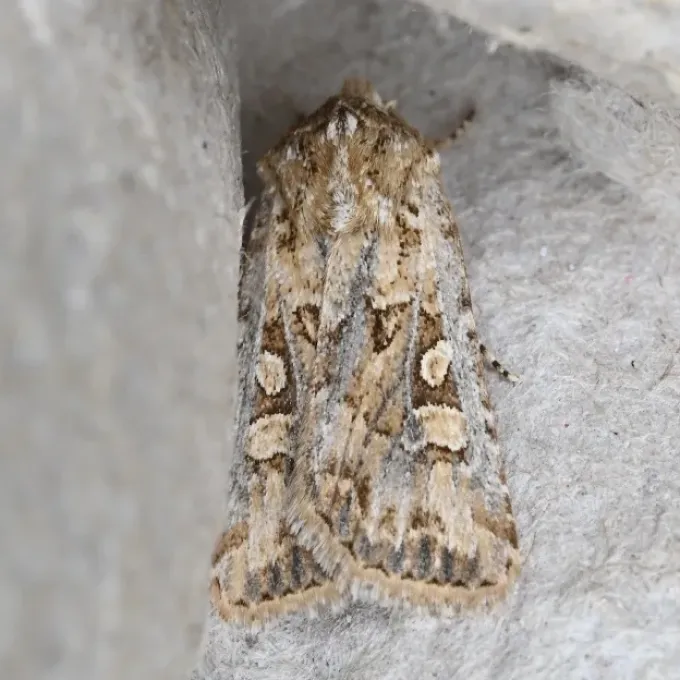
The sand cutworm (Euxoa detersa) belongs to the Noctuidae family of the order Lepidoptera. Adult moths typically have a wingspan of 30–40 mm.
The forewings exhibit a grayish-brown or sandy coloration, which provides excellent camouflage against sandy soil backgrounds where this species thrives.
The larvae, known as cutworms, have a dull, earthy appearance, usually ranging from gray to yellowish-brown, allowing them to remain hidden in the soil.
Pupation takes place underground within earthen cells constructed by the larvae. The pupae are dark brown, smooth, and typically found in the upper soil layers.
This species is specifically adapted to sandy and sandy-loam soils, which are characteristic of its preferred habitat across various agricultural regions.
What it damages
This pest is a polyphagous insect that causes significant damage to numerous agricultural and vegetable crops during the early seedling stage.
The damage is caused by larvae that cut off the stems of young plants at or just below the soil surface, leading to rapid wilting and plant death.
High-risk crops include maize, sunflower, sugar beet, and various horticultural plants that are sensitive to early season feeding pressures.
Infestations can be devastating, often resulting in patchy stands where large sections of the crop are entirely destroyed by feeding larvae.
Besides seedling destruction, larvae may also damage the root systems of more mature plants, reducing vigor and making the crop prone to disease.
When it appears
Adult moths typically emerge in the second half of summer, with egg-laying occurring shortly thereafter in soils with minimal vegetation.
The larvae develop throughout the summer and autumn, eventually reaching their final larval stages before overwintering deep within the soil.
Spring activity begins as temperatures rise, prompting the larvae to move to the upper soil layers where they resume feeding on early emerging crops.
The life cycle is univoltine in most regions, although local environmental conditions can influence the precise timing of emergence and larval development.
The most critical period for economic damage is the spring, coinciding with the germination and emergence of primary spring crops.
Signs of infestation
A primary indicator of infestation is the presence of wilted or collapsed plants that appear otherwise healthy but are severed at the base.
Upon inspecting the soil around damaged plants, one can often find larvae curled in a C-shape hidden in the top few centimeters of the dirt.
Thinning plant stands and gaps in rows are diagnostic signs that an underground pest is feeding on the subterranean or basal parts of the crops.
Feeding damage is often most visible during the early morning hours, as cutworms are nocturnal and hide during the daylight hours.
The presence of small holes or excavations near the base of the plant stem is a reliable sign of recent cutworm activity.
Control measures
Deep autumn plowing is a highly effective cultural practice, as it disrupts the soil and exposes overwintering larvae to predators and environmental stress.
Maintaining a weed-free field environment is crucial to minimize food sources for young larvae before the main crops emerge.
Chemical control involving seed treatments or soil-applied insecticides is often necessary in areas with historically high cutworm populations.
Biological control using entomopathogenic nematodes or specialized microbial pesticides can provide effective suppression in suitable soil moisture conditions.
- Deep autumn tillage.
- Effective weed management.
- Seed treatment with insecticides.
- Nocturnal field monitoring.
Taxonomy
- Latin name
- Euxoa detersa
- Order
- Lepidoptera (butterflies)
- Family
- Noctuidae
- EPPO code
- EUXODE
Discussion
No discussions yet — be the first.