
Army cutworm
Euxoa auxiliaris
Description
How to identify
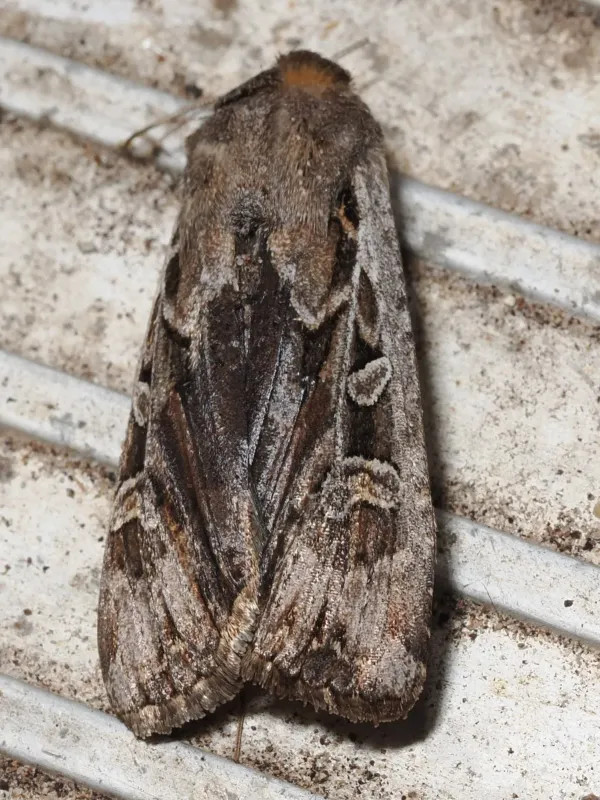
The army cutworm (scientific name: Euxoa auxiliaris) belongs to the Noctuidae family, within the order Lepidoptera. Adults are moths with a wingspan of up to 40 mm, exhibiting mottled gray and brown camouflage patterns.
The larvae, known as cutworms, have a cylindrical body measuring 35–45 mm in length. Their coloration ranges from light gray to dark brown, usually featuring distinctive pale longitudinal stripes along the back.
The life cycle includes four stages: egg, larva, pupa, and adult. A unique biological feature of this species is the adult moth's summer diapause, where they retreat to cool, dark areas to survive hot weather.
Overwintering typically occurs in the larval stage. Larvae hide in the topsoil or under dense crop residue during the cold months, remaining semi-active whenever soil temperatures rise sufficiently.
Developmental success is highly dependent on climate. A cool, moist spring promotes larval survival, while dry conditions may inhibit their population growth during the peak feeding period.
What it damages
The army cutworm is a highly polyphagous pest capable of consuming a wide variety of crops. Primary agricultural targets include small grains such as winter wheat, barley, and rye.
Furthermore, these larvae frequently attack broadleaf crops and seedlings, including corn, sunflowers, and sugar beets. High larval populations can devastate entire fields within a very short timeframe.
Early-stage larvae feed on the leaf epidermis, causing a skeletonized appearance. As they reach later instars, they become more destructive, often severing stems at the soil line, leading to plant death.
Damage often occurs in localized patches or "armies" of larvae moving across a field. This migratory behavior can lead to large bare spots in a field, significantly reducing crop density.
Beyond direct mechanical injury, the wounded tissues of surviving plants become highly susceptible to opportunistic bacterial and fungal pathogens, further reducing overall harvest potential.
When it appears
Adult moths are typically active in the spring before migrating to their summer diapause locations. They emerge again in the late summer and autumn to mate and lay eggs.
Larval activity is most intense in the early spring, immediately following the snowmelt. Feeding resumes as soon as soil temperatures reach approximately 5-8 degrees Celsius.
The period of greatest economic risk occurs during the seedling and early vegetative growth stages of winter crops. A prolonged, cool spring often extends this critical period of vulnerability.
While the species generally completes one generation per year, the migratory flight of adults allows for the rapid colonization of new regions and fields each cycle.
Effective scouting should begin as soon as crops emerge in the spring. Monitoring is essential to detect larval presence before extensive feeding damage occurs across the field.
Signs of infestation
The first visual symptoms of an infestation are small, irregular holes or notches on the leaves, often accompanied by the presence of dark larval frass in the surrounding soil.
A classic sign is the presence of wilted or severed seedlings. Digging slightly into the soil around a damaged plant will usually reveal a curled, grayish-brown larva hiding just below the surface.
Increased bird activity, particularly flocks of starlings or rooks foraging in the field, is a strong indicator that larvae are present in the topsoil and serving as a food source.
Nighttime scouting with a flashlight is the most accurate method to estimate population density. Larvae are nocturnal feeders and are most visible on the soil surface after sunset.
Large-scale infestations appear as significant thinning of the crop canopy and the development of dead patches, which can be observed from a distance if the infestation is severe.
Control measures
Cultural management is the first line of defense. Deep autumn plowing can help destroy overwintering sites, exposing larvae to desiccation and natural predators like birds and ground beetles.
Weed control is critical, as early-season weeds provide essential food for young larvae before crops germinate. Keeping field borders and fields clean reduces the initial population pressure.
Chemical control involving systemic or contact insecticides may be necessary if larval counts exceed established economic thresholds. Applications are most effective when timed for evening hours.
- Implementing diverse crop rotation.
- Using insecticidal seed treatments.
- Applying insecticides during nocturnal feeding peaks.
- Monitoring adult flight with pheromone or light traps.
Biological control options, such as the use of Bacillus thuringiensis-based products, provide an environmentally friendly alternative that targets young larvae without harming beneficial pollinators or predators.
Taxonomy
- Latin name
- Euxoa auxiliaris
- Order
- Lepidoptera (butterflies)
- Family
- Noctuidae
- EPPO code
- CHOZAU
Discussion
No discussions yet — be the first.