
Great Brocade
Eurois occulta
Description
How to identify
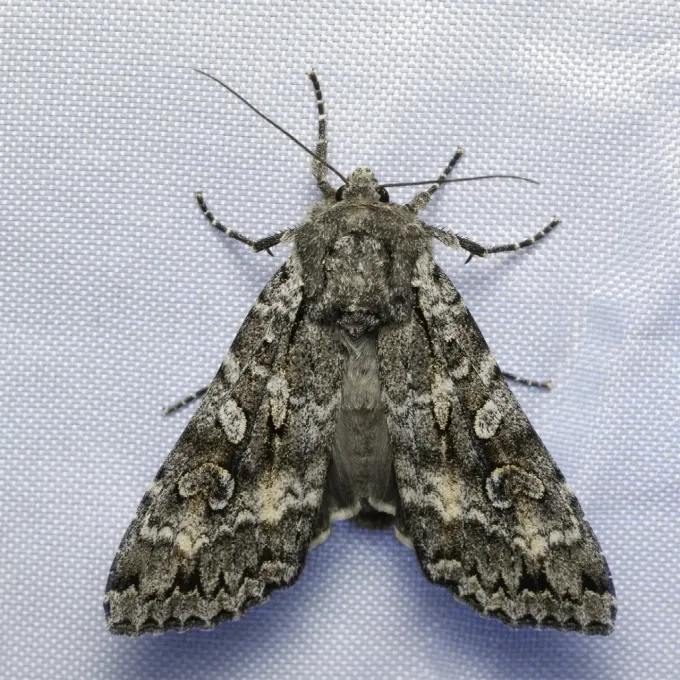
The Great Brocade (Eurois occulta) is a large noctuid moth belonging to the family Noctuidae. The adult moth has a wingspan ranging from 50 to 60 millimeters.
Its forewings are typically grey or brownish-grey with intricate dark markings and lines, providing excellent camouflage against bark and plant stems.
The hindwings are generally paler, often appearing greyish-white with dark margins, which is a characteristic feature of this species in its natural habitat.
Larvae, or caterpillars, reach lengths of 50-60 millimeters. They are typically brownish or greyish in color, often with a lighter dorsal stripe and dark lateral spots.
Systematically, this insect is a member of the order Lepidoptera. It is recognized for its high adaptability to varying environments, allowing it to thrive in diverse agricultural settings.
What it damages
The Great Brocade is a polyphagous pest, meaning it feeds on a wide array of plants, including vegetables, field crops, and various ornamental species.
The larvae are primary consumers that graze on foliage, often leaving behind shredded leaf margins or large holes in the plant tissue, which reduces photosynthesis.
Significant damage occurs early in the growing season when larvae emerge from hibernation and feed aggressively on young seedling tissues and new plant growth.
In cases of severe infestation, entire crops can be decimated as larvae target growth points, leading to stunted development or the complete loss of individual plants.
Beyond foliar damage, the caterpillars may also attack the base of stems and roots, particularly in young crops, causing wilting and providing entry points for secondary pathogens.
When it appears
Adult moths are typically active during the summer months, with flight periods occurring from June through August. They are strictly nocturnal, seeking shelter during daylight hours.
The species primarily overwinters as larvae of early instars, sheltering in the soil or beneath thick layers of organic debris to survive cold temperatures.
As spring approaches and temperatures rise, the overwintered larvae resume feeding, targeting emerging weeds and early-season agricultural crops.
The development of the caterpillars occurs throughout the spring and early summer, after which they undergo pupation in the soil to transform into the adult moth form.
Environmental conditions, particularly temperature and humidity, play a crucial role in the timing of each life stage and the overall survival rate of the population.
Signs of infestation
One of the first signs of infestation is the appearance of ragged, irregular feeding patterns along the leaf edges or large holes within the leaf surface.
The presence of larval frass (droppings) near the base of the plant or in the surrounding soil is a reliable indicator that caterpillars are feeding nearby.
Sudden wilting or collapsing of young seedlings, often occurring overnight, strongly suggests the presence of ground-dwelling caterpillars like the Great Brocade.
Monitoring for adult moths using light traps during summer evenings provides an early warning system for potential outbreaks and larval pressure later in the season.
Carefully inspecting the soil around the base of damaged plants during the day often reveals larvae hiding just beneath the surface to avoid heat and predation.
Control measures
Deep autumn tillage is a highly effective mechanical control method, as it exposes overwintering larvae and pupae to predators and harsh winter weather.
Maintaining a weed-free field environment is essential, as weeds serve as critical hosts for early-stage larvae and provide sites for moths to lay their eggs.
Chemical control involving insecticides is most effective when applied during the early larval stages, targeting the pest before it causes significant economic damage.
Biological control methods, including the application of Bacillus thuringiensis or the use of beneficial parasitoids, provide eco-friendly alternatives to chemical sprays.
Implementing a pest management plan that includes the use of pheromone traps helps farmers make data-driven decisions on when to intervene with protective measures.
Taxonomy
- Latin name
- Eurois occulta
- Order
- Lepidoptera (butterflies)
- Family
- Noctuidae
- EPPO code
- EURMOC
Discussion
No discussions yet — be the first.