
Bright-line Brown-eye
Euplexia lucipara
Description
How to identify
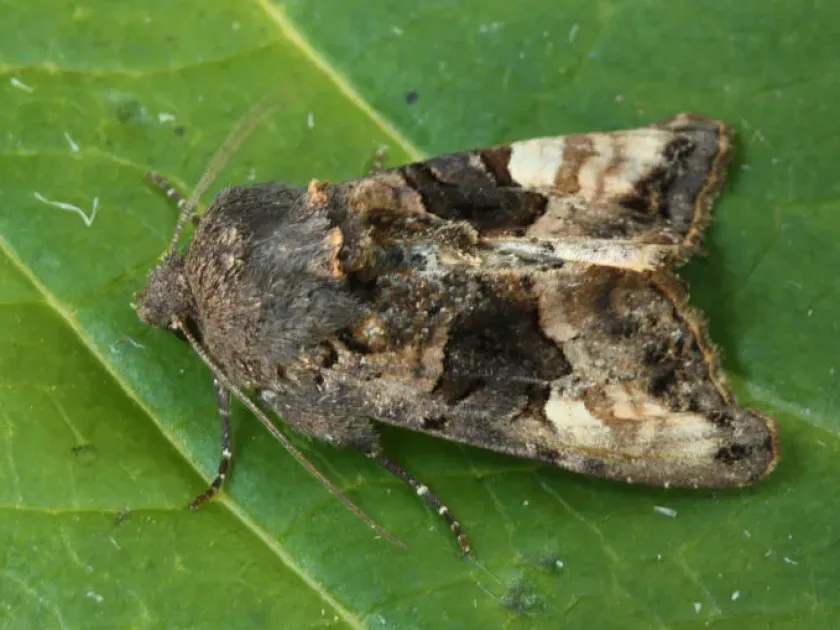
The Bright-line Brown-eye (Euplexia lucipara) is a moth belonging to the Noctuidae family. The adult moth has a wingspan of approximately 30–35 mm, with distinctive dark purplish-brown forewings featuring a prominent yellowish-white patch in the center.
The larvae, or caterpillars, reach lengths of 30–40 mm. They exhibit coloration ranging from bright green to brownish, which provides excellent camouflage against the foliage of host plants.
This species undergoes complete metamorphosis: egg, larva, pupa, and adult. They typically overwinter as pupae within the upper layers of the soil or among leaf litter near the host plant.
Females lay eggs in small clusters on the underside of leaves. The fertility of a single female can reach several hundred eggs per season, depending on environmental conditions.
Because these moths are nocturnal, they are difficult to detect during the day and are often only spotted when using light traps or during night inspections.
What it damages
This pest is polyphagous, meaning it feeds on a wide range of plants, including raspberries, blackberries, ferns, and various decorative garden species.
The primary damage is caused by the caterpillars, which are highly voracious. Younger larvae skeletonize the leaves, consuming the soft tissue and leaving only the veins.
As the caterpillars mature, they move on to eating the edges of leaves, which can lead to significant defoliation if the population density is high.
In addition to foliage damage, the caterpillars may attack buds, flowers, and developing fruit, directly reducing the yield of berry bushes.
Wounds caused by the caterpillars serve as entry points for secondary infections, such as fungal pathogens or bacteria, further weakening the host plant.
When it appears
The first generation of adult moths emerges from late May through mid-June, coinciding with the onset of warmer night temperatures.
The peak period for caterpillar activity, when they cause the most noticeable damage, occurs throughout June and July. This is the critical window for monitoring and intervention.
Depending on the region, the species may produce one or two generations per season. A second generation of adults typically appears in late summer.
Caterpillars from the second generation continue to feed until the onset of autumn cold, after which they burrow into the soil to pupate.
Understanding the phenology of this moth is crucial for scheduling preventive treatments and ensuring that measures are taken at the most vulnerable stage of the pest's lifecycle.
Signs of infestation
One of the earliest signs of infestation is the presence of "windows" or skeletonized patches on the leaves, leading to wilting and premature drying.
The presence of frass (dark granular droppings) on the leaves and at the base of the plant is a clear indicator that caterpillars are actively feeding in the canopy.
Caterpillars often use silk to tie leaves together to create protective shelters; observing these rolled or webbed leaves is a strong sign of infestation.
During evening hours, using a flashlight to inspect the undersides of the leaves can reveal the caterpillars in their active feeding state.
General loss of vigor and yellowing of the foliage without other obvious causes often suggests the presence of feeding larvae hidden from view.
Control measures
Cultural control methods include regular weeding and deep cultivation of the soil around the base of bushes in autumn to disturb or destroy overwintering pupae.
Mechanical control, such as hand-picking caterpillars during the evening or early morning, is highly effective for smaller gardens.
Biological treatments, such as products based on Bacillus thuringiensis, are highly effective against young caterpillars while being safe for pollinators.
Chemical insecticides should be used as a last resort during heavy infestations, always strictly following the manufacturer’s instructions and pre-harvest intervals.
- Maintain garden hygiene by clearing away debris and weeds.
- Encourage natural predators like birds and parasitic wasps.
- Use light traps for monitoring and reducing adult moth populations.
Taxonomy
- Latin name
- Euplexia lucipara
- Order
- Lepidoptera (butterflies)
- Family
- Noctuidae
- EPPO code
- EUPXLU
Discussion
No discussions yet — be the first.