
Six-spotted mite
Eotetranychus sexmaculatus
Description
How to identify
The six-spotted mite (Eotetranychus sexmaculatus) is a member of the Tetranychidae family, commonly known as spider mites. These are minute pests that require close inspection to detect.
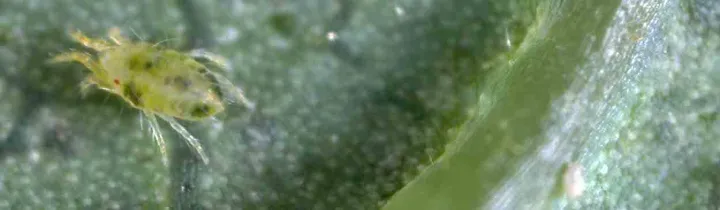
Adult females are approximately 0.3 to 0.4 mm in length. Their body coloration is generally pale yellow or greenish, typically marked with six dark spots arranged in rows along the back.
The life cycle progresses through the egg, larva, two nymphal stages, and the adult phase. Development speed is highly dependent on ambient temperature, often accelerating in warm, dry weather.
Adult females overwinter in protected locations such as bark crevices or leaf litter, becoming active again when temperatures rise in the spring.
Due to their high reproductive potential, these mites can rapidly build up large populations, creating significant stress for host plants during the growing season.
What it damages
This mite is a polyphagous pest, though it is particularly notorious for causing severe damage to citrus crops, including lemons, as well as various ornamental trees.
Mites primarily reside on the underside of leaves, feeding on the chlorophyll-rich contents of the leaf cells, which weakens the host plant significantly.
As feeding progresses, the plant loses its ability to perform efficient photosynthesis, leading to stunted growth and reduced vigor.
Severe infestations often result in premature leaf drop, which can lead to canopy thinning and a substantial decline in overall fruit production and tree health.
Over time, persistent mite feeding can cause chronic stress, making trees more susceptible to other secondary pests and various environmental stressors.
Signs of infestation
Symptoms of an infestation usually manifest as small yellow or chlorotic spots on the upper leaf surface, which correspond to feeding colonies located beneath.
As the infestation increases, these spots expand and coalesce, eventually causing the entire leaf to become pale, discolored, and necrotic.
The presence of fine webbing on the undersides of leaves, along with shed skins and dark waste particles, is a definitive indicator of a six-spotted mite colony.
Leaves that are heavily infested may eventually curl, wither, and drop from the branch, starting from the lower parts of the tree canopy.
Visual inspection using a hand lens is often necessary to confirm the presence of these microscopic mites, especially during the early stages of an outbreak.
Control measures
Managing the six-spotted mite requires a multi-faceted approach, balancing chemical, biological, and cultural controls to minimize tree stress.
Maintaining proper tree health through balanced fertilization and irrigation helps plants withstand the physiological damage caused by mite feeding.
Targeted chemical control using acaricides should be applied during the early stages of an outbreak to prevent the population from reaching economic threshold levels.
- Regular monitoring for early signs of leaf discoloration.
- Pruning to improve airflow and reduce humidity pockets.
- Encouraging the presence of natural predators, such as predatory mites.
- Removing infested leaves to physically reduce the pest load.
When applying pesticide sprays, ensure full coverage of the leaf undersides, as this is where the majority of the mites feed and reproduce.
Taxonomy
- Latin name
- Eotetranychus sexmaculatus
- Order
- Mites
- Family
- Tetranychidae
- EPPO code
- TETRSM
Discussion
No discussions yet — be the first.