
Atlantic jackknife clam
Ensis directus
Description
How to identify
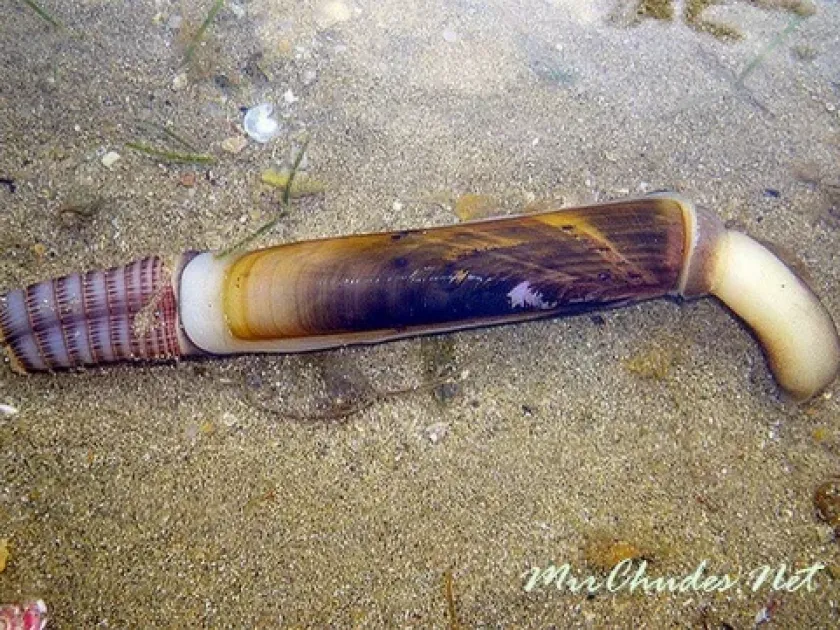
The Atlantic jackknife clam Ensis directus is a bivalve mollusk easily recognized by its long, thin, and straight shell, resembling a pocket knife handle.
The shell can grow up to 20 centimeters in length and features a brownish-yellow to greenish periostracum with smooth edges.
It belongs to the order Adapedonta and the family Pharidae, and it is native to the western Atlantic, now invasive in European waters.
The clam is equipped with a strong, muscular foot that allows it to burrow vertically into sandy substrates with remarkable speed.
When buried, it remains oriented vertically, extending its siphons to the surface to filter feed during high tide.
What it damages
While not a traditional agricultural pest, Ensis directus poses significant challenges to coastal management and shellfish aquaculture.
The species can alter the texture and stability of sandy bottoms, which disrupts the local environment for other farmed shellfish species.
Through intense filter-feeding, these clams compete with commercially valuable species for phytoplankton and essential nutrients.
Large colonies can affect sediment chemistry, leading to localized changes in water quality that may stress farmed stocks of oysters or mussels.
Increased density of shells on the seafloor can impede mechanical harvesting operations in commercial aquaculture sites.
When it appears
The reproductive cycle of the Atlantic jackknife clam is primarily triggered by seasonal water temperature increases during spring and summer.
Larvae are released into the water column, where they drift with currents until they reach a size suitable for settling in sandy substrates.
Adult populations remain relatively sedentary once established, although heavy storms can dislodge them and wash them onto beaches.
Feeding activity remains at its peak when water temperatures are optimal and food availability in the water column is highest.
In winter months, the clams reduce their metabolic activity and remain deeply buried to survive lower temperatures and potential predation.
Signs of infestation
The presence of a colony is often identified by small, keyhole-shaped depressions on the surface of the intertidal sandy flats.
Massive wash-ups of shells after storm events are clear indicators of a large-scale population living just offshore.
Changes in sediment compaction in tidal zones often suggest high concentrations of these mollusks beneath the surface layer.
The odor of organic decay following low tide can be a sign of high mortality rates if the colony has become overpopulated or stressed.
Reduced water flow or altered turbidity in coastal channels may be linked to the extensive filter-feeding activities of this mollusk.
Control measures
Control strategies for Ensis directus primarily involve commercial harvesting, which turns an invasive presence into an economic resource.
Mechanical substrate maintenance in aquaculture areas helps prevent the establishment of dense populations that interfere with farming infrastructure.
Regular environmental monitoring and reporting of population density shifts are essential for protecting local ecosystem balance.
Integrated management plans for coastal zones should include provisions for mitigating the impact of bio-fouling and habitat alteration by this species.
Public awareness programs help in managing the recreational spread of these clams, ensuring they are not introduced into new, sensitive habitats.
Taxonomy
- Latin name
- Ensis directus
- Family
- Pharidae
- EPPO code
- ENSSDI
Discussion
No discussions yet — be the first.