
Dugong
Dugong dugon
Description
How to identify
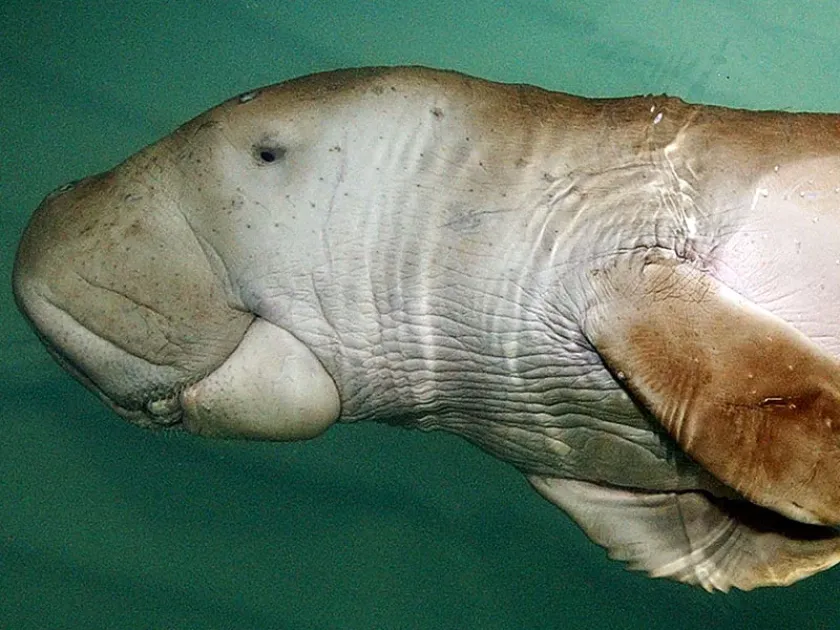
The dugong (Dugong dugon) is a large marine mammal and the only living species in the family Dugongidae, often referred to as the sea cow.
It possesses a streamlined, fusiform body, a fluke-like tail, and paddle-like front flippers, allowing for efficient movement in shallow coastal waters.
Their skin is thick, grayish, and often sparsely covered with sensory hairs, which are particularly concentrated around the mouth for detecting food sources.
The dugong’s mouth is downward-facing, specifically evolved for grazing on bottom-dwelling aquatic vegetation, which is a key biological trait of the species.
As a close relative of the elephant, the dugong is a unique organism that plays a vital role in marine ecosystems, though it can create conflicts in cultivated areas.
What it damages
Dugongs are specialized herbivores that consume vast quantities of seagrass, such as Halophila and Halodule species, using their powerful lips to uproot plants.
In aquaculture settings, they are considered pests as they graze on cultivated seaweed beds, causing total crop failure in affected sections.
Their feeding method is destructive; they remove the entire plant, including rhizomes and roots, which prevents natural regeneration of the seagrass meadows.
This grazing activity can lead to significant habitat degradation, resulting in increased turbidity and nutrient loss in the marine soil profile.
The damage is economically significant in regions where seagrass restoration or specific marine crop production is a primary livelihood for coastal communities.
When it appears
Dugongs are present in their habitats year-round, meaning they pose a consistent threat to seagrass meadows regardless of the season.
Increased grazing intensity often coincides with the peak growth stages of seagrass, when the plants are most nutrient-rich and attractive to the animals.
During extreme weather events or storm seasons, dugongs may shift their feeding grounds, potentially invading new areas of aquaculture to find sheltered food.
Concentrations of dugongs can vary throughout the year, with specific seasonal shifts often tied to water temperature and tidal dynamics affecting food availability.
There is no dormant period for the dugong; therefore, constant vigilance is required to protect sensitive marine zones from continuous grazing pressure.
Signs of infestation
Distinctive feeding trails, known as "grazing furrows," are the primary indicators of dugong presence, appearing as long, bare strips on the sandy seabed.
Patches of uprooted, floating seagrass debris are clear evidence that a dugong has been active in the immediate vicinity of a cultivated bed.
Visible changes in sediment turbidity in areas previously characterized by dense, clean seagrass cover point toward recent feeding activity by the animals.
The presence of fecal matter in the water column or on the substrate, containing recognizable fragments of marine plants, confirms the arrival of the species.
Occasional sighting of the animal surfacing for air is a definitive, albeit less frequent, sign of their presence in protected aquaculture zones.
Control measures
Management must be non-lethal, as the dugong is a strictly protected species under international law, requiring creative and passive deterrent methods.
Deployment of sub-surface acoustic deterrent devices (ADDs) can effectively steer dugongs away from sensitive areas without causing physiological harm.
Physical exclusion measures, such as large-scale underwater fencing, are used to create secure zones for highly valuable marine crops.
Implementing a buffer zone approach, where non-commercial seagrass is planted to attract dugongs away from productive beds, has shown promise in sustainable management.
- Use of non-invasive acoustic deterrents.
- Installation of protective physical barriers.
- Creation of sacrificial buffer zones.
- Real-time sonar monitoring systems.
- Community-based marine area zoning.
Taxonomy
- Latin name
- Dugong dugon
- Family
- Dugongidae
- EPPO code
- DUGODU
Discussion
No discussions yet — be the first.