
Guinea worm
Dracunculus medinensis
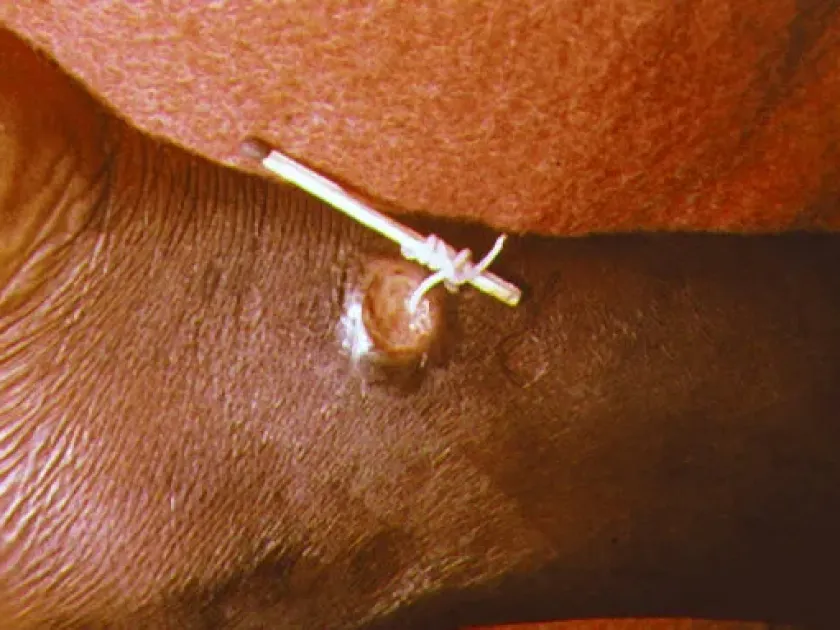
Description
How to identify
Dracunculus medinensis, commonly known as the Guinea worm, is a parasitic nematode belonging to the family Dracunculidae. It is not a plant pest and does not affect crops, vegetables, or trees.
Adult female worms are characterized by their extreme length, which can exceed 100 centimeters, while the males remain significantly smaller. They are white and thread-like in appearance.
This organism is a biological parasite that requires specific conditions for its life cycle. The larvae must be ingested by intermediate hosts, specifically copepods (small crustaceans like Cyclops), to become infectious.
As a parasitic helminth, its entire biological strategy is centered around infecting vertebrates, specifically mammals. It has no biological mechanisms to feed on plant matter.
In terms of agricultural classification, this organism is irrelevant as it possesses zero trophic relationships with any plant species.
What it damages
The Guinea worm does not cause damage to plants. It is exclusively a medical and veterinary concern related to the ingestion of contaminated water containing infected crustaceans.
The pathology caused by this nematode is known as dracunculiasis. It involves the migration of adult worms through the subcutaneous tissues of a vertebrate host, causing pain and inflammation.
There is no evidence of this nematode affecting agricultural yields, plant health, or soil quality. It does not possess mouthparts capable of piercing or consuming plant tissues.
From an agronomical perspective, this species is not considered a pest. Its presence in rural areas is a public health issue rather than a factor affecting agricultural productivity.
The plant growth cycle remains entirely unaffected by the presence or lifecycle stages of this parasitic worm.
Control measures
Control measures for Dracunculus medinensis are strictly non-agricultural. They focus on public health interventions to break the transmission cycle by preventing the ingestion of copepods.
The primary method of prevention is the use of water filtration systems to remove the intermediate host (water fleas) from drinking sources, preventing infection.
Public education and the establishment of clean water supplies are the standard protocols for managing the prevalence of this parasite in endemic areas.
There are no chemical or biological pesticides recommended for agriculture against this species, as it is not a plant pathogen or an agricultural pest.
- Filtration of drinking water.
- Prohibiting entry into water sources for infected individuals.
- Installation of protected water wells.
Taxonomy
- Latin name
- Dracunculus medinensis
- Order
- Nematodes
- Family
- Dracunculidae
- EPPO code
- DRACME
Discussion
No discussions yet — be the first.