
Nutmeg moth
Discestra trifolii
Description
How to identify
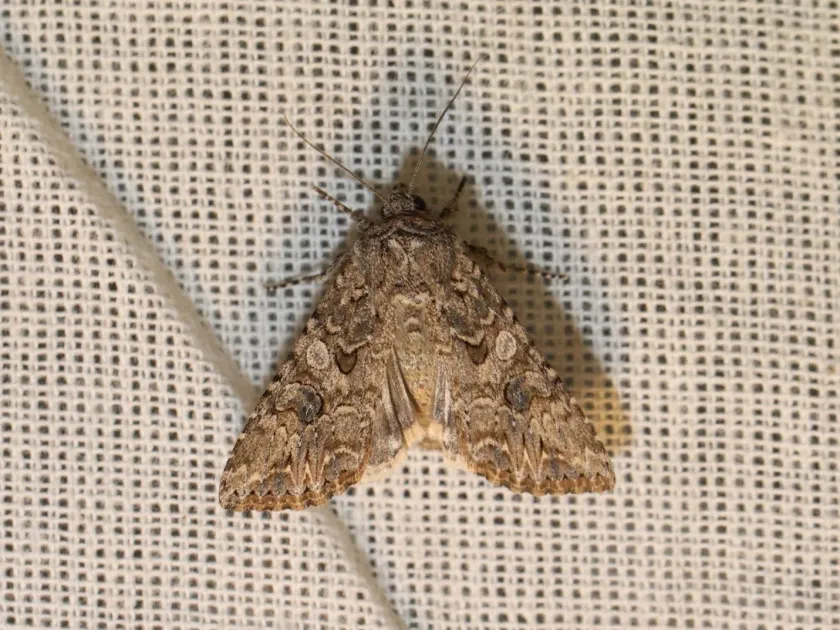
The Nutmeg moth (Discestra trifolii) belongs to the Noctuidae family of the order Lepidoptera. Adult moths typically have a wingspan of 35–40 mm, with mottled, greyish-brown forewings featuring light patterns.
The larvae, or caterpillars, vary in color from pale green to brownish-grey, often displaying distinct dark longitudinal stripes along their body as they mature to a length of 40 mm.
The eggs are hemispherical, ribbed, and yellowish, laid in clusters on the undersides of host plant leaves. This is a common pattern for many Noctuidae species.
Pupation occurs in the soil, where the pupa, which is reddish-brown and shiny, spends the winter in diapause. This allows the pest to survive harsh environmental conditions.
The life cycle is heavily influenced by climate, with warmer regions supporting multiple generations per year, leading to overlapping life stages throughout the summer.
What it damages
The Nutmeg moth is a polyphagous pest, meaning it feeds on a wide range of plants, causing significant economic losses to various agricultural sectors.
Commonly affected crops include legumes like clover, alfalfa, and peas, as well as vegetables such as cabbage, onions, and root crops like sugar beets.
Young larvae feed by skeletonizing leaves, eating only the soft tissue between veins, which significantly weakens the plant's photosynthetic capacity during early growth stages.
Older caterpillars consume entire sections of leaves, creating large, irregular holes that lead to severe defoliation and reduced crop yield and quality.
In cases of heavy infestations, the caterpillars can strip plants of their foliage entirely, making the crop susceptible to secondary diseases and further environmental stress.
When it appears
Adult moths of the overwintering generation typically emerge in late spring or early summer, depending on regional temperature variations and microclimatic conditions.
Once mated, females begin laying eggs. The larvae hatch within a week or two, immediately beginning to feed on the host plants, which often coincides with the crop's peak growth phase.
Throughout the summer, successive generations overlap, meaning damage can occur continuously from early summer through until the harvest season in late autumn.
Pupae usually retreat into the ground by September to prepare for winter dormancy. This underground stage protects them from natural predators and climatic extremes.
Farmers are advised to use pheromone traps for monitoring moth activity, which helps in timing control measures for the most vulnerable larval developmental stages.
Signs of infestation
Early identification of egg clusters on the underside of leaves is key to preventing large-scale outbreaks. Regular scouting is essential for proactive management.
Small, translucent patches or skeletonized leaf areas are early warning signs of young larval feeding activity. These patterns are often noticed at field margins first.
The presence of larval frass (excrement) on leaves is a clear indicator that caterpillars are actively feeding on the crop, signaling that intervention may be needed.
Visible defoliation or stunted growth in specific patches of the field indicates an established population that has likely progressed to later, more damaging larval instars.
- Irregular holes in leaf tissues.
- Skeletonized leaf veins.
- Visible larvae during night inspections.
- General poor vigor and retarded growth of infested plants.
Control measures
Good agricultural practices, such as autumn plowing, are highly effective in exposing overwintering pupae to the surface, where they succumb to cold and predators.
Weed management is critical, as many common field weeds serve as alternative hosts, allowing the pest population to build up before moving to the main crop.
Chemical control should be implemented based on economic injury thresholds. Using selective insecticides helps manage populations while preserving beneficial insect populations.
Biological controls, including the application of Bacillus thuringiensis or the use of parasitoid wasps like Trichogramma, provide sustainable alternatives to traditional chemicals.
Integrated Pest Management (IPM) strategies, which combine cultural, biological, and chemical methods, are the most effective way to manage the Nutmeg moth long-term.
Taxonomy
- Latin name
- Discestra trifolii
- Order
- Lepidoptera (butterflies)
- Family
- Noctuidae
- EPPO code
- SCOOTR
Discussion
No discussions yet — be the first.