
Figure of Eight moth
Diloba caeruleocephala
Description
How to identify
The Figure of Eight moth (Diloba caeruleocephala) is a moth of the family Noctuidae. It has a wingspan of 35–45 mm, with forewings that are greyish-brown with distinct white markings.
These markings are often shaped like a figure of eight, which provides the common name for the species and aids in its camouflage against tree bark.
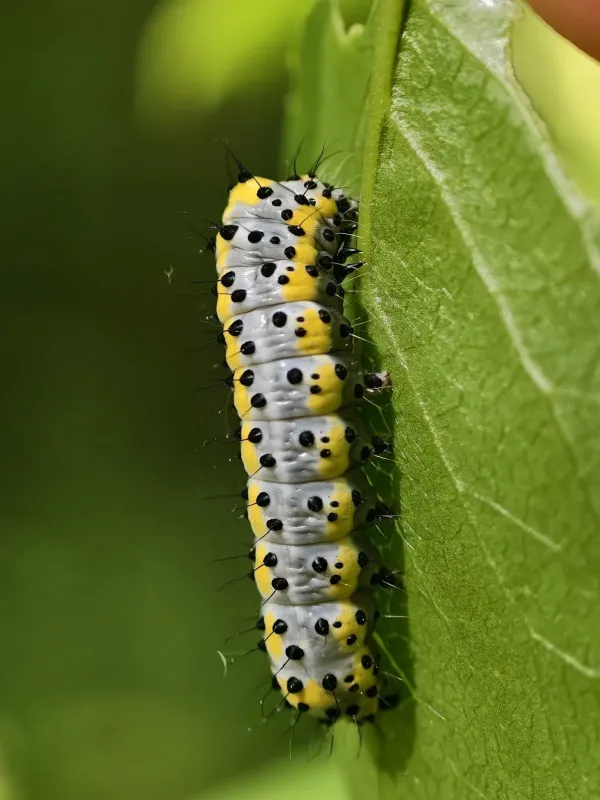
The larvae, or caterpillars, are typically 40 mm long when fully grown. They are blue-grey in color with yellow lines and sparse black hairs covering their bodies.
Their head is a vivid blue, making them easily identifiable for farmers and gardeners inspecting fruit trees during the spring budding season.
Pupae are found inside tough, brownish cocoons that are often cleverly hidden within bark crevices or organic debris near the base of host trees.
What it damages
This moth primarily targets the Rosaceae family. Key host plants include apple, pear, plum, apricot, and various species of hawthorn and blackthorn trees.
In early spring, the caterpillars feed extensively on developing buds. This activity is highly damaging as it destroys potential fruits before they even bloom.
As the season progresses, the larvae feed on young leaves. Heavy infestations can lead to severe defoliation, where the leaves are skeletonized, leaving only the veins.
Young fruit trees and nursery saplings are at the greatest risk, as the loss of foliage severely inhibits their growth, photosynthesis, and overall health.
Recurring damage over several seasons stresses the trees, making them more susceptible to drought, fungal diseases, and winter cold injury.
When it appears
The species completes one generation per year. It overwinters in the egg stage, with eggs attached to the bark of branches in clusters or single units.
Larvae emerge in spring, coinciding with the bud-burst stage of their host plants. This synchronization ensures immediate food access for the growing caterpillars.
The larval feeding period spans from May to June. During this time, they undergo multiple molts, rapidly increasing in size as they consume the host plant tissue.
Pupation occurs in July. The larvae construct cocoons and remain in this state throughout the summer, protected from predators and heat in their hidden locations.
Adult moths emerge from late summer to October. During this autumn flight period, they mate and lay eggs on the tree branches, which will remain until spring.
Signs of infestation
Early spring signs include stunted or hollowed-out buds that fail to open, indicating larval feeding activity within the tight bud structures.
Presence of larvae feeding openly on the leaves during late spring. Unlike leaf-rollers, they usually feed on the leaf surface, making them visible to the naked eye.
Skeletonized leaves with large, irregular holes and veins remaining intact. This unique leaf damage pattern is a clear indicator of a Figure of Eight moth infestation.
Accumulation of larval excrement (frass) under the canopy or on lower leaves, which is often the first visual warning of a large population present in the tree.
Detection of small, brownish egg plaques on the bark of shoots during late autumn or winter pruning, which serves as a warning for the next season.
Control measures
Good orchard hygiene is essential. Removing loose bark and debris can reduce the number of suitable sites for pupation and winter shelter for other pests.
Mechanical control, such as hand-picking caterpillars during the early hours of the day, is highly effective for smaller gardens or organic farming operations.
Biological control using Bacillus thuringiensis sprays during the early larval stage is an effective way to manage numbers without harming beneficial pollinators.
Chemical control should be limited to instances where the economic injury level is exceeded, using selective insecticides that minimize impact on natural predators.
Promoting a healthy environment for natural predators, such as birds and beneficial insects like ground beetles, helps maintain the moth population in check.
Taxonomy
- Latin name
- Diloba caeruleocephala
- Order
- Lepidoptera (butterflies)
- Family
- Noctuidae
- EPPO code
- DILBCA
Discussion
No discussions yet — be the first.