
Dichagyris flammatra
Dichagyris flammatra
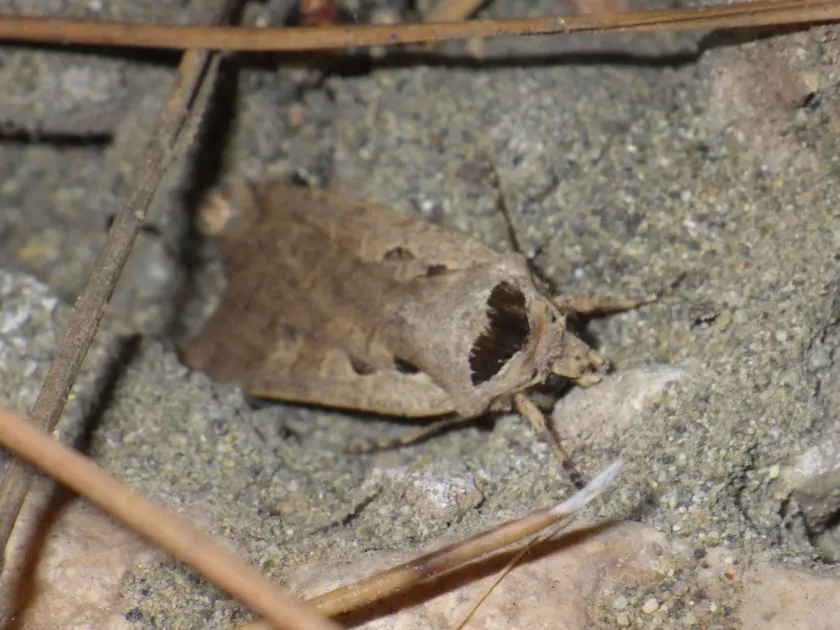
Description
How to identify
Dichagyris flammatra belongs to the Noctuidae family, order Lepidoptera. The adult moth has a wingspan of approximately 40–45 mm.
The forewings are characterized by a grayish-brown or ochre hue with distinctive dark, flame-like markings, which gave the species its specific name. The hindwings are paler in color.
The larvae are classified as cutworms. They possess a robust, cylindrical body ranging from gray to brown, providing effective camouflage within the topsoil.
The larval head is hard, dark, and adapted for chewing plant tissues. The body is sparsely covered with small hairs, assisting the larvae in navigating through the soil.
The life cycle includes complete metamorphosis: egg, larva, pupa, and imago. They typically overwinter as late-stage larvae in the soil at depths of 10–15 cm.
What it damages
This pest is a polyphage, capable of feeding on a wide range of agricultural crops. It causes significant economic damage to field, vegetable, and industrial crops.
Primary host plants include winter cereals, sugar beets, sunflowers, and various open-field vegetables.
Larvae are primarily nocturnal, hiding in the topsoil or under soil clods during the day and feeding on aerial plant parts at night.
Early-to-mid-stage larvae pose the greatest threat, consuming seedlings en masse during the early vegetative stage, leading to thin stands.
Under high population pressure, the pest can devastate large portions of crops, requiring immediate intervention from agricultural experts.
When it appears
Adult activity occurs during the summer months, typically from June to August. Moths are nocturnal and actively feed on nectar from flowering plants.
The oviposition period is extended. Females deposit eggs primarily on weeds or the soil surface near host plants.
Upon hatching, larvae initially feed on weeds before moving onto cultivated plants. Peak larval damage occurs during the spring (overwintering generation) and autumn.
In warmer climates, the development may involve one or two generations, which complicates monitoring and control efforts.
Pupation occurs in a soil chamber; this stage lasts from two to four weeks, depending on ambient temperature conditions.
Signs of infestation
The first sign of infestation is the appearance of bare patches in the field where seedlings have been completely destroyed or severely eaten.
Upon close inspection, one can observe characteristic damage: larvae chew leaf edges or completely cut through the stems near the soil surface.
Wilting of seemingly healthy plants without apparent cause often indicates damage to the root or root crown by larvae underground.
On the soil surface near infestation spots, larvae frass (excrement) can be found, appearing as small, dark granules.
- Patchy loss of seedlings.
- Characteristic chewing of leaf blades.
- Wilting of stems at the base.
- Presence of tunnels in the root zone.
Control measures
The primary control measure is agrotechnical: deep autumn plowing disrupts larval overwintering sites and exposes them to frost and natural predators.
Effective weed management is crucial, as weeds serve as the primary food source for young larvae during their early development.
Upon reaching the economic threshold, chemical control using contact-stomach insecticides applied in the evening hours is recommended.
Biological control involves the use of entomophages, such as Trichogramma, which parasitizes the pest's eggs, limiting the population size.
Regular monitoring using pheromone traps allows for precise timing of mass flight, enabling timely protective applications.
Taxonomy
- Latin name
- Dichagyris flammatra
- Order
- Lepidoptera (butterflies)
- Family
- Noctuidae
- EPPO code
- RHYIFL
Discussion
No discussions yet — be the first.