
Diaptomus castor
Diaptomus castor
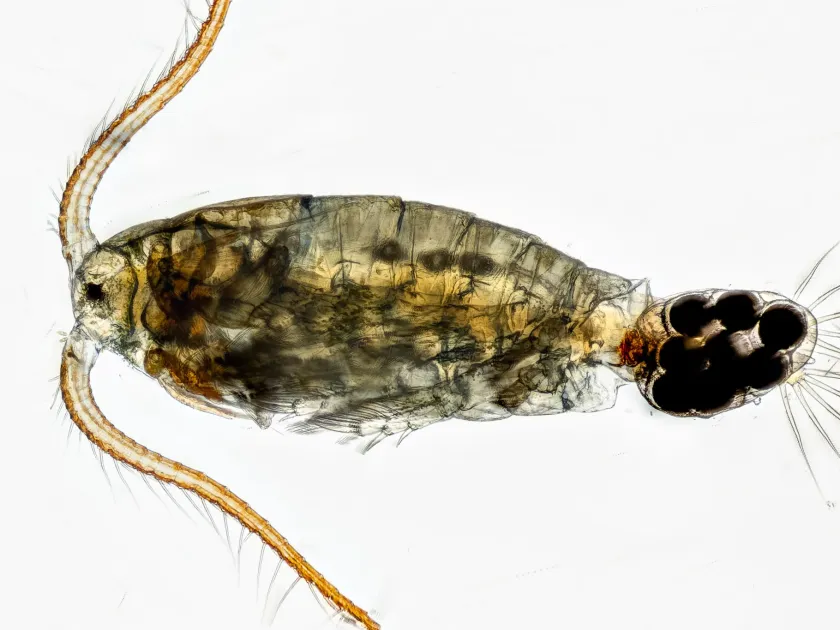
Description
How to identify
Diaptomus castor is a species of freshwater copepod crustacean belonging to the order Calanoida and the family Diaptomidae.
The organism typically possesses an elongated, segmented body, usually reaching a length between 1.5 and 3 millimeters, making it visible to the naked eye.
A distinctive feature of this species is its very long first antennae, often reaching the length of the entire body, which are used for rapid, jumping movements in the water column.
The coloration of these copepods can vary from transparent-white to reddish, depending largely on their diet and environmental conditions.
For identification in the field, agronomists and aquatic biologists use microscopic examination, focusing on the structure of the swimming legs and the specific shape of the female genital segments.
What it damages
It is important to clarify that Diaptomus castor is not a pest of agricultural crops, as it does not feed on terrestrial plants.
The main impact of this species is observed in aquaculture, where high population density can compete with fish fry for the available food supply.
In pond systems, these crustaceans actively consume phytoplankton, which is essential for the development of zooplankton, serving as the primary starter food for young fish.
Furthermore, excessive populations of diaptomids can act as intermediate hosts for various fish parasites, contributing to the spread of helminthiasis in artificial water bodies.
In rare instances, an excessive biomass of these crustaceans can negatively affect water quality, indirectly reducing the productivity of reservoirs used for agricultural irrigation.
When it appears
The active life cycle of Diaptomus castor is observed primarily during the spring and summer, when water temperatures are favorable for reproduction.
Population peaks typically occur in May and June, coinciding with the mass development of phytoplankton, which serves as their main nutrient source.
When unfavorable conditions arise, such as pond drying or a sharp drop in temperature, these crustaceans are capable of entering a dormant state.
During this period, females produce resting eggs that can remain viable in bottom sediments for extended periods until the onset of the new season.
The seasonality of development is closely linked to the hydrological regime; thus, in ephemeral pools, the life cycle concludes much faster than in permanent water bodies.
Signs of infestation
A primary indicator of high diaptomid density is the turbidity of the water in small ponds and the presence of characteristic reddish aggregations in the littoral zones.
Upon visual inspection of a water sample in a glass container, one can observe numerous tiny "jumping" dots performing erratic movements.
Reduced water quality for aquaculture purposes is often signaled by the stunted growth of fish fry, despite the presence of sufficient water volume.
In laboratory settings, the presence of these copepods is confirmed by analyzing water samples under a binocular microscope, where their characteristic long antennae are visible.
An indirect sign is the change in water transparency caused by the intensive grazing of microscopic algae by this species of crustacean.
Control measures
Management of Diaptomus castor in fish farms is based on maintaining the proper hydrobiological balance within the ponds.
One effective control method involves the planned stocking of water bodies with fish species that actively consume zooplankton at their juvenile stage.
It is recommended to carry out regular disinfection of pond bottoms during periods between drainage, which helps to destroy the dormant eggs of the crustaceans.
Monitoring levels of mineralization and organic content in the water also helps to suppress the overpopulation of this crustacean species.
When large-scale population reduction is necessary in specialized facilities, biological agents that are safe for the target fish population are employed.
Taxonomy
- Latin name
- Diaptomus castor
- Family
- Diaptomidae
- EPPO code
- DAPTCA
Discussion
No discussions yet — be the first.