
Derocheilocaris
Derocheilocaris
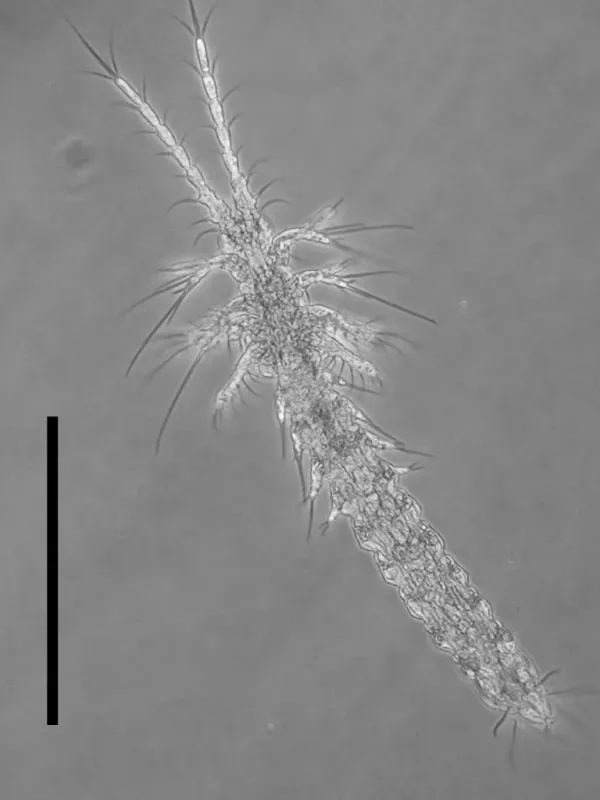
Description
How to identify
Derocheilocaris is a genus of small crustaceans belonging to the subclass Mystacocarida. These organisms are highly specialized for an interstitial lifestyle in sandy habitats.
Morphologically, they are characterized by an elongated, vermiform body consisting of multiple segments, which allows them to navigate through small spaces between sand grains.
As part of the meiofauna, they are extremely small in size, typically measuring around one millimeter, requiring specific laboratory techniques for identification.
The taxonomic position of this genus places it within the Derocheilocarididae family, reflecting their unique evolutionary adaptation to life in moist substrates.
They lack complex visual systems, relying on tactile and chemosensory appendages to interact with their surrounding environment.
What it damages
Derocheilocaris does not classify as a crop pest. It does not feed on plant tissues, roots, or seeds, and has no impact on agricultural plant health.
The potential concern for farmers is strictly related to the maintenance of irrigation systems if water is sourced from open, sandy-bottomed water bodies.
If these organisms enter irrigation pipes, they might contribute to the clogging of fine emitters in micro-irrigation or drip-tape systems over time.
However, they do not spread plant pathogens, nor do they compete with crops for nutrients or sunlight in any agricultural field scenario.
For agricultural purposes, they are considered incidental biological debris rather than significant threats to agricultural productivity.
Control measures
No chemical pesticides are required or recommended for managing Derocheilocaris, as they are not pests of any agricultural crop.
The most effective strategy is the implementation of adequate water filtration systems at the intake point of irrigation networks.
Regular flushing and maintenance of drip irrigation lines prevent the accumulation of any fine sediment or biological particles within the system.
Using deep well water or utilizing appropriate sedimentation basins significantly reduces the likelihood of encountering these organisms in irrigation water.
Agronomic best practices focus on ensuring the physical cleanliness of water supplies to maintain the longevity and efficiency of farming infrastructure.
Taxonomy
- Latin name
- Derocheilocaris
- Family
- Derocheilocarididae
- EPPO code
- DRCHSP
Discussion
No discussions yet — be the first.