
Dargida diffusa
Dargida diffusa
Description
How to identify
Dargida diffusa is a species of moth belonging to the family Noctuidae. It is recognized as a significant agricultural pest in several grain-producing regions, particularly where cereals are the primary crop.
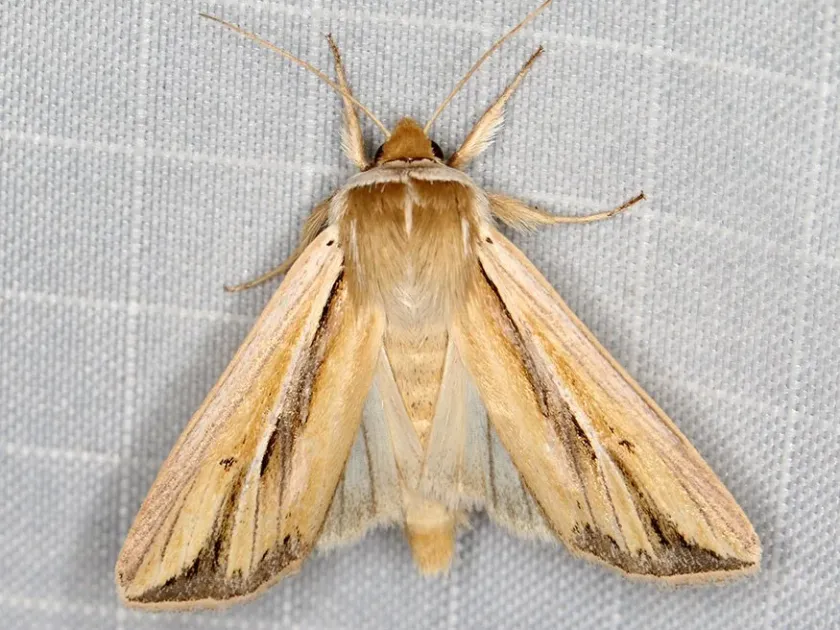
The adult moth typically has a wingspan ranging from 30 to 35 mm. The forewings are characterized by a brownish-gray coloration and a distinct longitudinal light streak, which serves as its primary diagnostic feature.
The larvae, known as caterpillars, exhibit a variable coloration ranging from light green to brown. Their body markings allow them to blend into the foliage, making them difficult to spot during daylight hours.
As part of the Noctuidae family, the life cycle of Dargida diffusa involves four distinct stages: egg, larva, pupa, and adult. Each stage is adapted to specific environmental conditions.
Pupation occurs in the soil, where the insect constructs a subterranean earthen cell to protect itself from extreme weather and potential predators during the non-active stage.
What it damages
The pest primarily targets cereal crops, including wheat, barley, rye, and oats. In some instances, it may also infest grasses surrounding the crop fields.
Larvae cause damage by feeding on the leaves of the plants. Early-stage caterpillars often create small holes, while older larvae consume larger portions of the leaf blade, reducing the plant's capacity for photosynthesis.
In cases of high infestation, caterpillars may attack the developing grain heads. This direct damage to the crop's reproductive organs leads to significant yield losses and a decrease in grain quality.
The cumulative effect of larval feeding can result in stunted growth and the weakening of the plants, leaving them more susceptible to other diseases and environmental stress.
Field scouting is essential to determine the extent of the damage, as the larval population can increase rapidly under favorable weather conditions.
When it appears
Adult moths typically emerge in late spring or early summer. Their flight period is closely related to local temperature patterns and the developmental stages of the host plants.
The female moths deposit eggs on the undersides of leaves or on wild grasses located near the edges of fields, ensuring food availability for the emerging larvae.
Larval activity usually peaks in mid-summer, which aligns with the vegetative growth and grain filling phases of cereal crops, making the impact on yield particularly severe.
Depending on the climatic zone, the pest may produce one or two generations per year. The ability to pupate in the soil facilitates successful overwintering.
Monitoring for adults via light traps or pheromone lures is a common practice to predict the onset of the reproductive cycle and time the control efforts accordingly.
Signs of infestation
The most evident sign of Dargida diffusa infestation is the presence of irregular "notches" or chewed leaf edges on the cereal plants.
Frass (larval excrement) found on the leaves or at the base of the stems provides clear evidence of active feeding sites within the field.
Clusters of damaged plants may appear as patches of stunted growth, signaling that larvae are localized in these specific areas and are causing significant harm.
Nighttime observation with a flashlight often reveals the larvae, as they are nocturnal feeders and are most active when the ambient temperature is suitable for feeding.
The presence of moths in the field during the evening hours serves as a precursor to larval development and warrants a detailed inspection of the lower canopy.
Control measures
Effective management begins with proper soil cultivation, such as deep plowing, which disturbs the pupal chambers in the soil and increases mortality rates.
Chemical control involving the application of insecticides is often necessary when larval populations exceed the economic injury level for the specific crop.
Managing non-crop vegetation and weeds around the field edges helps remove alternative food sources and shelters for the pest population.
- Regular monitoring of fields to identify early-stage infestations.
- Implementation of crop rotation to break the insect's life cycle.
- Use of selective insecticides to minimize impact on beneficial insects.
Biological control methods, including the use of entomopathogenic fungi or bacteria like Bacillus thuringiensis, can be effective in reducing larval populations in an environmentally friendly manner.
Taxonomy
- Latin name
- Dargida diffusa
- Order
- Lepidoptera (butterflies)
- Family
- Noctuidae
- EPPO code
- FARODI
Discussion
No discussions yet — be the first.