
Ringed mosquito
Culiseta annulata
Description
How to identify
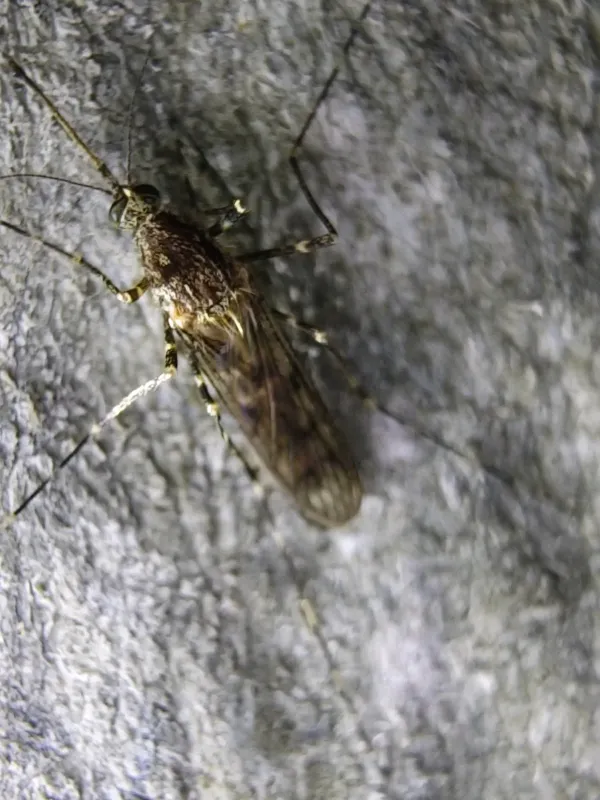
The ringed mosquito (Culiseta annulata) belongs to the Culicidae family, order Diptera. It is a relatively large mosquito species, easily recognized by the conspicuous white rings on its legs and dark mottled spots on its wings.
Adult females typically reach 10-12 millimeters in length. They possess a long, sharp proboscis used to pierce skin for blood meals, which are necessary for the development of their eggs, and they also feed on plant nectar.
Larvae develop in stagnant water, such as water butts, barrels, ponds, or even floodwater in damp basements. They breathe atmospheric air through a tube located at the tip of their abdomen.
This species is highly synanthropic, meaning it thrives in areas close to human activity. They frequently inhabit agricultural settings, orchards, and gardens where they find shelter and breeding sites.
Fertilized females overwinter in protected areas, including tree hollows, barns, sheds, or outbuildings. They are capable of becoming active whenever temperatures rise above the freezing point.
What it damages
While Culiseta annulata does not feed on crops directly, it is a significant pest for agricultural systems involving livestock. The constant annoyance caused by biting insects creates extreme stress for animals.
High mosquito density significantly hinders outdoor agricultural work. The physical discomfort and repeated bites force workers to reduce time spent on essential field or garden maintenance tasks.
In greenhouses and nursery environments, high humidity creates ideal conditions for mosquitoes to congregate. Their presence impacts the efficiency of laborers performing delicate plant care activities.
The mosquitoes act as mechanical vectors for various pathogens, potentially spreading diseases that affect animal health. This leads to increased veterinary costs and decreased overall livestock productivity.
Larvae living in irrigation tanks or water supply systems can lead to water contamination. In some cases, massive clusters of larvae may partially obstruct water intake pipes, causing operational issues.
When it appears
Activity typically begins in early spring as soon as temperatures exceed 5-8 degrees Celsius. These mosquitoes are among the first to emerge, often appearing during the first warm days of the season.
The peak population occurs during the summer months when environmental conditions favor rapid reproduction. The species can complete its life cycle quickly in favorable temperature ranges.
Depending on the climatic conditions of the region, several generations can develop in a single season. A warm summer often leads to an exponential increase in population size by mid-July.
In the autumn, females prepare for winter, migrating toward shelters and structures. They remain dormant but ready to emerge during winter thaws, making them a year-round nuisance in some structures.
Biological success is heavily dependent on moisture. Drought periods can cause significant mortality among larvae by drying out small, temporary water containers and drainage ditches.
Signs of infestation
Presence is first noticed by the audible hum of the mosquitoes, which is more pronounced due to their larger size compared to other common species. They are known to be persistent biters, active even on cloudy days.
Observing water storage containers like barrels or tanks reveals small, floating, dark raft-like structures. These are the egg clusters deposited by females on the surface of the water.
In the water, larvae are easily seen as they hang from the surface or swim rapidly to the bottom when disturbed. Their distinct positioning is a key visual indicator of an active breeding site.
Finding large numbers of resting adults in shaded corners of sheds, greenhouses, or garden outbuildings confirms that a local breeding colony is nearby and requires immediate action.
Severe localized swelling and itching on humans and livestock are strong indicators of a high population density, as this species is known for a particularly sharp and painful bite.
Control measures
The primary control strategy is source reduction. All water-holding containers on the farm should be emptied regularly, covered with tight-fitting lids, or protected with fine-mesh mosquito netting.
For persistent breeding sites like stagnant ponds or drainage ditches that cannot be drained, use biological larvicides containing Bacillus thuringiensis israelensis, which target larvae without harming crops.
Applying contact insecticides to walls, fences, and shaded resting areas in barns or sheds helps reduce the adult population significantly, improving working conditions for staff and animals.
Maintaining a clean agricultural site by removing overgrown weeds and brush helps decrease localized humidity, making the area less attractive to mosquitoes seeking shelter from the sun.
Installing carbon dioxide-based mosquito traps or attractant-based devices near working zones can successfully lower the mosquito pressure in high-traffic farm areas without excessive chemical use.
Taxonomy
- Latin name
- Culiseta annulata
- Order
- Diptera (flies)
- Family
- Culicidae
- EPPO code
- THEDAN
Discussion
No discussions yet — be the first.