
Mullein moth
Cucullia verbasci
Description
How to identify
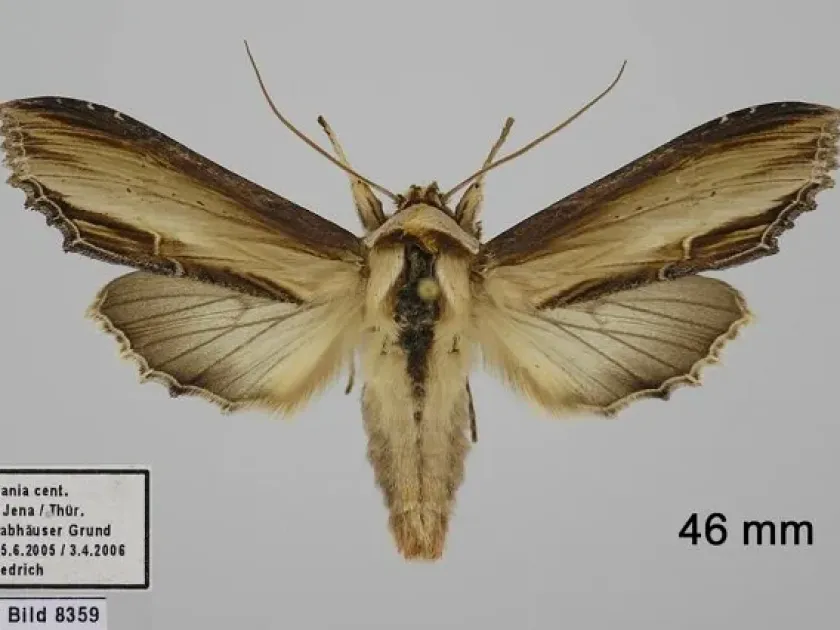
The Mullein moth (Cucullia verbasci) is a species of moth in the family Noctuidae. The adult moths are nocturnal, possessing a cryptic coloration that perfectly mimics dead leaves or wood, providing excellent camouflage while resting during the day.
The larvae, or caterpillars, are remarkably different in appearance. They are strikingly colored with white, yellow, and black bands or spots, serving as an aposematic signal to warn predators that they are unpalatable due to the toxins they accumulate from their food plants.
This species undergoes a complete metamorphosis, passing through the stages of egg, larva, pupa, and imago. The life cycle typically consists of one generation per year, with the pupal stage serving as the overwintering form in a tough, subterranean cocoon.
Adult moths are strong fliers and are highly attracted to artificial light sources. Despite their ability to fly, they spend most of their daylight hours resting motionless on stems or leaves, making them very difficult to spot during routine garden inspections.
The pupation takes place in the soil, usually several centimeters deep. This stage is critical for the survival of the species, as it protects the developing insect from winter frosts and desiccation until the following spring emergence.
What it damages
The primary host plants for the Mullein moth caterpillars belong to the Scrophulariaceae and Boraginaceae families. In domestic gardens, they are frequently found feeding on Mullein (Verbascum) and Butterfly bush (Buddleja).
The larvae are voracious feeders and can cause significant damage to the foliage. In cases of high infestation, they can quickly strip a plant of its leaves, leaving only the central veins and stems, which severely affects the plant's health.
For young or newly planted specimens, such damage can be fatal. The loss of foliage reduces the photosynthetic capacity of the plant, weakening its immune system and its ability to store energy for the subsequent growth season.
Beyond the leaves, caterpillars often feed on flower buds. This is particularly problematic for ornamental varieties of Buddleja, as the destruction of buds ruins the aesthetic value of the shrub during its flowering period.
While the species is rarely considered a major agricultural threat, its tendency to aggregate can lead to localized "hot spots" where a plant may be completely defoliated within a matter of days if the caterpillars are not managed.
When it appears
The flight period of the adult moths generally occurs between April and May. During this time, the moths mate, and females lay eggs on the undersides of the leaves of suitable host plants.
The caterpillars emerge in June and feed actively through July and early August. This period corresponds to their rapid growth phase, during which their food consumption increases exponentially to support their development.
By late August, the caterpillars finish feeding and descend to the ground to burrow into the soil, where they create a cocoon for pupation. They remain as pupae for the duration of the autumn and winter months.
Climatic factors, such as temperature and humidity, significantly influence the rate of development. A warmer summer often results in an accelerated life cycle, causing caterpillars to finish feeding and pupate earlier in the season.
Gardeners should monitor their plants for caterpillar activity starting in mid-June. Regular visual checks are the most effective way to ensure early detection before the larvae grow large and become more destructive.
Signs of infestation
The most obvious sign of an infestation is the presence of irregular, ragged holes in the leaves of Mullein or Buddleja. These holes tend to expand rapidly as the caterpillars grow larger and consume more tissue.
Frass, which is the caterpillar's waste, is another clear indicator of their presence. You will often find black or dark green pellets scattered on the leaves or on the ground directly beneath the plant's canopy.
Due to their distinctive, bright coloration, the caterpillars themselves are the most reliable sign. They are often found resting openly on the leaves, especially near the edges or along the veins, during both day and night.
Damaged or eaten flower buds are another warning sign. If you notice distorted or chewed buds on your butterfly bush, it is highly likely that Mullein moth larvae are at work, potentially preventing a full and healthy bloom.
A general decline in the plant's vitality, characterized by yellowing of the foliage or premature wilting of specific branches, may also indicate that a large population of caterpillars is feeding on the plant's resources.
Control measures
Hand-picking is the most practical and environmentally friendly method for controlling these caterpillars in residential gardens. Their bright colors make them easy to locate and remove during the early morning hours.
Cultivating the soil around the base of host plants in the autumn or early spring can disrupt the pupal chambers. This brings the pupae to the surface, where they become vulnerable to predation by birds or exposure to harsh weather.
Biological control using Bacillus thuringiensis (Bt) is highly effective and safe for other beneficial insects, including bees and butterflies. It specifically targets caterpillars and is an excellent solution for larger infestations.
If chemical intervention becomes necessary due to extreme pressure, choose contact insecticides labeled for use on ornamental plants. Always apply these products in the evening to minimize the risk to pollinating insects.
- Regularly check Buddleja and Verbascum plants in early summer.
- Encourage local bird populations, as they are natural predators of larvae.
- Remove volunteer Mullein plants that might serve as a breeding reservoir.
Taxonomy
- Latin name
- Cucullia verbasci
- Order
- Lepidoptera (butterflies)
- Family
- Noctuidae
- EPPO code
- CCULVE
Discussion
No discussions yet — be the first.