
Brown-hooded Owlet
Cucullia convexipennis
Description
How to identify
The Brown-hooded Owlet (Cucullia convexipennis) belongs to the Noctuidae family, the order Lepidoptera. The adult moth is known for its distinct shape, with wings that fold tightly against the body when at rest, resembling a hood.
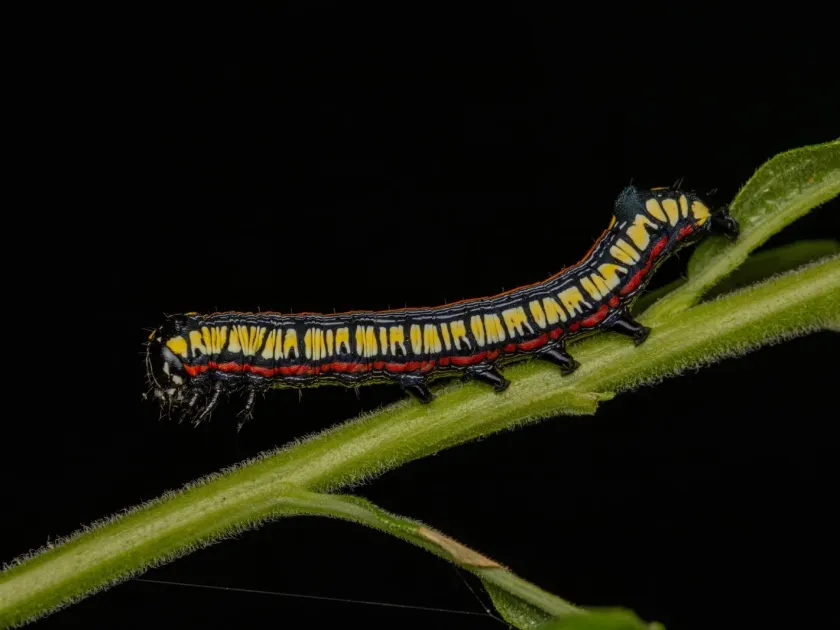
The larvae are visually striking, typically featuring a combination of yellow, red, and black markings. These bright patterns serve as a warning to potential predators, although the caterpillars prefer to remain hidden during the day.
Adult moths display a mottled grey-brown coloration, which provides excellent camouflage against tree bark or weathered wood, allowing them to remain undetected during daylight hours.
The life cycle includes a pupal stage, where the insect overwinters within a subterranean cocoon composed of soil and silk. The adults emerge in late spring or summer to begin their reproductive phase.
Caterpillars of this species exhibit nocturnal behavior. They are active feeders during the night, retreating to the base of the plant or soil debris when the sun rises to avoid detection.
What it damages
The primary damage is caused by the larval stage. These caterpillars possess strong mandibles capable of consuming significant amounts of foliage and flower tissue in a relatively short period.
They have a strong preference for members of the Asteraceae family. Plants such as goldenrod (Solidago) and various species of asters are frequently targeted by these voracious feeders.
Bud feeding is a particularly destructive habit, as it ruins the ornamental value of flowers before they even have a chance to bloom, leading to loss of aesthetic quality in gardens.
Young sprouts and growth points are often consumed, which can cause severe stunting and abnormal branching patterns in the infested ornamental plants.
In cases of high infestation, the total defoliation of the host plant weakens the root system, potentially affecting the plant's ability to survive the following winter or produce healthy growth.
Signs of infestation
The first sign of activity is often the appearance of irregular holes or notched leaf margins. As the larvae grow larger, the extent of the damage becomes more pronounced, eventually leading to heavy leaf skeletonization.
Dark granular frass (excrement) found on the leaves or the surface of the soil directly beneath the plant is a definitive indicator of caterpillar presence and active feeding cycles.
Seeing caterpillars resting on stems or tucked into floral clusters during evening inspections confirms an active infestation that requires management intervention.
Wilting of flower buds or blossoms that show visible bite marks suggests that larvae have moved from the foliage to the reproductive parts of the plant, which is a sign of a severe problem.
Yellowing of foliage without a clear pathogenic cause, combined with physical evidence of chewing on the stems, warrants a thorough investigation at night using a flashlight.
Control measures
Hand-picking is the most effective and eco-friendly control method for small-scale gardens. Searching for the larvae at night with a flashlight allows for quick manual removal.
Biological insecticides, specifically those containing Bacillus thuringiensis, are highly effective against young noctuid larvae and have minimal impact on non-target beneficial insects.
Chemical control with systemic insecticides should be reserved for severe outbreaks where other methods fail to prevent excessive plant damage and aesthetic loss.
Cultural control involves tilling the soil around host plants in late autumn and early spring. This practice disrupts the soil-dwelling pupae, exposing them to environmental elements and predators.
Light traps can be utilized during the flight period of the adult moths to reduce the breeding population, thereby limiting the total number of eggs laid in the target garden area.
Taxonomy
- Latin name
- Cucullia convexipennis
- Order
- Lepidoptera (butterflies)
- Family
- Noctuidae
- EPPO code
- CCULCO
Discussion
No discussions yet — be the first.