
Wormwood Shark
Cucullia absinthii
Description
How to identify
The Wormwood Shark (Cucullia absinthii) belongs to the Noctuidae family, a group of moths known for their nocturnal activity and often cryptic coloration.
The adult moth has a wingspan of approximately 35 to 40 millimeters, with forewings that mimic the grey and brown tones of dry wormwood stems.
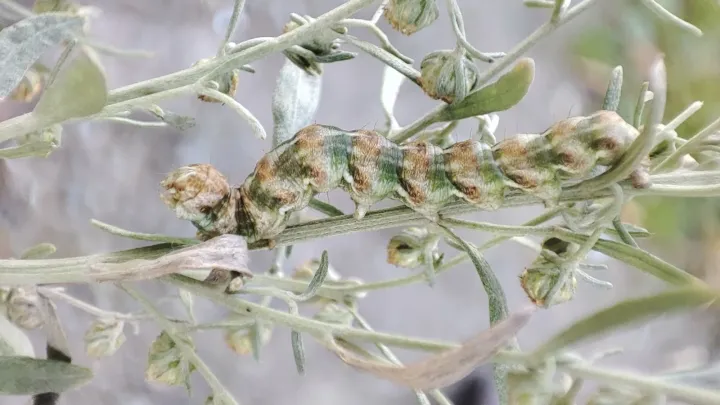
The larvae, or caterpillars, are the most recognizable stage, characterized by longitudinal stripes of green, yellow, and brown, often with distinct tubercules.
These moths are highly adapted to environments where their host plants, primarily various species of Artemisia, are prevalent.
The life cycle includes a robust pupal stage, which remains dormant in the soil or ground litter during the winter months.
What it damages
The primary hosts for Cucullia absinthii are species within the genus Artemisia, particularly common wormwood.
Caterpillars cause damage by feeding on leaves and occasionally attacking the flower buds, which can affect seed production.
In cases of high infestation, the larvae can cause significant defoliation, leading to reduced plant vigor and stunted development.
For ornamental gardens, the aesthetic damage to foliage can be significant if the larval population is not managed in time.
Agricultural or medicinal growers may experience yield losses if the timing of the larvae's feeding peak coincides with the harvest phase.
When it appears
Adult moths are typically on the wing during the summer months, specifically from June through July.
As nocturnal insects, they are most active after sunset, which makes them difficult to observe during daylight hours.
Larval development occurs throughout the summer, reaching peak feeding activity between July and August.
The species usually completes one generation per year, with the emergence of moths determined by local temperature and climate patterns.
Pupation occurs in late summer, and the insects remain as pupae in the soil until the arrival of the next year's growing season.
Signs of infestation
The most visible sign of an infestation is irregular holes or completely consumed leaf blades, leaving only the primary veins behind.
Larval droppings (frass) appearing on the soil surface or caught in the plant canopy are reliable indicators of active feeding.
Direct observation of the colorful, distinctively patterned caterpillars on the upper stems or buds confirms the presence of the pest.
Noticeable thinning of the foliage on infested wormwood patches is a clear signal that the pest population is established.
Monitoring for adults can be done using light traps, which reveal the presence of moths in the vicinity of host plants at night.
Control measures
Hand-picking caterpillars is a viable solution for small-scale gardens or when infestations are localized and minor.
Cultivation practices such as autumn tilling can effectively disrupt the soil, exposing and destroying the overwintering pupae.
Biological controls, such as spraying with Bacillus thuringiensis, provide an effective and environmentally friendly option for managing larvae.
When chemical intervention is required, selective insecticides applied during the early larval stages can minimize damage to the crop.
Removing wild wormwood in the surrounding area can help reduce the overall pressure of the pest by limiting available breeding grounds.
Taxonomy
- Latin name
- Cucullia absinthii
- Order
- Lepidoptera (butterflies)
- Family
- Noctuidae
- EPPO code
- CCULAB
Discussion
No discussions yet — be the first.