
Ctenoplusia accentifera
Ctenoplusia accentifera
Description
How to identify
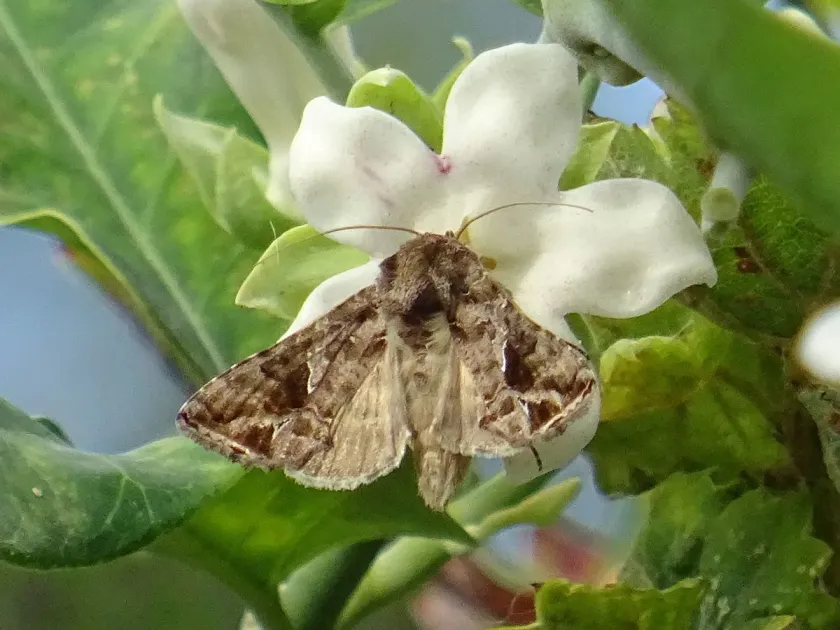
Ctenoplusia accentifera belongs to the Noctuidae family, order Lepidoptera. The adult moth has a wingspan ranging from 30 to 40 mm, with forewings colored in shades from grey-brown to golden-brown.
A key identifying feature of this species is the presence of light-colored markings on the forewings, resembling a comma or an accent mark, which gives the species its specific name. The hindwings are typically lighter with a dark outer border.
The larvae (caterpillars) possess a typical noctuid appearance, colored in green tones, which provides excellent camouflage on the underside of plant leaves. The caterpillar's body tapers towards the head and is covered in sparse, fine hairs.
The pupa is encased in a loose silken cocoon, usually found on the leaves of the host plant or within the top layer of the soil. The color of the pupa shifts from greenish to dark brown as it nears the adult emergence stage.
The life cycle encompasses four stages: egg, larva, pupa, and imago. In warmer climates, this species is capable of completing multiple generations within a single growing season.
What it damages
This pest is a polyphage, attacking a wide range of agricultural and ornamental crops. The primary damage is caused by the caterpillars, which feed aggressively on plant foliage.
Plants from the Asteraceae family, including sunflowers, chrysanthemums, and various salad greens, are most frequently affected. Infestations have also been recorded on Solanaceae and Apiaceae species.
In greenhouses or controlled environments, this pest can cause significant damage to seedlings, often destroying the growth point or consuming large surface areas of leaves, leading to plant loss.
During mass outbreaks, the caterpillars cause severe defoliation, which drastically reduces the plant's photosynthetic capacity and leads to significant yield losses at harvest time.
Damage to marketable parts, such as flower heads or lettuce hearts, renders the produce unfit for sale due to loss of aesthetic value and contamination with caterpillar frass.
When it appears
Adult moths typically emerge in early spring once temperatures stabilize. In warmer regions, adult activity can continue well into late autumn.
First-instar larvae appear within one to two weeks following the onset of moth flight and oviposition. Larval activity is most pronounced during nighttime, though young larvae may occasionally feed during the day.
Population peaks often occur in mid-summer, when weather conditions favor rapid development. Hot and dry summers are particularly conducive to intense population surges.
The insect overwinters as a pupa or a mature caterpillar in the soil, among plant debris, or within greenhouse structures, which provide protection from harsh winter temperatures.
The number of generations per year is dependent on the local climate; in greenhouse settings, development may be continuous provided that host plants are available.
Signs of infestation
The most common sign of infestation is characteristic "window-pane" leaf damage. Young larvae skeletonize the leaves, leaving the veins intact, which creates a distinct mesh-like pattern.
Older caterpillars consume irregular holes in the leaves, often starting from the leaf margins and moving progressively toward the center of the blade.
The presence of frass — small dark pellets found on the leaf surface or on the ground beneath the plants — serves as a strong indicator of active larval feeding.
Silken cocoons found on the underside of leaves indicate the pupation phase, signaling that a new generation of moths will soon emerge.
Heavy infestations result in overall plant decline, stunted growth, and wilting, which becomes particularly evident during morning or evening hours when water stress is present.
Control measures
Effective management begins with robust crop rotation practices and the timely removal of weeds, which often serve as alternative hosts for the pest.
In greenhouses, the use of pheromone traps is recommended for monitoring population density and capturing males, allowing for more precise timing of chemical applications.
Biological control methods include the use of Bacillus thuringiensis-based products, which are highly effective against early larval stages while remaining safe for beneficial insects.
During high-pressure infestations, insecticides from the pyrethroid or organophosphate groups may be used, ensuring that pre-harvest intervals are strictly followed.
Deep plowing or soil cultivation after harvest is a vital agronomic measure, as it helps destroy overwintering pupae and significantly reduces the pest pressure for the following season.
Taxonomy
- Latin name
- Ctenoplusia accentifera
- Order
- Lepidoptera (butterflies)
- Family
- Noctuidae
- EPPO code
- CTNUAC
Discussion
No discussions yet — be the first.