
Flat grain beetle
Cryptolestes galeopsidis
Description
How to identify
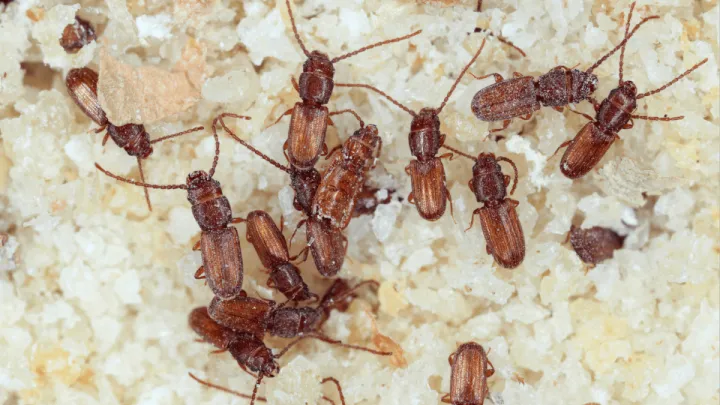
The flat grain beetle, scientifically known as Cryptolestes galeopsidis, is a small insect belonging to the family Cucujidae. It is characterized by a very flattened body, usually ranging from 1.5 to 2.0 mm in length, which allows it to thrive in tight spaces.
Adult beetles have a rust-brown color and distinct, long antennae. The rectangular shape of the pronotum and the wide head are key morphological features that distinguish this pest from other stored-product coleoptera.
The larvae are typically whitish or pale yellow, reaching approximately 3 mm in length. They are highly mobile and prefer the dark, humid environment found in deep layers of stored grain, where they remain protected from external conditions.
The development cycle of this beetle is highly temperature-dependent. At optimal temperatures ranging from 25 to 30 degrees Celsius, the beetle can complete its life cycle quite rapidly, leading to exponential population growth in favorable conditions.
They are well-adapted to indoor environments such as granaries and silos. While they can endure colder periods by entering a state of diapause, their primary activity and reproduction occur within the warm, stored grain mass.
What it damages
These pests target a wide array of stored commodities, including wheat, barley, oats, rye, corn, and various processed grain products. They are especially destructive to seeds, as they specifically target and consume the grain embryo.
Both adults and larvae feed on grain particles, leaving behind empty hulls. Extensive infestations result in significant weight loss of the stored product, turning it into a mass of dust and debris that is unfit for human or animal consumption.
The excrement left by the beetles creates an ideal environment for fungi and mold growth. This secondary damage can lead to the production of mycotoxins, which pose serious health risks and further degrade the commercial quality of the grain.
A major consequence of flat grain beetle infestation is the phenomenon of hot spots in grain storage. The metabolic activity of the pests raises the temperature and moisture levels, which encourages the development of other pests and spoilage organisms.
Economic losses are severe, involving not only the reduction in marketable quantity but also the costs associated with chemical fumigation, grain cleaning, and potential rejection of batches during export or trade inspections.
Signs of infestation
An early indicator of infestation is a peculiar, slightly sweet or musty odor emanating from the grain storage unit. This is often followed by visual evidence of fine grain dust and the formation of small clumps within the bulk grain.
Adult beetles can be detected by probing the grain mass or using specialized traps. Because of their flattened bodies, they are experts at hiding in structural cracks, beneath pallets, and inside machinery, making visual inspection difficult.
The presence of shed larval skins on the surface of the grain is a clear sign that a new generation has emerged. If grain samples are sieved, the tiny larvae and adult beetles become visible, confirming the extent of the contamination.
Abnormal temperature spikes in the storage mass are critical warning signs. Monitoring systems that detect hot spots often identify the presence of these beetles long before they are visible on the surface of the grain pile.
Laboratory analysis of grain samples is the most reliable method for detecting hidden infestations. Even a low count of insects per kilogram of grain is a strong justification for initiating control measures before the population explodes.
Control measures
Integrated Pest Management (IPM) for the flat grain beetle starts with rigorous warehouse sanitation. Removing residual grain from the previous season is essential to break the insect's life cycle and eliminate potential hiding spots.
Proper storage conditions are vital. Keeping the grain dry (below 14% moisture) and cool (below 10 degrees Celsius) significantly inhibits the reproductive capacity of the beetle, effectively preventing population outbreaks.
Fumigation remains the most effective method for eradicating heavy infestations. Using approved phosphine-based products in airtight chambers or under gastight tarpaulins ensures that the gas reaches all larvae hidden inside the kernels.
Mechanical cooling through aeration is a sustainable way to manage grain quality. By pushing cold air through the grain bulk, the storage environment becomes unsuitable for the beetle's rapid development, extending the shelf life of the crop.
- Use pheromone traps to monitor adult beetle activity levels.
- Maintain storage facilities to prevent moisture leaks and entry points.
- Implement strict quarantine protocols for incoming grain shipments.
- Ensure periodic inspections of all grain storage equipment and transport vessels.
Discussion
No discussions yet — be the first.