
Nile crocodile
Crocodylus niloticus
Description
How to identify
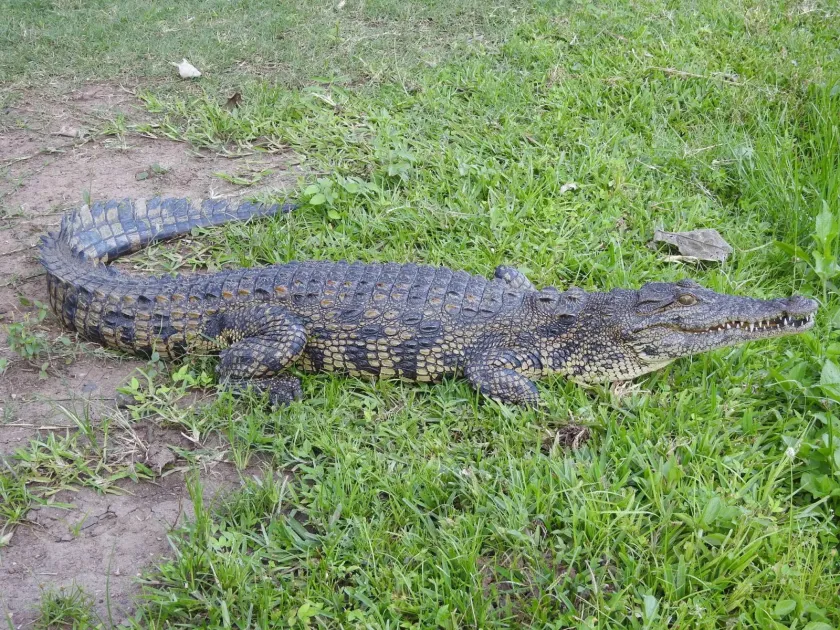
The Nile crocodile (Crocodylus niloticus) is a large crocodilian, a reptile belonging to the order Crocodilia and the family Crocodylidae.
Adult specimens can grow to significant lengths, often exceeding 5 meters, featuring a thick, armored hide that serves as a protective barrier.
They possess an elongated snout with powerful jaws and sharp teeth, designed for grasping prey and interacting with the environment.
As semi-aquatic animals, they spend a considerable amount of time in water but frequently move onto land for basking, which puts them in proximity to agricultural lands.
In an agricultural context, their identification is often based on the discovery of their distinct heavy tracks and the observation of their basking habits near irrigation channels.
What it damages
Direct damage occurs through the trampling of crops such as rice, sugar cane, and vegetables as the reptiles move between water bodies and nesting sites.
Destruction of irrigation infrastructure, including dams and dikes, causes significant water loss and soil erosion, which can compromise the entire harvest yield.
By disrupting the soil structure near the roots of crops, their movement hinders proper drainage and nutrient uptake, leading to localized plant death.
The presence of large predators often necessitates the suspension of agricultural activities, creating significant downtime and loss of labor productivity.
Additionally, the pollution of water supply systems with organic waste from these animals can negatively alter the water quality required for delicate crops.
When it appears
Activity levels are highest during warmer months when these cold-blooded animals seek terrestrial spots to thermoregulate, overlapping with peak growing seasons.
The breeding season, occurring during the onset of the wet season, forces crocodiles to seek suitable nesting sites in the soft soil of farm fields.
During dry seasons, they congregate in remaining water sources, increasing the risk of direct encounters with farm personnel and irrigation systems.
Juvenile activity is frequently observed in late summer as young crocodiles hatch and begin to disperse throughout nearby water networks in search of food.
Seasonal migration patterns are dictated by water levels, allowing for the mapping of high-risk areas throughout the agricultural calendar.
Signs of infestation
Clear evidence of a crocodile's presence includes deep, multi-toed footprints and dragging marks from their heavy tails found along irrigation banks.
Flattened areas of crops indicate where the animal has crawled, creating distinct pathways that cut through previously healthy vegetation.
Nesting mounds, consisting of a mix of sand, mud, and decaying vegetation, serve as highly visible signs of their presence within the field borders.
Damaged irrigation piping or breached earthen banks are classic indicators of a crocodile attempting to navigate through human-engineered structures.
Localized disturbances in pond surfaces or the disappearance of small livestock often accompany the movement of these predators into farming areas.
Control measures
Physical exclusion remains the most effective method, utilizing high-tensile wire fencing or concrete barriers to block access from waterways to the fields.
Maintenance of cleared buffer zones, stripped of dense vegetation, discourages crocodiles from lingering near farm operations and agricultural zones.
Implementation of modern sensors and alarm systems at key crossing points helps detect and deter animals before they enter critical crop zones.
Collaborative management with wildlife authorities is necessary to ensure the safe and ethical removal of problematic individuals from agricultural sites.
- Regular inspection and repair of water management dams.
- Clearance of hiding spots near irrigation pathways.
- Workplace safety training to avoid crocodile encounters.
Taxonomy
- Latin name
- Crocodylus niloticus
- Family
- Crocodylidae
- EPPO code
- CROKNI
Discussion
No discussions yet — be the first.